
Top 10 Competitor Price Monitoring & Repricing Software 2026
Compare the top 10 competitor price monitoring and repricing software for 2026. Features, pricing, matching accuracy, and best-fit use cases.
Top 10 Competitor Price Monitoring & Repricing Software 2026
Pricing teams in 2026 face a tougher environment than ever: marketplaces expose prices in real time, competitors change prices multiple times a day, and customers compare instantly. The right competitor price monitoring and repricing software turns that chaos into a controlled, data-driven process. This guide ranks the 10 strongest products in the category, explains the evaluation criteria, and helps you match a tool to your catalog size, matching complexity, and repricing ambitions.
How We Evaluated These Tools
We ranked products on five practical dimensions:
- Competitor price monitoring coverage – number of retailers, marketplaces, and countries supported, plus data refresh frequency.
- Product matching accuracy – ability to match products without relying solely on EAN/UPC/SKU codes, including AI and human verification options.
- Repricing and automation – rule-based repricing, dynamic pricing, and integration with your own pricing strategy.
- MAP and reseller monitoring – detection and enforcement workflows for brands.
- Transparency and scalability – clear pricing tiers, API access, and ability to grow with your catalog.
We also considered publicly available review data and vendor documentation. No single tool wins every category; the best choice depends on your specific bottlenecks.
1. Price2Spy – Best Overall for Monitoring, Matching, and Repricing
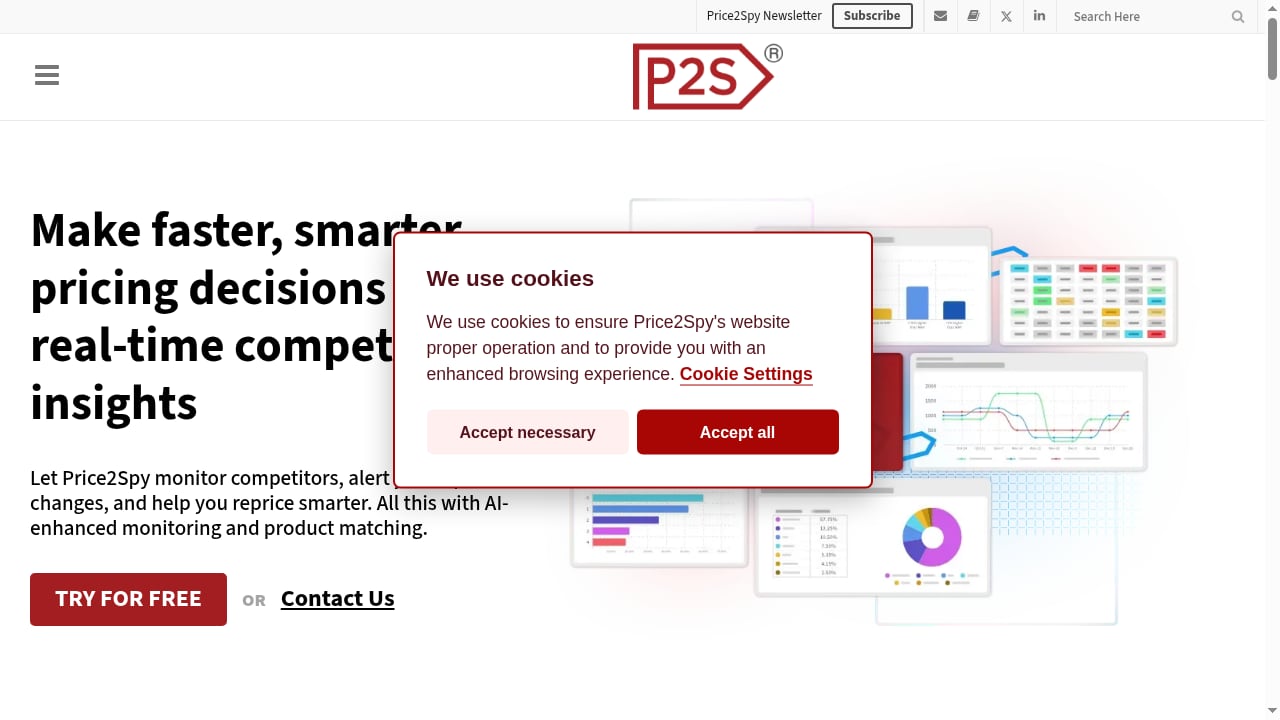
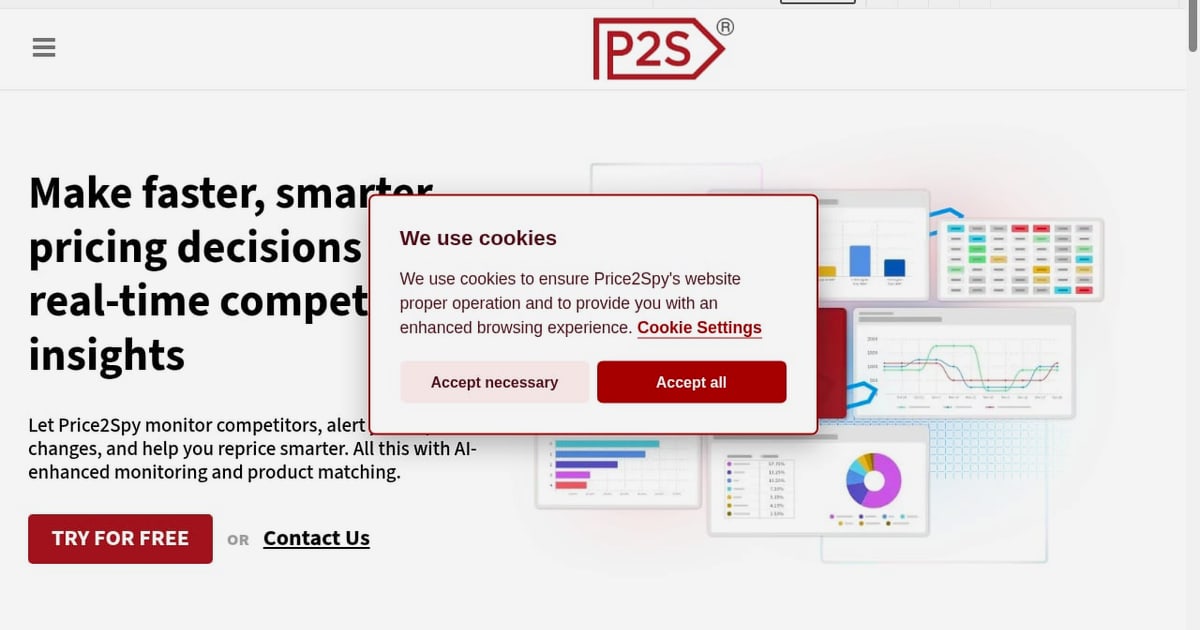
First viewport screenshot of Price2Spy® – Competitor price monitoring.
Price2Spy has been a fixture in price monitoring for over a decade, with more than 750 clients acquired in 11 years. It serves brands, manufacturers, online retailers, and distributors, and its feature set covers the full loop from monitoring to action.
Why it ranks first: Price2Spy combines advanced repricing, AI-enhanced product matching, automatch, screenshot capture, and a customizable pricing dashboard. The screenshot capture feature is particularly valuable for compliance teams that need evidence of price changes over time. Its matching service and site crawl options help teams with complex catalogs avoid manual URL management.
Best for: Mid-market and enterprise teams that need a mature, full-featured platform with strong MAP monitoring and repricing capabilities.
Watch-outs: The interface can feel dense for new users, and pricing starts around $134.95/month for 100 SKUs and 30 competitors, which may be high for very small stores.
2. Prisync – Best for Real-Time Tracking and Simplicity
Prisync is one of the most recognized names in competitor price tracking. Its clean interface and responsive support make it a strong choice for teams that want to get started quickly.
Strengths: Real-time price and stock availability tracking, comprehensive reports, and global coverage. It is easy to deploy and understand.
Limitations: Automatic matching relies on EAN/UPC codes, which breaks down on marketplaces, fashion retailers, and private-label catalogs where barcodes are not exposed. MAP monitoring is locked behind higher-tier plans, and API access carries a 20% surcharge. Pricing tiers (100, 1,000, 5,000 SKUs) leave gaps for mid-sized catalogs.
Best for: Smaller ecommerce teams with clean barcode data and straightforward monitoring needs.
3. Competera – Best for Enterprise AI-Driven Dynamic Pricing
First viewport screenshot of Price2Spy® Blog.
Competera focuses on intelligent pricing analytics and competitive market insights for large retailers. It goes beyond simple competitor tracking by incorporating demand, elasticity, and business objectives into pricing recommendations.
Strengths: Advanced AI models, strong analytics, and the ability to handle complex assortments across multiple markets. It is built for pricing teams that need optimization, not just monitoring.
Limitations: Enterprise-focused pricing and implementation. Smaller teams may find it overkill.
Best for: Large retailers and enterprise pricing teams with dedicated analysts.
4. Wiser Solutions – Best for Omnichannel Retail Intelligence
Wiser Solutions provides retail pricing intelligence, competitor monitoring, and MAP monitoring with a focus on omnichannel execution. It connects online and in-store data, which is valuable for brands sold through multiple channels.
Strengths: Broad data coverage, strong MAP monitoring, and actionable insights for commerce execution.
Limitations: Custom pricing and a focus on larger organizations.
Best for: Brands and retailers that need to monitor both digital and physical retail channels.
5. Intelligence Node – Best for Image-Based Matching and Retail Analytics
Intelligence Node uses AI-driven competitive pricing intelligence and retail analytics, with a notable strength in image-based product matching. This is a major advantage for catalogs where product identifiers are inconsistent.
Strengths: Advanced matching technology, deep analytics, and enterprise-scale data coverage.
Limitations: Custom pricing and a complex implementation process.
Best for: Enterprise retailers with large, messy catalogs that need sophisticated matching.
6. Omnia Retail – Best for Dynamic Pricing and Promotional Execution
Omnia Retail focuses on dynamic pricing and price monitoring for retailers and brands, with strong capabilities in promotional pricing and campaign execution at scale.
Strengths: Automated repricing, promotion management, and the ability to execute pricing strategies across channels.
Limitations: Custom pricing and a focus on mid-to-enterprise retailers.
Best for: Retailers that need to connect competitor data to promotional and campaign decisions.
7. PriceShape – Best for Connecting Pricing to Google Shopping Ad Spend
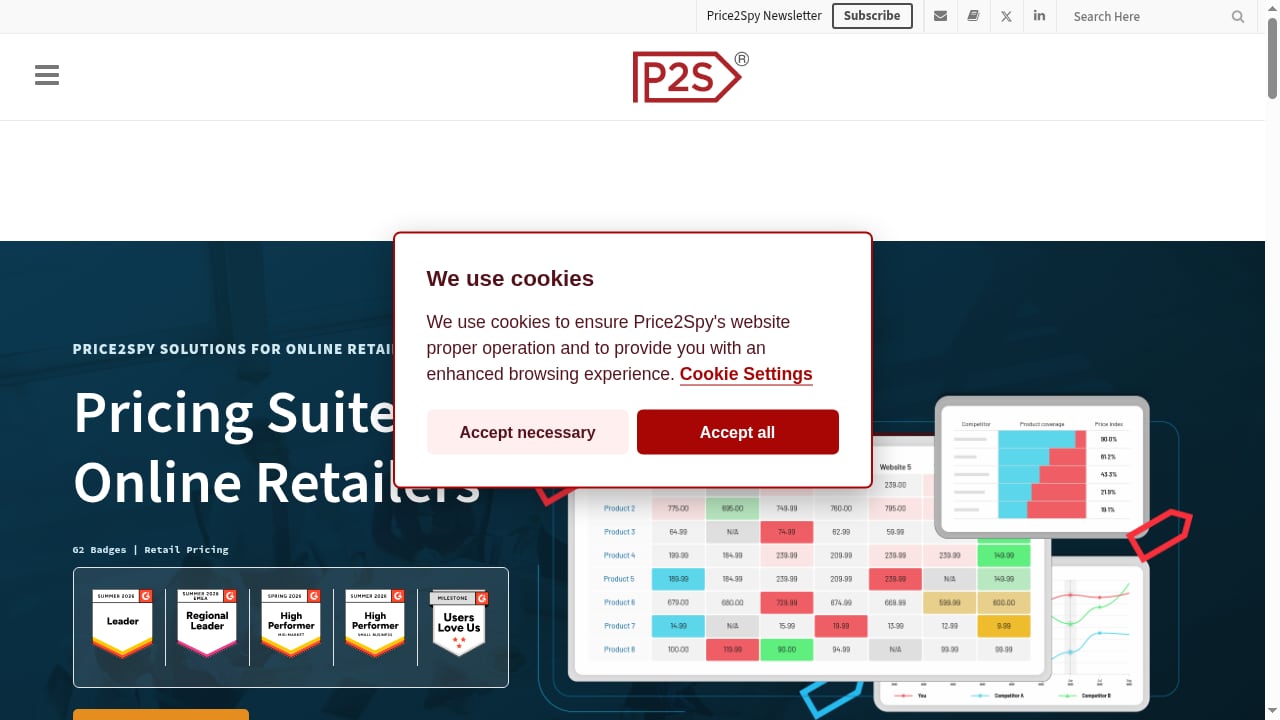
First viewport screenshot of Online retailers – Price2Spy®.
PriceShape links competitor pricing directly to Google Shopping ad spend, helping retailers optimize both price and advertising efficiency.
Strengths: Unique integration of pricing and ad spend, useful for performance marketing teams.
Limitations: Starts around €299/month, which may be high for small stores.
Best for: Mid-market retailers that invest heavily in Google Shopping.
8. Priceva – Best for Analytics-Heavy Teams
Priceva offers deep price history dashboards and analytics, making it a good fit for teams that want to dig into historical trends and competitive positioning.
Strengths: Strong analytics, clear dashboards, and a starting price around $99/month.
Limitations: Less emphasis on automated repricing compared to some competitors.
Best for: SMB and mid-market teams that prioritize analysis over automation.
9. Pricefy – Best Free Entry Point for Small Stores
Pricefy offers a free plan with basic functionality, making it accessible for small businesses or individuals just starting with price monitoring.
Strengths: Free tier, clean interface, and support for competitor price tracking, stock levels, and Google Shopping integrations.
Limitations: May lack advanced features for brand analysis and complex repricing.
Best for: Small ecommerce stores that want to start monitoring without a financial commitment.
10. Skuuudle – Best for Grocery and FMCG Assortment Intelligence
Skuuudle specializes in competitor price tracking and product matching, with a strong focus on grocery and FMCG assortment intelligence.
Strengths: High accuracy in matching, deep assortment insights, and a strong reputation among grocery retailers.
Limitations: Custom pricing and a narrower focus than general-purpose tools.
Best for: Grocery and FMCG retailers with complex assortment monitoring needs.
How to Choose the Right Tool
Start by identifying your biggest bottleneck:
- If product matching is your pain point: Prioritize tools with AI-based matching that does not depend on EAN/UPC codes, such as Price2Spy, Intelligence Node, or Skuuudle.
- If you need automated repricing: Look at Price2Spy, Omnia Retail, or Competera.
- If MAP enforcement is critical: Price2Spy and Wiser Solutions are strong options.
- If you are a small store on a budget: Pricefy's free tier or Priceva's low starting price may be sufficient.
- If you need to connect pricing to advertising: PriceShape is the standout.
Also consider API access. Some vendors charge extra for it, while others include it. If your team needs to feed pricing data into internal systems, verify API costs upfront.
When Browser Automation Complements Price Monitoring
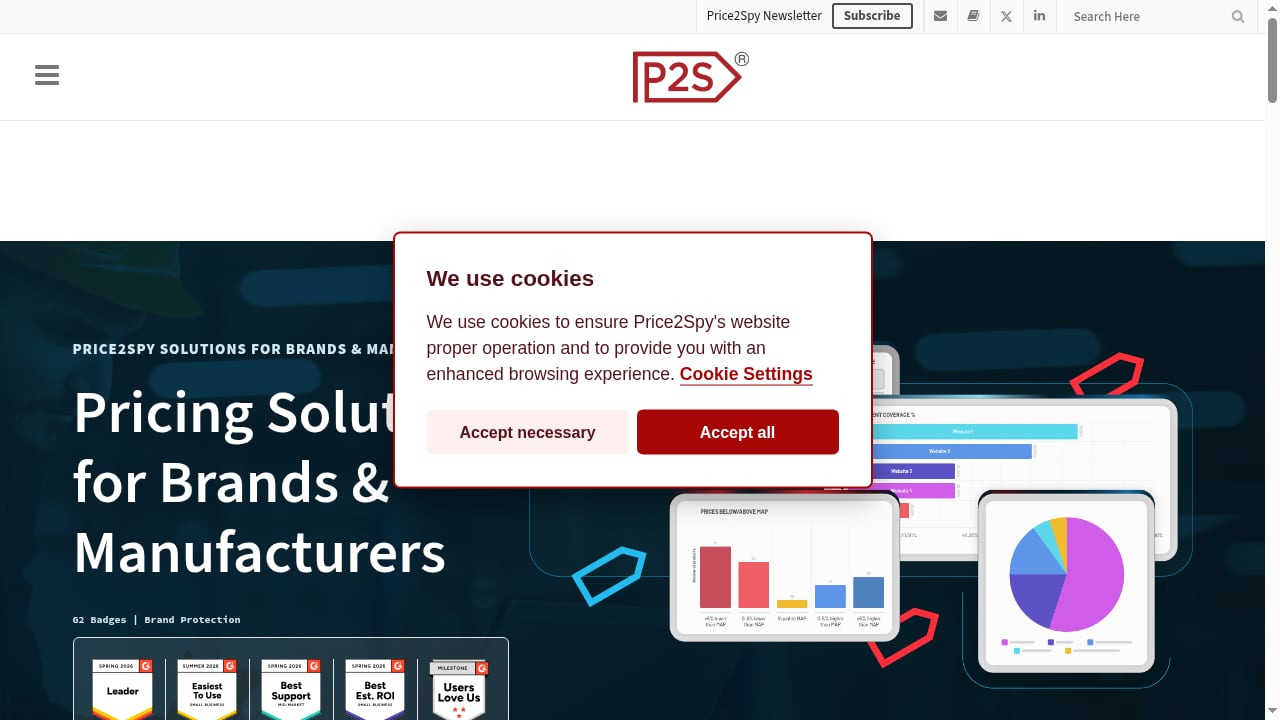
First viewport screenshot of Brands / Manufacturers – Price2Spy®.
Some pricing teams need to capture pages that standard scrapers miss, validate rendering states, or build custom data pipelines. In those adjacent workflows, a browser automation API can be useful alongside a dedicated price monitoring platform. For example, AdsCrawl provides real browser sessions and data extraction for teams that need to collect public web pages at scale. It is not a price monitoring or repricing tool, but it can support custom monitoring and automation projects. If you are evaluating browser infrastructure for such tasks, see our comparison of AdsCrawl vs Octoparse vs axiom.ai and our guide on how to use AdsCrawl with Bright Data.
Related reading
- AdsCrawl vs ParseHub: API Browser Automation or Visual Scraper? - Compare AdsCrawl and ParseHub: API-driven browser automation vs a visual no-code scraper. See which fits AI agents, monitoring, and data pipelines.
- ScraperAPI Review: Real Costs, Limits, and Best Fit - An evidence-based ScraperAPI review covering credit multipliers, real pricing, setup, strengths, limits, and who should choose it over alternatives.
Sources and further reading
- 10 Best Price2Spy Alternatives & Competitors in 2026 (Full Guide) - Discover the best Price2Spy alternatives for smarter price monitoring, powerful features, and flexible pricing. Compare top tools and find your fit now!
- 10 Best Pricemole Alternatives 2026 — Expert Comparison - Side-by-side comparison of 10 Pricemole alternatives. Features, pricing, pros, cons and a clear editor's pick for every budget.
- Prisync Competitors Alternatives - Compare the 10 best Prisync alternatives for 2026. Honest breakdown of features, pricing, pros & cons — including Altosight, Price2Spy, Competera & more.
Frequently Asked Questions
What is the best competitor price monitoring software in 2026?
There is no single best tool for everyone. Price2Spy ranks first in this guide because of its combination of monitoring, matching, repricing, and MAP features. However, Prisync is better for simplicity, Competera for enterprise optimization, and Pricefy for small budgets.
How important is product matching accuracy?
It is critical. If your tool cannot match products accurately, you will spend hours manually managing URLs and correcting data. Tools that rely solely on EAN/UPC codes struggle on marketplaces and private-label catalogs. Look for AI-based matching with human verification options.
Do I need repricing automation?
If you compete on price in fast-moving categories, yes. Automated repricing lets you respond to competitor changes within minutes instead of hours. If your pricing strategy is more stable, monitoring and alerts may be enough.
What is MAP monitoring and why does it matter?
MAP (Minimum Advertised Price) monitoring tracks whether resellers are advertising your products below agreed prices. It is essential for brands that want to protect margins and brand value. Price2Spy and Wiser Solutions are strong in this area.
Can I use a browser automation API instead of a price monitoring tool?
A browser automation API like AdsCrawl can collect web data, but it does not provide the matching, repricing, analytics, and alerting workflows that dedicated price monitoring platforms offer. It is best used as a complementary tool for custom or hard-to-scrape pages.
Conclusion
The competitor price monitoring and repricing software market in 2026 offers strong options for every budget and complexity level. Price2Spy leads our ranking for its comprehensive feature set and maturity. Prisync remains a solid choice for simplicity, while Competera, Wiser, and Intelligence Node serve enterprise needs. Smaller stores can start with Pricefy or Priceva. Evaluate your matching complexity, repricing needs, and API requirements before committing, and consider complementary browser automation tools only where standard monitoring falls short.