
Top 10 Public Web Data & SERP API Platforms 2026
Compare the top 10 public web data and SERP API platforms of 2026 on pricing, latency, coverage, and free tiers. Find the right API for SEO, AI, and RAG.
Top 10 Public Web Data & SERP API Platforms 2026
Public web data and SERP APIs have become the connective tissue of modern software: they feed AI agents with fresh search results, power rank trackers, and supply e-commerce teams with live pricing. But the category is crowded, and most roundups blur the line between a true SERP API, a web search API, and a general scraping service.
This guide ranks 10 platforms that genuinely belong to the public web data and SERP API category. We evaluated each on output depth, pricing model, latency, free tier, and developer experience, using published pricing and documented capabilities as of 2026. Where a tool sits adjacent to this category, we say so.
How We Evaluated These Platforms
Top 10 Public Web Data & SERP API Platforms 2026 - How We Evaluated These Platforms.
We scored every provider across five dimensions:
- Output depth: Does it return parsed SERP objects (organic results, People Also Ask, AI Overviews, Local Pack, Shopping) or only organic links?
- Pricing transparency: Is the per-unit cost published, and does the billing unit match what you actually consume?
- Latency and delivery mode: Live, queued, or both. A nightly rank check and an interactive AI agent have very different needs.
- Coverage: Google only, multi-engine, or multi-dataset (Maps, Amazon, Jobs, Finance).
- Developer experience: Auth model, SDKs, documentation, and free tier for testing.
One note on scope: browser automation platforms like AdsCrawl are complementary to this category, not members of it. They render pages and extract HTML; SERP APIs return parsed search data. Some teams use both, and we mention that where relevant.
The Top 10 Public Web Data and SERP API Platforms in 2026
Top 10 Public Web Data & SERP API Platforms 2026 - The Top 10 Public Web Data and SERP API Platforms in 2026.
1. OpenWeb Ninja
Best for: Teams that need SERP data plus 40+ adjacent public data APIs under one key.
OpenWeb Ninja is a web data and SERP API stack covering SERP & Search, E-Commerce, Maps & Local, Jobs & Hiring, News, Finance, and more. Its Real-Time Web Search API returns organic results, People Also Ask, Knowledge Graph, Local Pack, Shopping results, and structured AI Overviews data, including a has_ai_overviews flag that helps SEO teams detect which queries have shifted to AI-generated answers.
The differentiator is breadth under a single API key. The Local Business Data API returns Google Maps data with reviews, photos, emails, social profiles, and 30+ data points. The Real-Time Amazon Data API covers product searches, reviews, offers, best sellers, deals, and sellers. For AI grounding pipelines, that means adding Maps or Amazon context without a second account.
Pricing: Free plan with 100 requests/month, no credit card required. Paid tiers start at $25/month for 10,000 requests ($2.50 per 1K), dropping to $0.75 per 1K at the 200,000-request tier.
Trade-off: Google only for search. No Bing, Baidu, or Yandex coverage.
Evidence: OpenWeb Ninja publishes real-world case studies, including Cork Safety Alerts polling the Waze API across 12 regions every 60 seconds to reach 300,000+ people in Ireland, and HiringSky using the JSearch API for live job listings. APIs are also available on RapidAPI.
2. SerpApi
Best for: Applications that need the broadest search engine coverage and deeply parsed Google features.
SerpApi supports 80+ search engines, including Google, Bing, Baidu, Yahoo, Yandex, and DuckDuckGo. It covers Google Search, Maps, Images, Shopping, News, and Jobs, with official SDKs for Python, Ruby, Node.js, Go, and PHP. The documentation is mature and the playground makes testing straightforward.
Pricing: Free tier of 250 searches/month. Starter plan at $25 for 1,000 searches, Developer at $75 for 5,000, and Production at $150 for 15,000. Only successful searches count; cached, failed, and errored searches are not billed.
Trade-off: The highest per-request cost in this list at every tier. Credits expire monthly.
Evidence: SerpApi's engine catalog and feature parsing are documented per engine, and its pricing page lists the exact billing rules. It remains the default shortlist when non-Google engines matter.
3. DataForSEO
Best for: Bulk SEO pipelines where cost at scale matters more than latency.
DataForSEO separates standard queue, priority queue, and live delivery, which lets you match freshness to price. A nightly rank tracker can use the standard queue; an interactive tool can pay for live mode. It also offers other SEO datasets from the same vendor.
Pricing: Pay-as-you-go with no monthly fee. Standard queue at ~$0.60 per 1,000 SERPs, priority at ~$1.20, and live at ~$2. One priced SERP contains ten results, and some parameters cost extra. Minimum payment is $50 after the trial credit.
Trade-off: The most complex setup in this list: HTTP Basic auth with base64-encoded credentials, a JSON array request body, and async polling for queued tasks.
Evidence: DataForSEO publishes its SERP pricing page with explicit per-task rates and latency expectations, making the cost model verifiable before you commit.
4. Serper
Best for: A small, fast Google integration at low-to-mid volume.
Serper keeps the Google request and response simple: a POST with your query, returning clean JSON with organic results. Response times are typically 1–2 seconds, and the free tier is the most generous in this list.
Pricing: 2,500 free credits. Starter at $50 for 50,000 credits ($1.00 per 1K), dropping to $0.30 per 1K at the 12.5M-credit tier. Paid credits are valid for 6 months.
Trade-off: Google only. No AI Overviews, no Amazon, Maps, or Jobs data. Adding those means a second account and a second API key.
Evidence: Serper's pricing page lists credit costs per endpoint, and its homepage documents the free tier. It is a common first stop for prototypes that only need organic links.
5. SearchApi
Best for: Teams that need Google and Bing plus AI search surfaces.
SearchApi covers Google, Bing, YouTube, ChatGPT Search, Perplexity, and AI-oriented Google surfaces. That makes it useful for AI visibility tracking, where you need to see how a brand appears in both classic SERPs and AI-generated answers.
Pricing: Developer plan at $40/month for 10,000 searches; Production at $100 for 35,000. Failed requests are not charged, and hourly usage is capped at 20% of plan credits.
Trade-off: The hourly cap matters for bursty launches. Monthly bundles mean unused searches do not roll over.
Evidence: SearchApi's pricing page documents the billing rules and hourly limit, and its engine list is published per endpoint.
6. Scrapingdog
Best for: High-volume SERP collection on a budget.
Scrapingdog offers a SERP API alongside general scraping endpoints, with a Lite plan that advertises 200,000 request credits per month. It is a practical option when you need volume and can tolerate a narrower feature set than SerpApi.
Pricing: 200 free credits, then Lite at $40/month for 200,000 request credits. Failed requests are not charged, and different endpoint features can consume different credit amounts.
Trade-off: Credit costs vary by endpoint, so the effective per-SERP price depends on which features you enable. Check the credit table before scaling.
Evidence: Scrapingdog publishes its credit costs per endpoint and its free trial terms on its pricing page.
7. Bright Data
Best for: Production-scale collection with compliance and procurement support.
Bright Data's SERP API is part of a larger web data platform that includes proxy infrastructure, unblocker APIs, datasets, and an MCP server for AI integration. For enterprises that need global infrastructure and contractual controls, it is a common choice.
Pricing: 5,000 free requests/month, then pay-as-you-go at $1.50 per 1,000 results. Larger commitments publish lower unit prices. Only successful requests are billed.
Trade-off: More product and contract than a small project needs. The platform's breadth can be overwhelming if you only want Google results.
Evidence: Bright Data publishes its SERP API pricing and free tier on its product pages, and its MCP server is documented for AI integration.
8. ScraperAPI
Best for: Teams that want general scraping plus a SERP endpoint in one account.
ScraperAPI is primarily a proxy-heavy scraping service with a SERP API attached. That combination is useful when your pipeline needs both search results and full-page retrieval, since you can keep one vendor and one billing relationship.
Pricing: 7-day trial with 5,000 credits, then the first paid plan at $49/month for 100,000 credits. Rendering, premium proxies, and other options consume more credits per request.
Trade-off: The credit multiplier for rendering and premium proxies can make the effective cost per SERP higher than the headline rate suggests.
Evidence: ScraperAPI documents its credit costs per feature on its pricing page and lists the trial terms.
9. Apify
Best for: Configurable scraper jobs with scheduling and datasets.
Apify is a marketplace of Actors, including SERP scrapers, that run on managed infrastructure with scheduling, datasets, and proxies. It is less a single SERP API and more a platform for building repeatable collection jobs.
Pricing: Free plan with $5 platform usage, then Starter at $29/month plus usage. Actor compute, proxy traffic, storage, and the Actor's own pricing can all apply.
Trade-off: Costs vary by Actor and by developer, so the effective per-SERP price depends on which Actor you choose. Inputs and outputs are not standardized across the marketplace.
Evidence: Apify's pricing page documents the platform usage model, and each Actor lists its own pricing and input schema.
10. Tavily
Best for: RAG pipelines and AI agents that need answer-ready context.
Tavily is a web search API designed for LLM integration. Instead of preserving the search page and its positions, it selects sources, fetches page text, reranks it, and returns context suitable for a model. That makes it a different contract from a SERP API, but it belongs in this category because it is a public web data API for search.
Pricing: $0.008 per credit, with 1,000 free credits per month.
Trade-off: It does not return raw SERP positions, ads, or Local Pack objects. If you need rank tracking or ad monitoring, you still need a SERP API alongside it.
Evidence: Tavily's pricing page lists the credit rate and free tier, and its documentation describes the search-and-retrieve output format.
SERP API vs Web Search API: Which Do You Need?
Top 10 Public Web Data & SERP API Platforms 2026 - SERP API vs Web Search API: Which Do You Need?.
The most common mistake in this category is treating every returned JSON object as the same product. They are not.
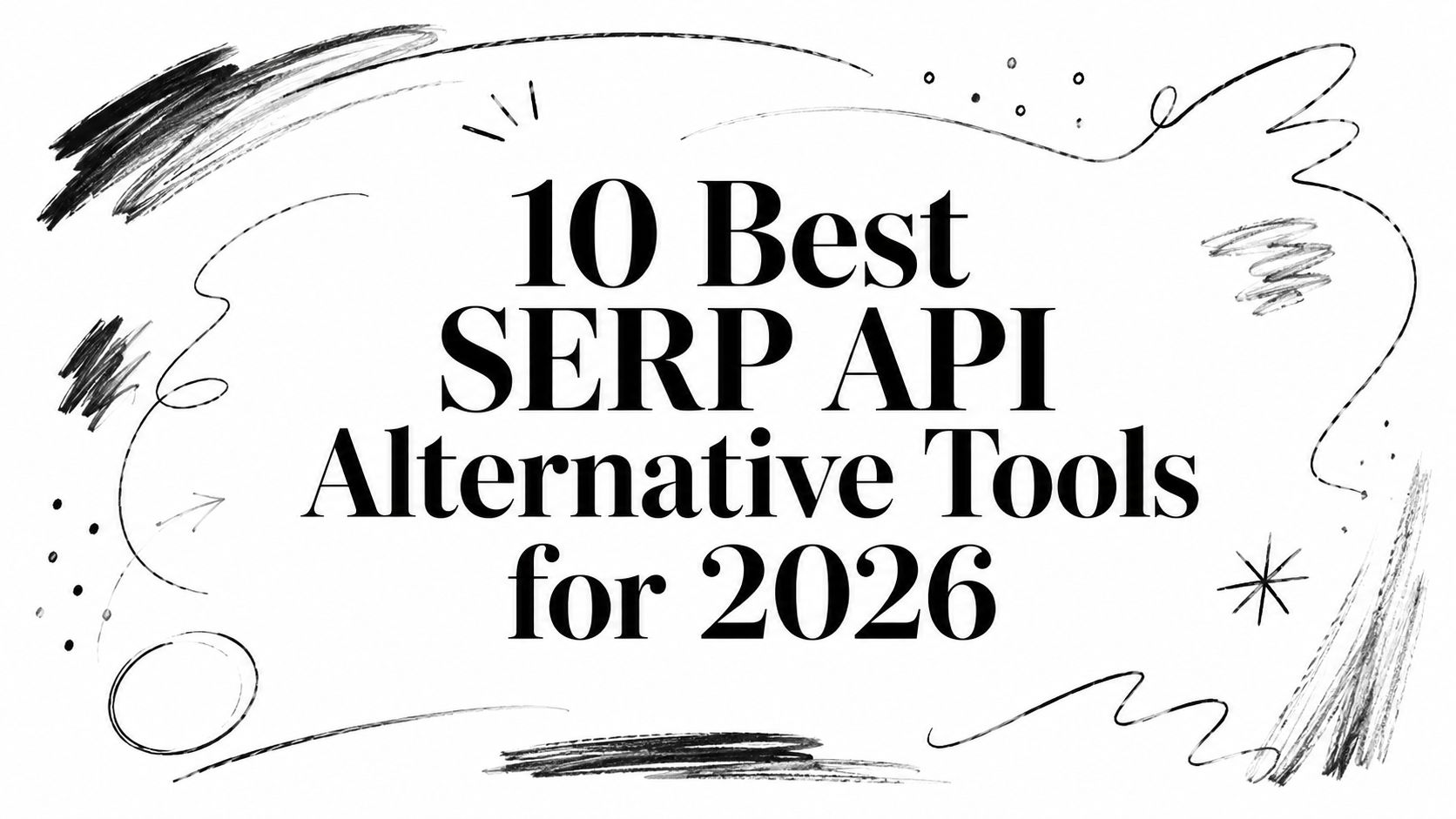
- A SERP API preserves the search page: positions, ads, People Also Ask, Local Pack, Shopping, and AI Overview citations. Use it for SEO monitoring, rank tracking, ad intelligence, and market research.
- A web search API selects and reranks sources for a model. Use it for RAG chatbots, AI agents, and research tools where the model needs clean context, not raw positions.
Many teams need both. Search identifies sources; retrieval gets the page content; the model evaluates the evidence. If your agent only needs ten links, do not pay for full-page text. If it needs cited page content, do not buy ten links and then build your own retrieval layer.
For a deeper look at the SERP-specific side of this decision, see our Top 10 Search Engine Results Scraping APIs 2026.
Pricing Models Compared: What Actually Changes the Math
Top 10 Public Web Data & SERP API Platforms 2026 - Pricing Models Compared: What Actually Changes the Math.
The cheapest headline rate is rarely the cheapest workload. Here is what to check before you commit:
- Billing unit: A search, a request, a credit, a SERP page, and a successful result are different things. Normalize to cost per usable SERP.
- Delivery mode: Queued results can be 3–5x cheaper than live results. Match the mode to the workflow.
- Feature multipliers: Rendering, premium proxies, and extra parameters can consume multiple credits per request.
- Expiry: Some providers expire unused credits monthly or after six months. Others do not.
- Free tier size: A large free tier lets you benchmark real queries before you pay. Serper's 2,500 credits and Bright Data's 5,000 monthly requests are the most generous here; OpenWeb Ninja's 100 requests/month is smaller but requires no credit card.
Where Browser Automation Fits
SERP APIs return parsed search data. Browser automation platforms do something different: they render pages, capture screenshots, and extract HTML or Markdown. Teams often need both when a workflow requires the SERP result and the destination page's rendered state.
If your pipeline needs to validate how a page renders after you find it in search, a browser API is the right complement. For example, AdsCrawl provides remote Chrome DevTools Protocol sessions and extraction for AI agents and monitoring workflows. It is not a SERP API, and it should not be evaluated as one, but it is a natural adjacent tool when your search data pipeline also needs page-level rendering.
How to Choose in 2026
Use this decision path:
- If you need multiple search engines and deeply parsed Google features: start with SerpApi.
- If you need bulk SEO batches where latency is flexible: start with DataForSEO.
- If you need fast Google JSON at low volume: start with Serper.
- If you need SERP data plus Maps, Amazon, Jobs, or Finance under one key: start with OpenWeb Ninja.
- If you need AI search surfaces alongside classic SERPs: start with SearchApi.
- If you need answer-ready context for a RAG pipeline: add Tavily alongside a SERP API.
- If you need enterprise procurement and global infrastructure: evaluate Bright Data.
Before committing, run the same three queries through two or three providers. Compare the JSON fields, not just the price. A provider that returns the wrong locale or omits the fields you need has a low invoice and a high cost per usable result.
Related reading
- How to Use AdsCrawl with UptimeRobot: Browser Checks + Alerts - Combine AdsCrawl browser automation with UptimeRobot monitoring to catch rendering failures, not just HTTP 200s. Setup, code, and alert workflow.
- BrowserCloud Review 2026: Cloud Browser Automation at Scale - Hands-on BrowserCloud review: stealth browsing, CAPTCHA solving, 100M+ residential IPs, pricing, setup, and who should use it in 2026.
Sources and further reading
- The 16 Best SERP and Web Search APIs of 2026 - Bright Data - Compare the 16 best SERP and web search APIs of 2026 on pricing, features, search engines, and AI integration to find the right tool for your needs.
- Best SERP APIs in 2026: 7 Tested and Compared - We compared 7 SERP APIs on pricing, response time, and data depth, with code examples and real JSON responses.
- Best SERP API in 2026: 10 tools priced and compared - Compare 10 SERP APIs for Google, SEO tools, and AI agents by coverage, billing unit, live vs queued delivery, pricing, and honest limitations.
FAQ
What is the difference between a SERP API and a public web data API?
A SERP API specifically returns search engine results pages, parsed into structured objects like organic results, ads, and People Also Ask. A public web data API is broader: it can return Maps business data, Amazon product data, job listings, or financial data. Many providers offer both under one key.
Which SERP API has the best free tier in 2026?
Serper offers 2,500 free credits, and Bright Data offers 5,000 free requests per month. OpenWeb Ninja offers 100 requests/month with no credit card required. The best free tier depends on whether you need volume for benchmarking or a no-friction way to test the API design.
Can I use a SERP API for AI grounding?
Yes, but check the output format. A SERP API returns positions and search-page objects, which is useful for SEO and ad monitoring. For AI grounding, you often want a web search API that selects sources and returns cleaned text. Some providers, including OpenWeb Ninja and Bright Data, offer MCP integration for AI workflows.
Is a browser automation platform a SERP API?
No. Browser automation platforms render pages and extract HTML or Markdown; they do not return parsed SERP objects. They are complementary tools. If your workflow needs both search data and rendered page state, use a SERP API for the search layer and a browser API for the rendering layer.
How do I compare SERP API pricing fairly?
Normalize to cost per usable SERP. Check the billing unit, whether failed requests are charged, whether credits expire, and whether rendering or premium proxies consume extra credits. A $0.60 queued SERP and a $2.50 live SERP are not the same product, even if both return ten results.
Conclusion
The public web data and SERP API category in 2026 rewards specificity. SerpApi remains the broadest engine catalog. DataForSEO is the cost leader for queued batches. Serper is the simplest Google integration. OpenWeb Ninja is the strongest choice when you want SERP data plus Maps, Amazon, Jobs, and Finance under one key and one pricing tier.
Start with the output you need, not the headline price. Run the same queries through two providers, compare the JSON fields, and check the billing rules for failed requests and credit expiry. That process will tell you more than any comparison table, including this one.