
Top 10 Search Engine Results Scraping APIs 2026
Compare the top 10 SERP scraping APIs for 2026 on pricing, latency, output formats, and free tiers. Find the right search data API for SEO, AI, and RAG.
Top 10 Search Engine Results Scraping APIs 2026
Search engine results pages (SERPs) are no longer just for SEO rank tracking. In 2026, AI agents, RAG pipelines, and competitive intelligence tools all need fresh, structured search data on demand. A SERP scraping API handles the proxies, CAPTCHAs, and parsing so you get clean JSON instead of raw HTML.
This guide ranks the top 10 search engine results scraping APIs for 2026 using transparent criteria. We evaluated each product on result fidelity, latency, output structure, pricing clarity, free tier, and developer experience. Every entry includes evidence from vendor documentation and independent comparisons.
How We Evaluated These SERP APIs
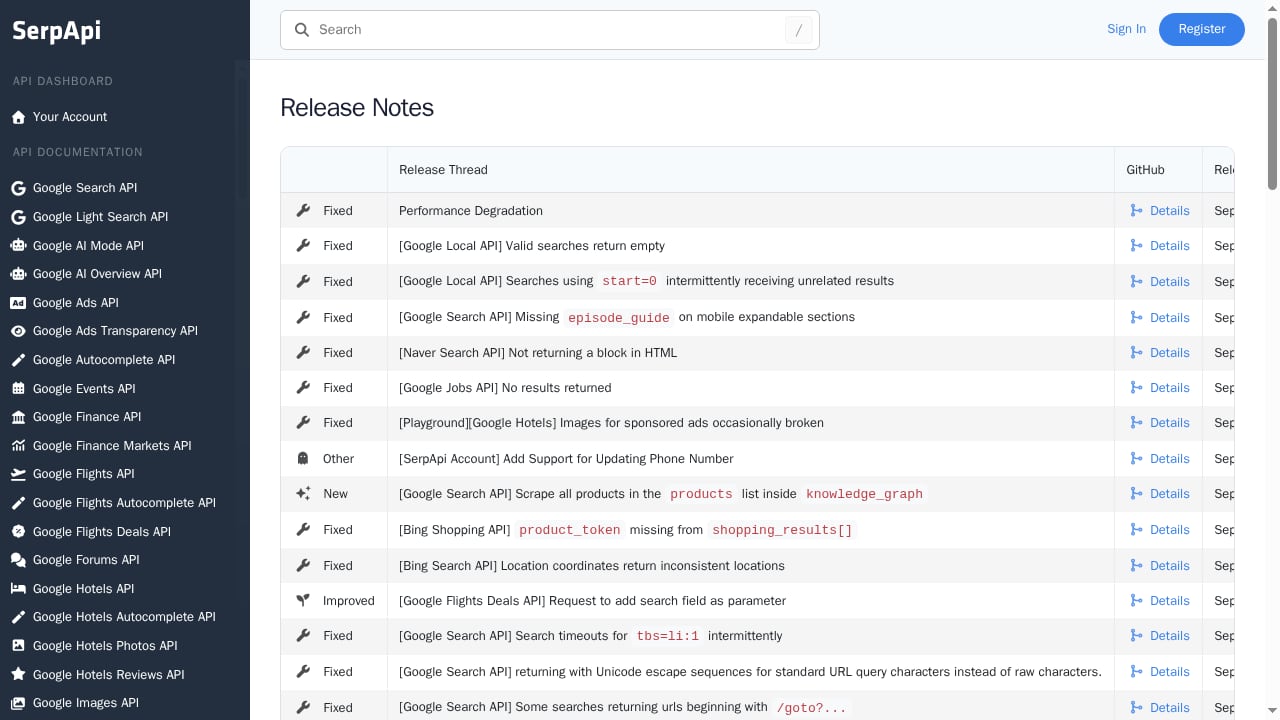
First viewport screenshot of SerpApi Release Notes - SerpApi.
We scored each provider against six criteria:
- Result fidelity: Does it return the same organic results, ads, and rich features a real user sees?
- Latency: How fast does a typical query return?
- Output structure: Is the response clean JSON with parsed fields, or raw HTML?
- Pricing clarity: Are costs per search, per credit, or per success? Are there hidden multipliers?
- Free tier: Can you test without a credit card?
- Developer experience: SDKs, documentation, and MCP support for AI workflows.
We prioritized products that specifically target SERP scraping rather than general-purpose web scraping. Where a product offers SERP as one module among many, we noted that trade-off.
1. SerpApi
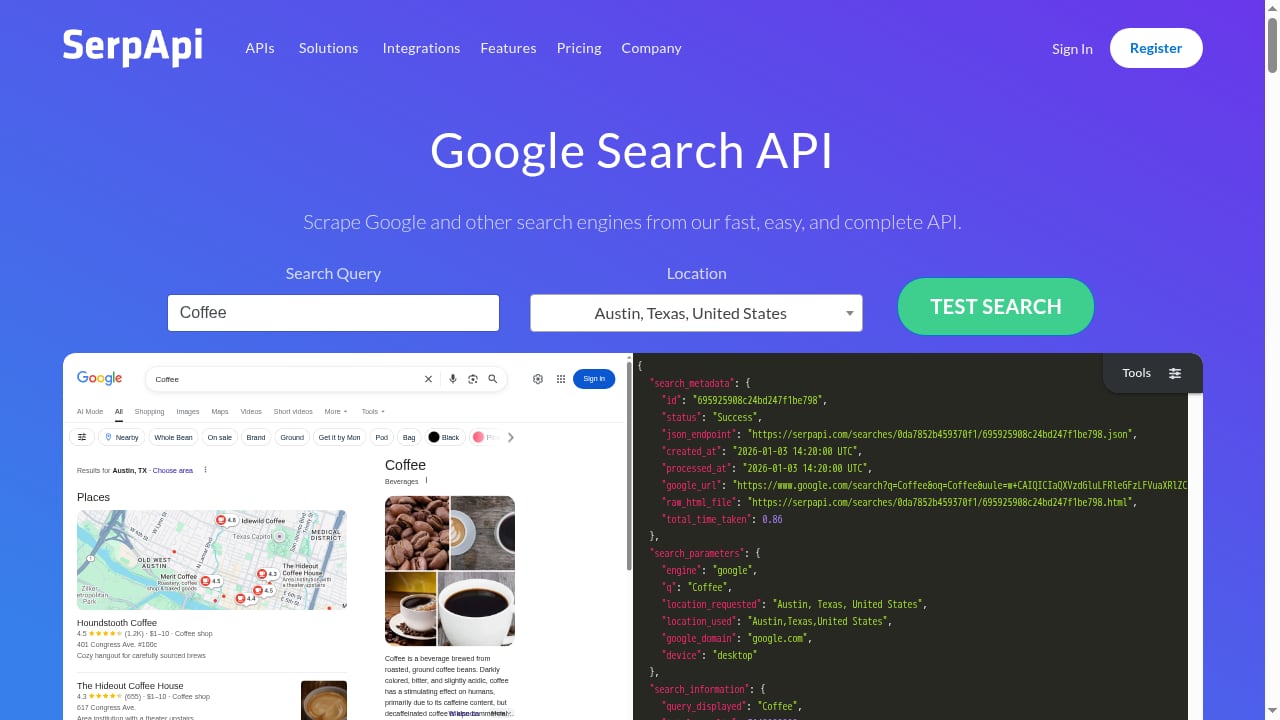
First viewport screenshot of SerpApi: Google Search API.
Best for: developers who want the broadest search engine coverage with minimal setup.
SerpApi is a real-time API that returns structured JSON from Google Search, Google Maps, Google News, Google Jobs, Google Flights, Google Hotels, Amazon Product, Bing, Yahoo, and more. It handles proxy rotation, CAPTCHA solving, and parsing on its side, so you send a query and get back titles, links, snippets, and rich result blocks.
The product is designed for developers, data engineers, SEO professionals, and businesses that need reliable search data without building a scraper. Key features include a playground for testing queries, month-to-month pricing, a free plan, and enterprise options. Release notes show continuous updates and new API features, which signals active maintenance.
Pricing: Free plan available; paid plans start around $75/month for 5,000 searches. Enterprise pricing is custom.
Trade-off: Latency is typically 2–5 seconds, which is fine for batch SEO jobs but slower than some AI-native search APIs for real-time agent loops.
2. Oxylabs Fast Search API
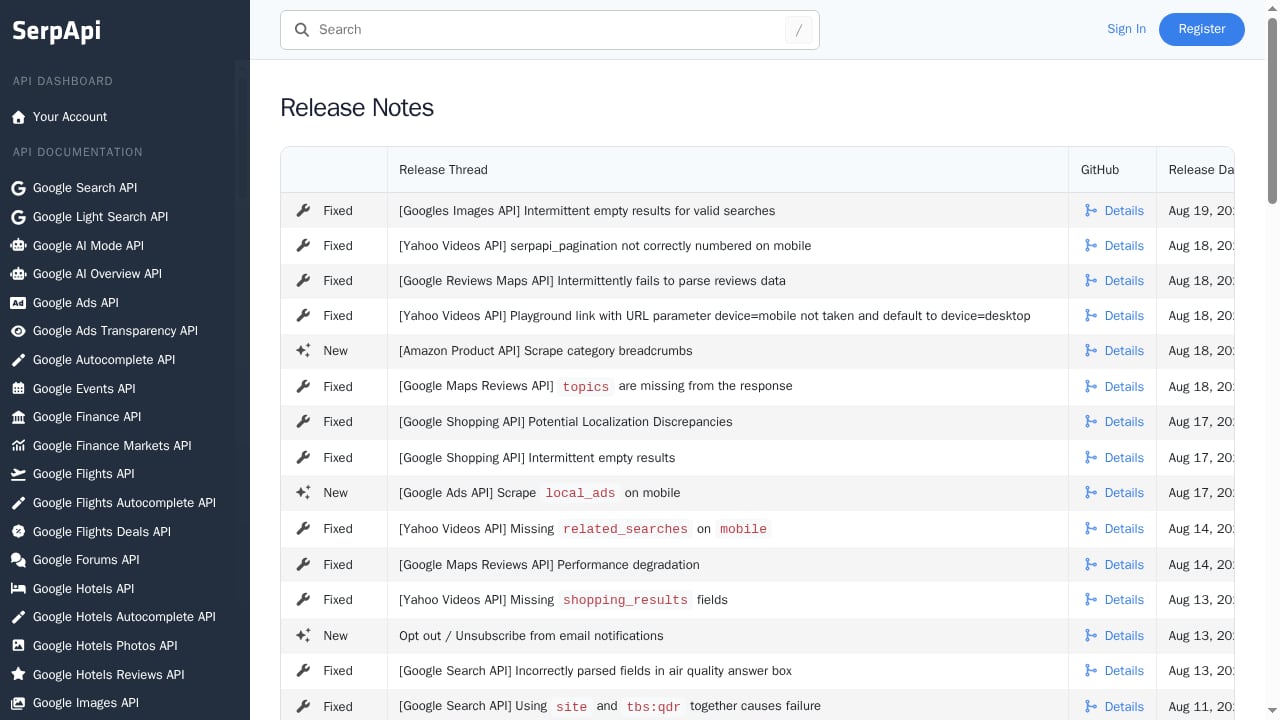
First viewport screenshot of SerpApi Release Notes - SerpApi.
Best for: high-volume, sub-second SERP data for AI and ML teams.
Oxylabs Fast Search API is a lightweight SERP scraper built for speed. It returns structured JSON with 10 organic results plus top stories and news, and it intentionally leaves out ads, featured snippets, and extra metadata to maximize throughput. The full Oxylabs Web Scraper API covers richer SERP features when you need them.
Oxylabs reports sub-second responses and the ability to process millions of queries per day. It ships an official MCP server and AI Studio, with integrations for LangChain and n8n. Infrastructure runs on a large proxy network with zero data retention and enterprise compliance certifications.
Pricing: Web Scraper API from $49/month; AI Studio from $12/month. Free trial and 10K AI Studio credits.
Trade-off: The Fast Search output is deliberately lightweight. If you need ads, AI Overviews, or knowledge graph data, you must use the heavier Web Scraper API.
3. Firecrawl
Best for: agent and RAG pipelines that want search plus full page content in one call.
Firecrawl is an AI-native platform that turns web pages into clean Markdown or structured JSON. Its /search endpoint combines search and content extraction, so you get results with the underlying page content already cleaned. It also supports scrape, crawl, map, and browser interaction.
Firecrawl is especially strong for LLM workflows. It returns Markdown by default, supports JSON extraction against a schema, and has native change tracking with git-style diffs. It has a large developer community and a well-known MCP story.
Pricing: Free tier with 1,000 credits/month; paid plans from about $16/month (Hobby). Search costs 2 credits per 10 results.
Trade-off: Firecrawl is not a pure SERP API. It does not aim to reproduce every Google rich result or ad block. If you need exact SERP fidelity for SEO rank tracking, a dedicated SERP API is a better fit.
4. Tavily
Best for: RAG pipelines that need citations and LLM-ready answers.
Tavily is an AI-native search API designed for RAG. It returns structured JSON with citations, and it is built to ground LLM answers in fresh web data. It integrates with LangChain and MCP, and it is optimized for agentic workflows rather than raw SERP reproduction.
Pricing: $30/month or $0.008/credit; free tier with 1,000 credits/month.
Trade-off: Tavily is not a SERP scraper in the traditional sense. It does not return the same organic results a user would see on Google, so it is less suitable for rank tracking or ad monitoring.
5. Exa
Best for: semantic and neural search where meaning matters more than exact keyword matching.
Exa runs a neural search index that returns semantically relevant results rather than keyword-matched SERPs. It offers sub-150ms latency on its Instant tier and returns JSON with full content. It supports MCP and SDKs, and it is popular for AI research and discovery workflows.
Pricing: $7 per 1K requests pay-as-you-go; $20 signup credit plus about $10/month in credits.
Trade-off: Exa is not a Google SERP proxy. If your goal is to see what Google ranks for a keyword, Exa's semantic index will not match that.
6. Parallel
Best for: AI agents that need fast, compressed search results.
Parallel is an AI-native search API for agents. It returns compressed JSON excerpts with around 200ms latency on its Turbo tier. It offers a hosted MCP server and up to 5,000 free requests per month.
Pricing: $1 per 1K requests (Turbo/Fast); free tier up to 5,000 requests/month.
Trade-off: Like other AI-native search APIs, Parallel does not reproduce Google's exact SERP. It is optimized for agent context, not SEO rank tracking.
7. Brave Search API
Best for: teams that want an independent web index with sub-second latency.
Brave Search API runs its own independent index rather than proxying Google or Bing. It returns JSON and LLM context, with sub-second latency and an official MCP server. It is a good fit for privacy-conscious teams and those who want first-party index data.
Pricing: $5 per 1K requests; $5 monthly credits on the free tier.
Trade-off: The independent index means results will differ from Google. For SEO work that requires Google SERP fidelity, this is a limitation.
8. Decodo
Best for: teams that want SERP data with multiple output formats and MCP support.
Decodo offers a SERP scraper with proxy-based infrastructure. It returns JSON, CSV, Markdown, HTML, and PNG, and it reports sub-second latency on its Fast Search tier. It supports MCP and offers a 7-day trial.
Pricing: From about $29/month; 7-day free trial.
Trade-off: Decodo is a broader proxy and scraping platform, so SERP is one module among many. The output format flexibility is a plus, but the SERP-specific depth may not match a dedicated SERP API.
9. ScrapingBee
Best for: developers who want a general scraping endpoint that also handles Google SERP.
ScrapingBee is a general-purpose scraping API with headless Chrome rendering and Google SERP support. It returns JSON or HTML, and it bills only successful requests. It has SDKs for Python and Node.
Pricing: $49/month; 1,000 free credits on trial.
Trade-off: ScrapingBee is not a dedicated SERP API. You may need to parse the SERP yourself if you want structured fields beyond what its Google endpoint returns.
10. Google Custom Search JSON API
Best for: site-restricted search where you control the index.
Google Custom Search JSON API lets you build a search engine over a specific set of sites. It returns JSON and has a generous free tier of 100 queries per day. It is useful for internal search or site-specific discovery.
Pricing: $5 per 1K queries; 100 queries/day free.
Trade-off: This is not a general SERP scraper. It is site-restricted and legacy, and Google has signaled it is retiring. It does not return the full Google SERP.
Comparison Table
| Provider | Category | Starting Price | Free Tier | Typical Latency | Output |
|---|---|---|---|---|---|
| SerpApi | SERP API (80+ engines) | $75/mo (5K searches) | 250 searches/mo | 2–5s | Structured JSON |
| Oxylabs Fast Search | Real-time SERP | $49/mo | Free trial + 10K credits | Under 1s | Structured JSON |
| Firecrawl | AI-native search + extraction | ~$16/mo | 1,000 credits/mo | ~1s | Markdown, JSON |
| Tavily | AI-native search for RAG | $30/mo | 1,000 credits/mo | 1–2s | JSON + citations |
| Exa | Neural / semantic search | $7 per 1K | $20 + ~$10/mo credits | Sub-150ms–seconds | JSON + content |
| Parallel | AI-native search for agents | $1 per 1K | 5,000 requests/mo | ~200ms | Compressed JSON |
| Brave Search API | Independent index | $5 per 1K | $5 monthly credits | Sub-second | JSON, LLM context |
| Decodo | SERP scraper (proxy-based) | ~$29/mo | 7-day trial | Under 1s | JSON, CSV, MD, HTML, PNG |
| ScrapingBee | Scraping + Google SERP | $49/mo | 1,000 credits | 1–5s | JSON, HTML |
| Google Custom Search | Site-restricted (retiring) | $5 per 1K | 100 queries/day | ~1s | JSON |
How to Choose the Right SERP API
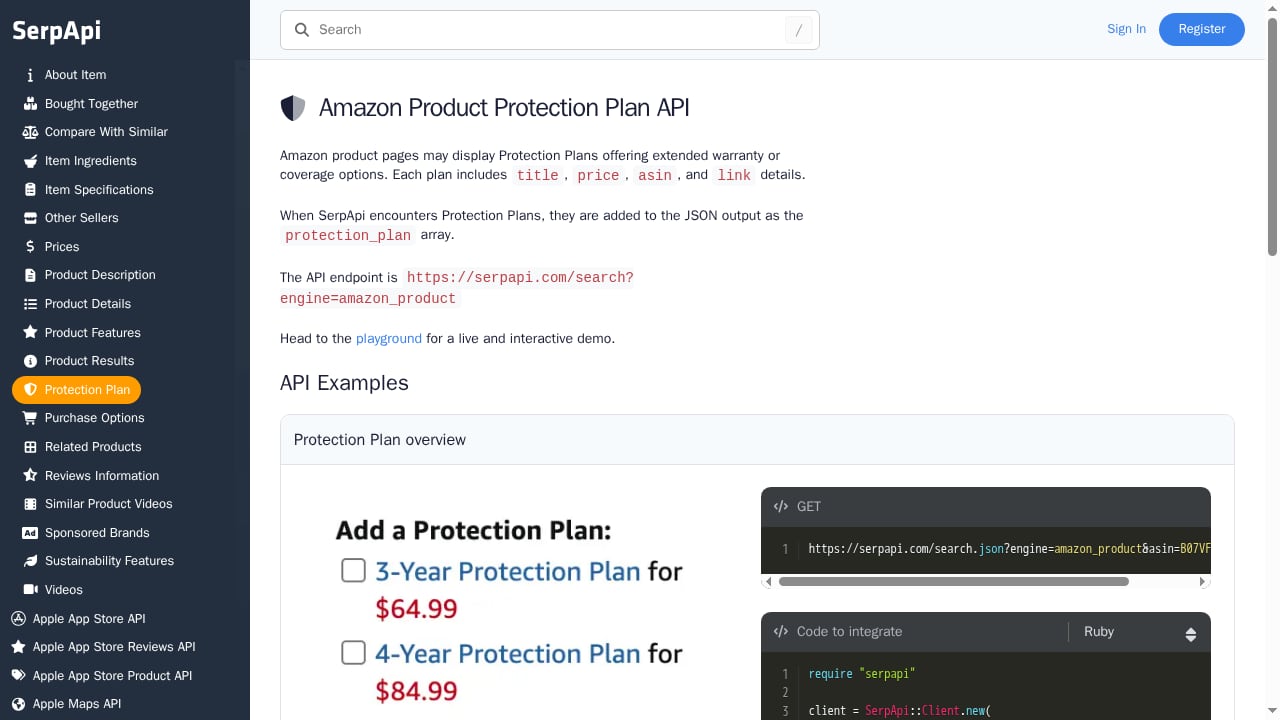
First viewport screenshot of Amazon Product Protection Plan API - SerpApi.
Start with your primary use case:
- SEO rank tracking and ad monitoring: You need exact Google SERP fidelity. Choose a dedicated SERP API like SerpApi or Oxylabs Fast Search.
- AI agents and RAG: You need clean, LLM-ready content with citations. Firecrawl, Tavily, or Parallel are stronger fits.
- Semantic discovery: You want meaning-based results rather than keyword matches. Exa is built for this.
- Independent index: You want first-party data without relying on Google. Brave Search API is the clear option.
- Budget prototyping: Look for generous free tiers. SerpApi, Firecrawl, Tavily, and Parallel all offer free monthly credits.
If your workflow also involves browser automation, screenshot capture, or HTML extraction beyond SERP data, you may need a complementary tool. For example, AdsCrawl provides browser sessions and CDP control for AI agents, which can sit alongside a SERP API when you need to validate rendered pages or capture visual states. You can see how that combination works in practice in this guide to using AdsCrawl with Oxylabs proxies.
For teams comparing broader scraping stacks, our AdsCrawl vs Parallel vs Octoparse comparison breaks down where browser automation fits versus API-based extraction.
Related reading
- How to Use AdsCrawl with Oxylabs Proxies (2026 Guide) - Connect AdsCrawl browser automation with Oxylabs proxies: setup steps, code examples, rotation strategy, and fixes for geo-blocks and CAPTCHAs.
- AdsCrawl vs Parallel vs Octoparse: Which Fits in 2026? - Compare AdsCrawl, Parallel, and Octoparse across browser control, extraction, monitoring, and pricing to pick the right tool for your 2026 workflow.
- AdsCrawl vs Kernel: Browser API Comparison for 2026 - AdsCrawl vs Kernel compared: browser sessions, HTML and Markdown extraction, CDP control, pricing models, and which fits your AI agent workflow.
Sources and further reading
- Best Web Search API: 10 Providers Compared for 2026 - Compare the 10 best web search API providers for 2026 by price, latency, free tier, output, and MCP support – built for AI agents, RAG, and SEO tools.
- Best Web Scraping APIs in 2026: Compared, Priced, and When Monitoring Fits Better - Twelve web scraping APIs compared on output formats, browser rendering, pricing and change tracking, plus when a monitoring API is the better fit.
- 10 Best Scraping APIs in 2026 - A practical 2026 comparison of the best scraping APIs for AI apps, RAG pipelines, product data, and teams that need reliable web context without maintaining their own crawler.
Frequently Asked Questions
What is a search engine results scraping API?
A SERP scraping API takes a search query and returns structured results from search engines like Google or Bing. It handles proxies, CAPTCHAs, and parsing so you get JSON instead of raw HTML.
Is SERP scraping legal?
Scraping public search results is generally legal in many jurisdictions, but you should review the search engine's terms of service and local laws. Using a compliant API provider shifts much of the operational risk.
Which SERP API is best for SEO rank tracking?
For exact Google SERP fidelity, SerpApi and Oxylabs Fast Search API are strong choices. SerpApi offers broader engine coverage; Oxylabs offers faster latency for high-volume queries.
Which SERP API is best for AI agents?
Firecrawl, Tavily, and Parallel are built for AI workflows. They return LLM-ready content and support MCP, which makes them easier to wire into agent frameworks.
Can I use a SERP API for free?
Yes. SerpApi offers 250 free searches per month. Firecrawl, Tavily, and Parallel offer 1,000 or more free credits monthly. Google Custom Search gives 100 queries per day.
How much does a SERP API cost?
Pricing ranges from $5 per 1,000 queries for independent index APIs to $75 per month for 5,000 searches on dedicated SERP APIs. Costs depend on volume, output richness, and whether you need premium proxies.
Conclusion
The best search engine results scraping API for 2026 depends on whether you need exact SERP fidelity, AI-ready content, or independent index data. SerpApi leads for breadth and structured JSON across many engines. Oxylabs Fast Search wins on speed for high-volume AI workloads. Firecrawl, Tavily, and Parallel are the strongest choices for RAG and agent pipelines. For teams that also need browser automation, pairing a SERP API with a tool like AdsCrawl can cover both structured search data and rendered page validation.
Evaluate against your own latency, volume, and output requirements, and use the free tiers to test before you commit.