
AdsCrawl vs Steel vs Zyte: Browser API and Data Delivery
Compare AdsCrawl, Steel, and Zyte for browser automation and managed data delivery. See which fits CDP workflows, AI agents, or turnkey scraping.
AdsCrawl vs Steel vs Zyte: Browser APIs and Managed Data Delivery Compared
If you are choosing infrastructure for web automation in 2026, the real question is not which product has the longest feature list. It is which layer of the stack you want to own. AdsCrawl, Steel, and Zyte each solve a different part of the problem: raw browser control, agent-scale browser fleets, and end-to-end data delivery.
This comparison looks at where each option is genuinely strong, where it is a poor fit, and how to decide based on your team and workload.
The three products at a glance
| Product | Category | Best for |
|---|---|---|
| AdsCrawl | Managed cloud browser and browser automation API | Developers who want real Chromium browsers over CDP with Playwright, Puppeteer, or any CDP client |
| Steel | Cloud browser infrastructure for AI agents | Engineering teams running large fleets of agent browser sessions |
| Zyte | Web scraping and data extraction platform | Teams that want managed scraping plus delivered, structured data |
AdsCrawl: a real browser you control remotely
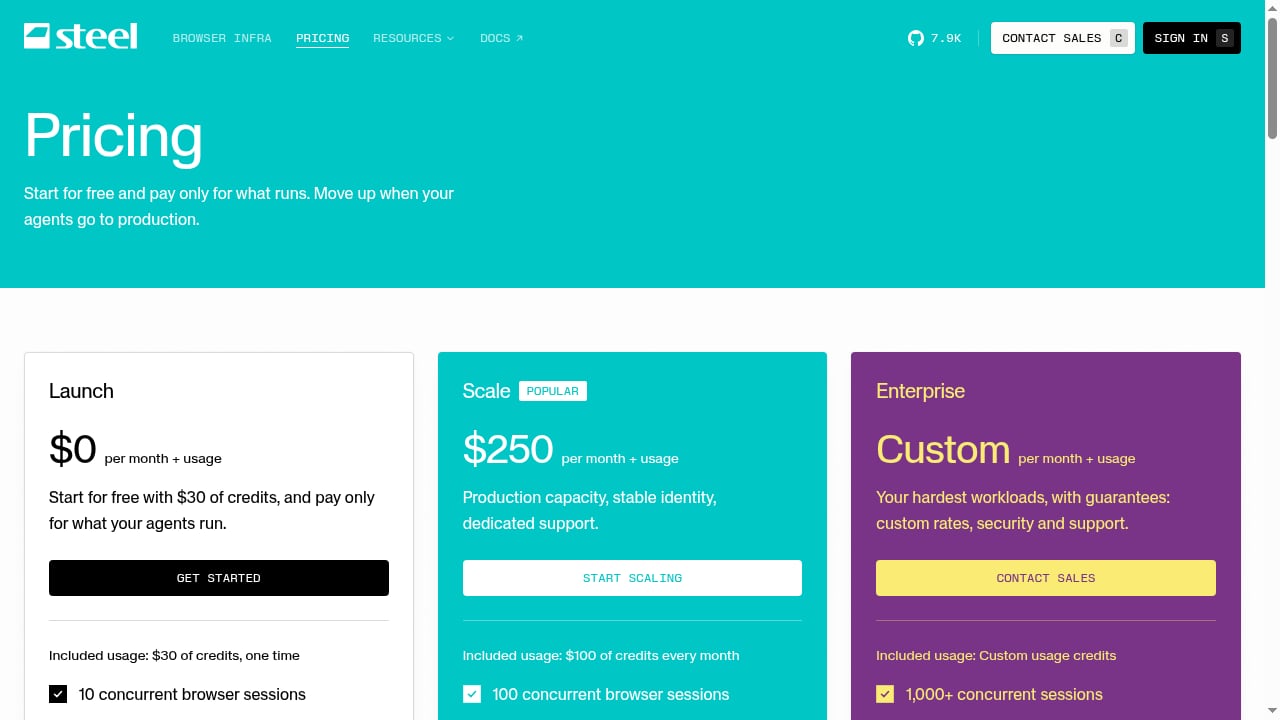
First viewport screenshot of Steel | Pricing.
AdsCrawl is a managed cloud browser API. You connect Playwright, Puppeteer, or any Chrome DevTools Protocol client to real cloud Chromium browsers, then drive them the same way you would drive a local browser. That matters when a site depends on JavaScript, single-page app rendering, or an authenticated session.
Key capabilities include:
- Synchronous browser tasks such as screenshots, HTML capture, and SPA extraction.
- Stateful remote CDP sessions for multi-step workflows that need to keep browser state.
- Saved cloud browser profiles with lifecycle management, useful for logged-in sessions.
- Live browser control through short-lived tokens.
- Proxy routing, including free rotating residential proxies and custom proxies.
- Multiple output formats, including HTML, Markdown, JSON, and screenshots.
Pricing is subscription-based with monthly credits, starting from a free tier with 500 one-time credits and a Pro plan at $199 per month for 500,000 credits. New users get 500 credits on signup.
Where AdsCrawl fits best: teams that already write Playwright or Puppeteer code and want to move it to managed infrastructure without rewriting their logic. If you are new to the model, the explainer on what a headless browser user is covers how code-driven sessions work in practice.
Steel: browser infrastructure built for agent fleets
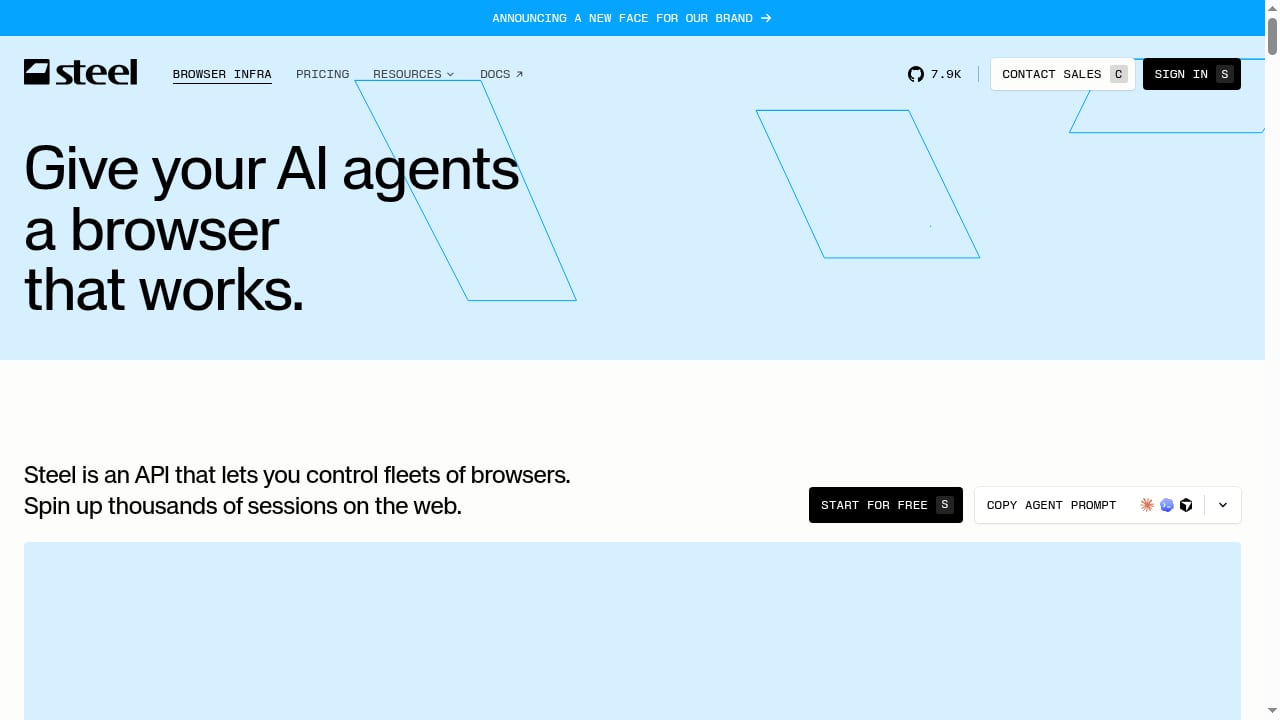
First viewport screenshot of Steel | Open-source Browser Infrastructure for AI Agents.
Steel is an open-source browser API and cloud platform designed around AI agents. Its pitch is scale: agents can spin up thousands of concurrent browser sessions, with each session starting in under a second. The company reports more than 30,000 engineers using the platform, millions of browser sessions weekly, and over 1.5 million browser hours served.
Notable strengths:
- Sub-second session startup, which matters when an agent needs a browser on demand.
- Session persistence so agents can continue work across steps.
- Built-in anti-bot and stealth browser support, plus dedicated IPs on higher tiers.
- Session recording, agent logs, and traces for debugging agent behavior.
- SDKs for Rust and Go, alongside its browser API.
- Atlas, an open-source deep research harness that turns web evidence into cited reports.
Pricing includes a free Launch tier with $30 in credits, a Scale plan at $250 per month with 100 concurrent sessions and dedicated IPs, and custom Enterprise plans with 1,000+ concurrent sessions, stealth browser, reserved browser pools, and uptime SLAs.
Where Steel fits best: engineering teams building AI agents, scrapers, QA testers, and research tools that need reliable, high-concurrency web access without managing browser infrastructure themselves. Its open-source core and agent-focused tooling are real differentiators for that audience.
Zyte: managed scraping and data delivery
First viewport screenshot of www.zyte.com.
Zyte positions itself as an all-in-one, AI-powered web scraping platform with a world-class data delivery team. The core value proposition is different from a browser API: instead of handing you a browser and letting your code do the work, Zyte offers managed extraction and delivery of structured data.
Strengths to weigh:
- Turnkey data delivery, which suits teams that want datasets rather than browser sessions.
- AI-powered extraction for handling varied page structures.
- A data delivery team, useful when you need operational support rather than raw infrastructure.
- A broad platform scope that can cover scraping and delivery in one vendor relationship.
Where Zyte fits best: organizations that do not want to build and maintain scraping pipelines themselves, or that need structured data delivered on a schedule rather than a browser to drive.
How to choose: decision criteria
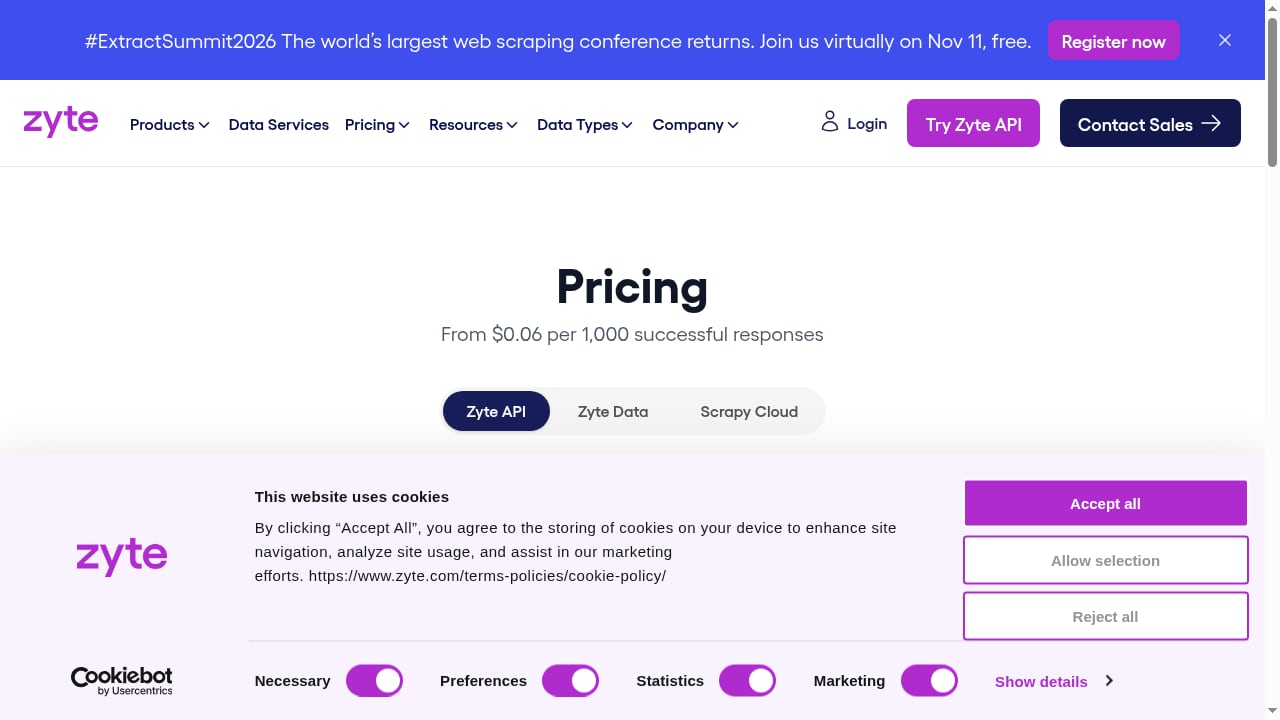
First viewport screenshot of www.zyte.com.
If you already have Playwright or Puppeteer code
AdsCrawl is the most direct fit. You keep your existing scripts and point them at managed Chromium browsers over CDP. Steel also supports browser automation, but its center of gravity is agent fleets and its SDKs lean toward Rust and Go. Zyte is a different model entirely: you are buying extraction and delivery, not a browser to script.
If you are building AI agents at high concurrency
Steel is purpose-built for this. Sub-second startup, session recording, agent traces, and enterprise tiers with 1,000+ concurrent sessions are designed around agent workloads. AdsCrawl supports stateful CDP sessions and live browser control, which works well for agent workflows that need a real browser, but Steel's explicit agent tooling and concurrency tiers are a stronger match for very large fleets.
If you want data, not infrastructure
Zyte is the clear choice. If your team does not want to write or maintain scrapers, managed extraction and delivery removes that burden. AdsCrawl and Steel both assume you will write the automation logic yourself.
If you need authenticated sessions and saved profiles
AdsCrawl's saved cloud browser profiles with lifecycle management are designed for this. You can log in once, persist the profile, and reuse it across sessions. This is a practical advantage for workflows that depend on staying logged in.
If you need proxy routing built in
AdsCrawl includes free rotating residential proxies and support for custom proxies. Steel offers dedicated IPs on its Scale and Enterprise plans. Zyte's managed model handles access as part of its service. The right choice depends on whether you want to configure proxies yourself or have them managed for you.
If budget predictability matters
AdsCrawl's credit-based subscription starts free and scales to $199 per month for 500,000 credits. Steel's Scale plan is $250 per month for 100 concurrent sessions. Zyte's pricing depends on the scope of managed delivery. Compare these against your expected session volume rather than headline price alone.
Practical examples
Scenario 1: A SaaS team scraping its own authenticated dashboard. AdsCrawl fits well. Save a browser profile after login, then run scheduled CDP sessions to extract HTML or JSON.
Scenario 2: An AI research agent that needs a browser per task. Steel's sub-second startup and session tracing are designed for this pattern. Atlas is also relevant if the output needs to be a cited report.
Scenario 3: A retailer that needs competitor pricing data delivered weekly. Zyte's managed extraction and delivery removes the engineering burden. The team receives structured data instead of maintaining a scraper.
Scenario 4: A developer combining rendering with proxy aggregation. AdsCrawl's cloud browser rendering can be paired with a proxy layer. The walkthrough on using AdsCrawl with ScrapeOps shows a resilient pattern.
Where each option is weaker
No product wins everywhere, and it is worth being explicit:
- AdsCrawl assumes you will write and maintain automation code. Teams without engineering capacity will find Zyte's managed delivery easier.
- Steel is optimized for agent fleets. Teams with existing Playwright scripts may find AdsCrawl's CDP-first model a shorter path.
- Zyte is a managed service. Teams that need direct browser control, custom CDP commands, or live session debugging will want a browser API instead.
Related reading
- AdsCrawl vs Screenshotlayer: Browser API vs Screenshot Tool - Compare AdsCrawl and Screenshotlayer for web automation. AdsCrawl offers full browser control and data extraction; Screenshotlayer specializes in screenshots.
- Screenshotlayer Review: Features, Pricing, and Fit for Developers - An evidence-based Screenshotlayer review covering ideal users, use cases, strengths, limitations, pricing signals, setup, and decision criteria for developers.
Sources and further reading
- API Pricing Plans - APIs.io - Browse pricing plans and tiers across API providers in the APIs.io network.
- Simple Index - ... data · 101703311-outliers · 101703312-outlierremoval · 101703322-missing-val ... apis · abhakliste · abhanti · abhay · abhay-python-day2 · abhaykipavbhaji
- JSON-LD Vocabularies - APIs.io - Browse JSON-LD semantic vocabularies across the APIs.io network.
FAQ
Is AdsCrawl a scraping API or a browser API?
AdsCrawl is a managed cloud browser and browser automation API. You connect Playwright, Puppeteer, or any CDP client to real cloud Chromium browsers and extract HTML, Markdown, JSON, or screenshots. The scraping logic is yours to write.
Can I use Steel with Playwright?
Steel provides a browser API and cloud infrastructure for controlling real browsers, with SDKs for Rust and Go. Check its current documentation for the exact client support and connection details before committing.
Does Zyte provide a browser I can control?
Zyte's positioning is an AI-powered web scraping platform with managed data delivery. If you need to drive a browser directly over CDP, a browser API such as AdsCrawl is the more direct fit.
Which option is best for AI agents?
Steel is explicitly designed for AI agent fleets, with sub-second session startup, session recording, and agent traces. AdsCrawl supports stateful CDP sessions and live browser control for agent workflows that need a real browser.
How does pricing compare?
AdsCrawl starts free with 500 one-time credits and offers a Pro plan at $199 per month for 500,000 credits. Steel offers a free Launch tier with $30 in credits and a Scale plan at $250 per month. Zyte's pricing depends on managed delivery scope. Model your expected session volume before comparing.
Can I switch between these tools later?
If your automation is written against CDP or Playwright, moving between browser APIs is relatively straightforward. Moving from a managed data delivery service to a browser API means building the extraction logic yourself, so plan for that effort.
Conclusion
AdsCrawl, Steel, and Zyte are not direct substitutes so much as different layers of the same stack. AdsCrawl gives developers a real cloud browser they control over CDP, with saved profiles, proxy routing, and multiple output formats. Steel gives AI agent teams high-concurrency browser infrastructure with strong debugging and tracing. Zyte gives organizations managed extraction and delivered data without the engineering burden.
Choose based on what you want to own. If you want browser control, AdsCrawl is the most direct fit for existing Playwright and Puppeteer code. If you want agent-scale fleets, Steel is built for that. If you want data delivered, Zyte is the managed option. For a broader view of how browser automation tools compare, see the roundup of browser automation SDKs for AI agents.