
Price2Spy Review 2026: Features, Pricing & Tradeoffs
Evidence-based Price2Spy review covering features, module pricing, setup, strengths, limitations, and who it fits in 2026.
Price2Spy Review 2026: Features, Pricing, and Honest Tradeoffs
Price2Spy has been a fixture in competitor price monitoring since 2010, with more than 750 clients and a 4.8/5 rating across 104 G2 reviews. But a long track record does not automatically mean the platform fits your workflow. This review examines what Price2Spy actually does, how its module-based pricing works, where reviewers consistently hit friction, and which teams should shortlist it.
What Price2Spy Does
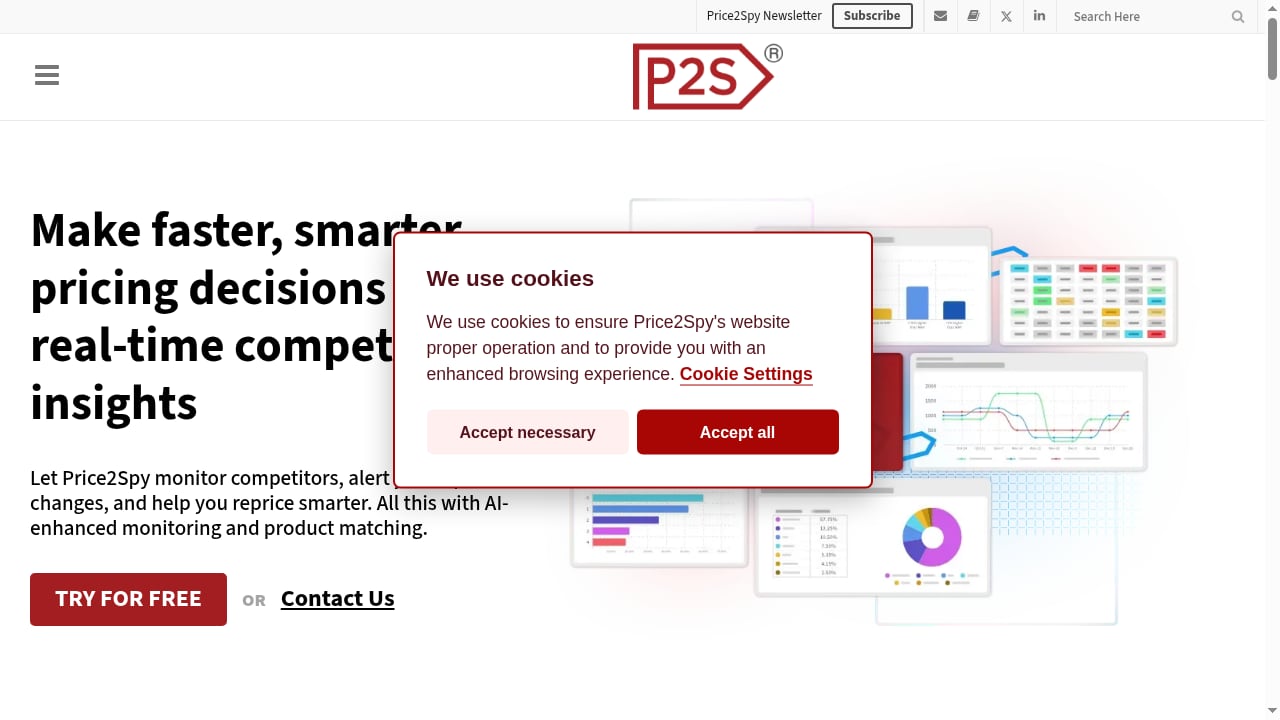
First viewport screenshot of Price2Spy® – Competitor price monitoring.
At its core, Price2Spy monitors competitor prices and stock availability. You match your products to competitor URLs, the system collects data on a schedule, and the dashboard turns that data into alerts, reports, and historical charts. Plans are sized by product URLs, not competitors, so your catalog size multiplied by the number of monitored sites drives your tier.
Beyond monitoring, Price2Spy offers:
- Automated repricing — indirect repricing suggests changes for approval; direct repricing pushes updates automatically based on your rules.
- AI-enhanced product matching and Automatch — pairs your products with competitor listings using identifiers like EAN/UPC codes.
- Screenshot capture — stores visual evidence of price changes, useful for MAP monitoring.
- Pricing dashboard — customizable widgets, reports, and granular alerts.
- Integrations — Shopify, WooCommerce, BigCommerce, Shopware, Google Shopping, GA4, and an API with a reference guide.
Services include manual product matching, site crawl, custom development, product variation tracking, and custom details tracking.
Who Price2Spy Is Built For
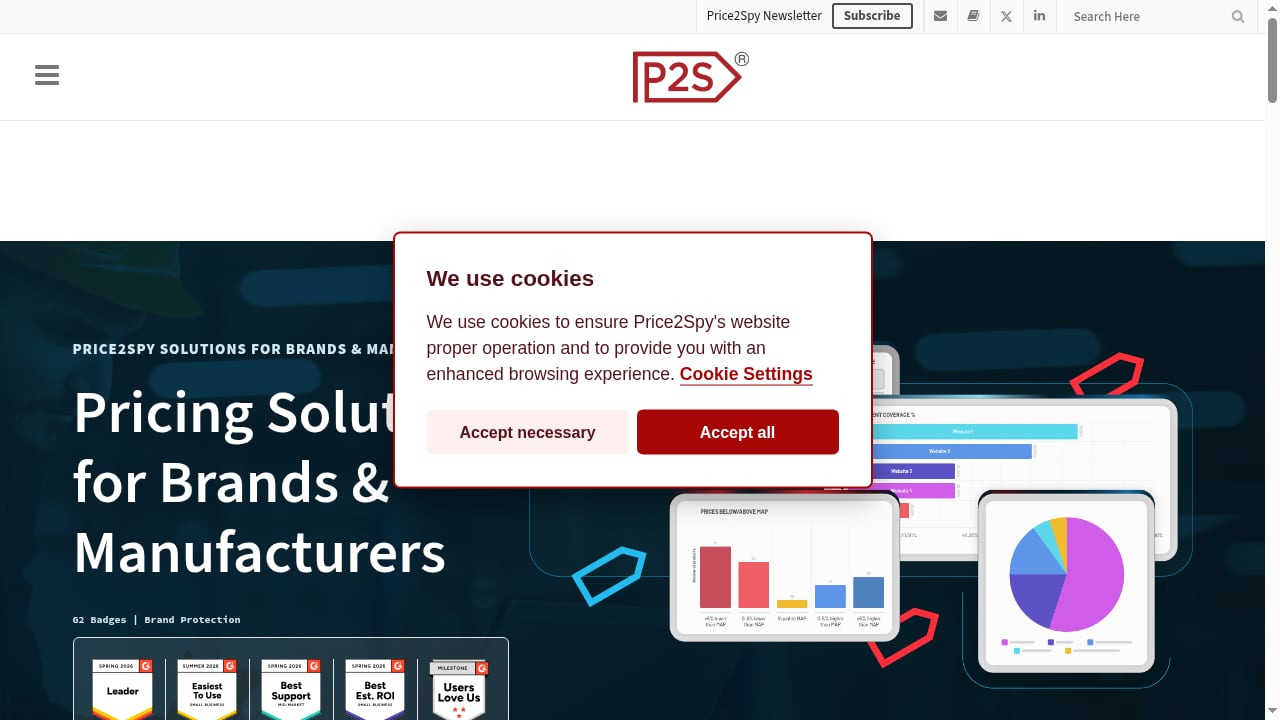
First viewport screenshot of Brands / Manufacturers – Price2Spy®.
Price2Spy fits best with mid-size to large catalogs that have clean product identifiers and a dedicated pricing owner. On G2, 70.5% of reviewers identify as small businesses, but the platform's economics improve as URL counts grow. The module system rewards buyers who scope their needs precisely.
Ideal users:
- Brands and manufacturers monitoring MAP compliance across resellers.
- Online retailers and distributors tracking competitor prices at scale.
- Teams that value configurability, granular alerts, and a dedicated account manager.
- Businesses with strong EAN/UPC coverage that can leverage Automatch.
Less ideal for:
- Very small catalogs where module costs add up quickly.
- Identifier-poor catalogs (private label, fashion, bundles) where matching becomes manual or paid.
- Teams that prefer a single all-inclusive bill or a modern, lightweight interface.
The Module System: What You Actually Pay For
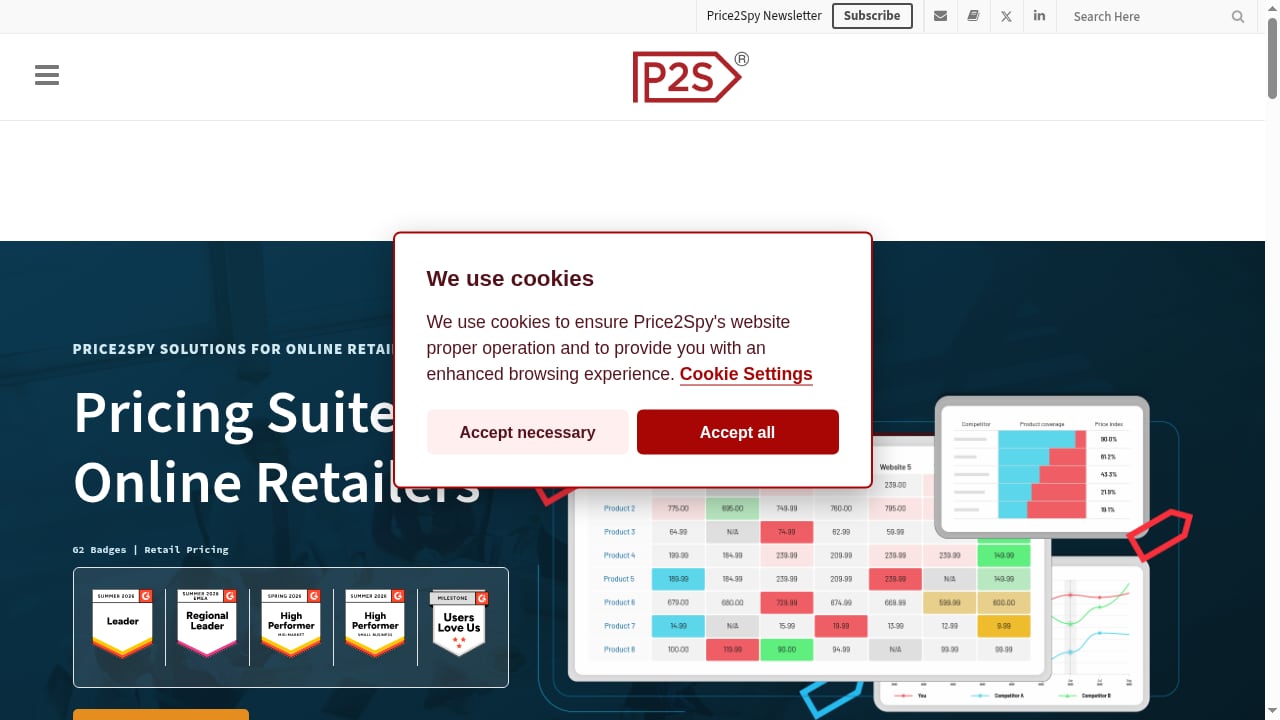
First viewport screenshot of Online retailers – Price2Spy®.
The subscription covers monitoring only. Matching, repricing, screenshots, stealth IP traffic, GA4 integration, additional users, and custom development are each billed separately. This à la carte approach means you only pay for what you use, but it also means the advertised plan price and your working monthly cost are different numbers.
Public pricing has shifted to tailored quotes. The clearest public anchors come from the Shopify App Store listing: $157.95/month for 2,000 URLs and $788.95/month for 10,000 URLs, with add-ons extra. Stealth IP monitoring is charged per MB of traffic, so hard-to-crawl sites cost more.
Before comparing vendors on headline price, list every module your workflow requires. That total is your real budget.
Setup and Ease of Use
G2 rates Price2Spy's ease of setup at 8.6, which trails some newer rivals. The interface is the most common criticism across review platforms: reviewers describe it as dated, slow on repetitive tasks, and unintuitive at first. Support, however, is consistently praised — G2 rates quality of support at 9.6/10, and "responsive team" appears repeatedly in written feedback.
If your team values a modern UI and fast onboarding, factor that into your evaluation. If you value deep configurability and responsive human support, Price2Spy's tradeoff may be acceptable.
Strengths and Limitations
Strengths:
- 15-year track record with 750+ clients across 40+ countries.
- Support rated 9.6/10 on G2 — the most consistently praised aspect.
- Deep module catalog covering edge cases like stealth IP monitoring and screenshot evidence.
- Strong economics at large URL counts.
- High overall satisfaction: 4.8/5 on G2, 4.7/5 on Capterra and GetApp.
Limitations:
- Core capabilities (matching, repricing, screenshots) are paid add-ons on every tier.
- Interface shows its age; repetitive tasks can feel slow.
- Setup complexity trails newer competitors.
- Automatch depends on clean EAN/UPC codes; identifier-poor catalogs go manual or paid.
- Public pricing has given way to tailored quotes, so budgeting requires a sales conversation.
Pricing Signals and Decision Criteria
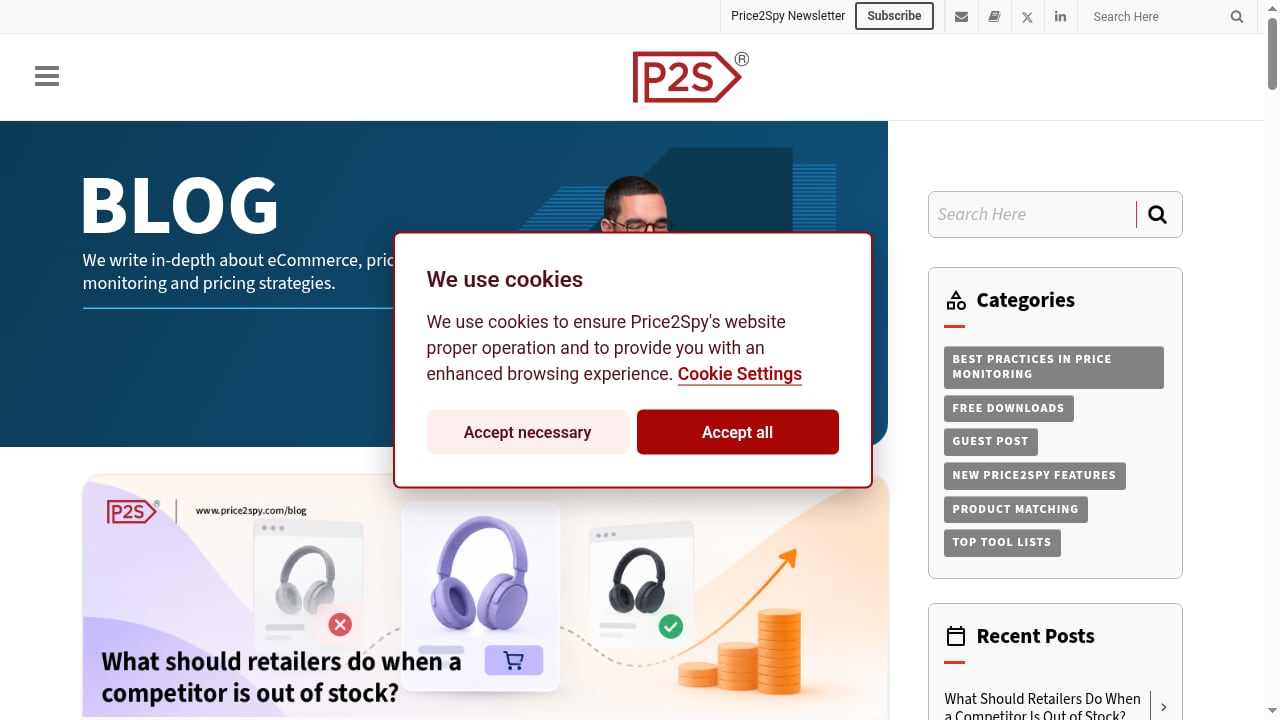
First viewport screenshot of Price2Spy® Blog.
Price2Spy does not publish a full public price grid. The Shopify listing provides the clearest anchors, but add-ons drive the real cost. When evaluating, ask:
- How many product URLs and competitors will you monitor?
- Which modules do you need — matching, repricing, screenshots, stealth IP?
- How clean are your product identifiers?
- How much does interface speed matter to your team?
- Do you prefer à la carte control or a single all-inclusive bill?
If you need broad web data infrastructure alongside price monitoring, compare options in our Top 10 Web Data Platform Products 2026. For teams automating browser-based collection, AdsCrawl vs Kernel vs Steel breaks down browser API tradeoffs.
Related reading
- Axiom.ai vs Browser APIs: Which Automation Fits? - Axiom.ai versus browser API platforms: compare visual bots, runtime-hour billing, and developer-grade Chrome control for scraping and AI agents.
- Top 10 Proxy & Web Scraping Platforms 2026: Ranked - We rank the top 10 proxy and web scraping platforms of 2026 by proxy network, anti-bot performance, pricing, and developer experience.
- How to Use AdsCrawl with Visualping: Setup & Workflow - Combine AdsCrawl browser automation with Visualping change alerts to monitor dynamic, login-gated pages. Setup steps, code, and a decision guide.
Sources and further reading
- Read Customer Service Reviews of price2spy.com - Trustpilot - We had been looking for a long time for a suitable platform, but Price2Spy convinced us with their competitive pricing and surprisingly good quality. Company ...
- Price2Spy Reviews 2026: Details, Pricing, & Features | G2 - Price2Spy has been an excellent pricing intelligence solution for our business. The accuracy of their pricing data is outstanding and gives us real confidence ...
- Price2Spy Review (2026): Pricing, Features, and Honest Tradeoffs - An honest Price2Spy review for 2026: what fifteen years in the market earns it, where reviewers hit friction, and what its module-based pricing really costs.
FAQ
Is Price2Spy good for small businesses?
It can be, but the module system means costs add up quickly for small catalogs. Small businesses with clean identifiers and limited monitoring needs may find simpler tools more economical.
Does Price2Spy offer automated repricing?
Yes. Indirect repricing suggests changes for approval, while direct repricing pushes updates automatically based on your rules. Both are paid add-ons.
How does Price2Spy handle hard-to-crawl sites?
It offers stealth IP monitoring charged per MB of traffic, which helps with sites that block ordinary crawlers but adds cost.
What do reviewers praise most about Price2Spy?
Support. G2 rates quality of support at 9.6/10, and responsiveness is the most consistent theme in written reviews.
What is the biggest criticism of Price2Spy?
The interface. Reviewers across G2, Capterra, and GetApp describe it as dated and slow on repetitive tasks.
Conclusion
Price2Spy is a mature, configurable price monitoring platform with a strong support reputation and deep module catalog. It fits mid-size to large catalogs with clean identifiers and teams that want à la carte control. The tradeoffs — add-on costs, dated interface, quote-led pricing — are structural, not incidental. Before committing, scope your module list precisely and compare the total against alternatives. For a broader view of data collection options, see our ParseHub review and Bright Data vs alternatives comparison.