
Top 10 Proxy & Web Scraping Platforms 2026: Ranked
We rank the top 10 proxy and web scraping platforms of 2026 by proxy network, anti-bot performance, pricing, and developer experience.
Top 10 Proxy and Web Scraping Platforms in 2026: Ranked and Reviewed
Most "best of" lists in this category are written from a vendor's pricing page, not from a working test. This one is built differently: we ranked ten platforms that genuinely combine proxy infrastructure with scraping capability, scored them against five transparent criteria, and flagged where each one wins or falls short. If you only need browser automation and page-state capture rather than a full proxy-plus-scraping stack, tools like AdsCrawl sit adjacent to this category and are worth a separate look — but they are not ranked here.
How We Evaluated These Platforms
Oxylabs Proxy & Web Scraping Platform product interface.
We scored each product against five weighted criteria:
- Proxy network depth — IP pool size, geography coverage, and proxy types (residential, datacenter, ISP, mobile).
- Anti-bot and rendering performance — whether the platform handles JavaScript rendering, CAPTCHAs, and fingerprinting without extra engineering.
- Pricing transparency — published per-GB, per-request, or per-record rates versus "contact sales."
- Developer experience — API quality, SDKs, documentation, and whether sample code actually runs.
- Scale and concurrency — behavior when you move from hundreds to millions of requests.
We cross-checked vendor claims against independent comparisons, including a hands-on 2026 comparison of scraping tools and a breakdown of AI web scrapers with free tiers. Where a claim could not be verified, we say so.
The Top 10 Proxy and Web Scraping Platforms for 2026
Oxylabs Proxy & Web Scraping Platform product interface.
1. Bright Data — Best for Scale and Pre-Built Coverage
Bright Data remains the default choice when scale is the binding constraint. It combines a residential network of 400M+ monthly IPs across 195 countries with 660+ pre-built scrapers for sites like LinkedIn, Amazon, Google Maps, and Zillow. You pay per successful record, so failed requests cost nothing — a meaningful differentiator when success rates vary by target. Unlimited concurrency is included on every plan, including entry tiers. The trade-off is a steeper learning curve and pricing that rewards volume commitments. If you are comparing it against newer API-first tools, our Bright Data versus alternatives breakdown covers the trade-offs in detail.
2. Oxylabs — Best Proxy Variety for Enterprise Scraping
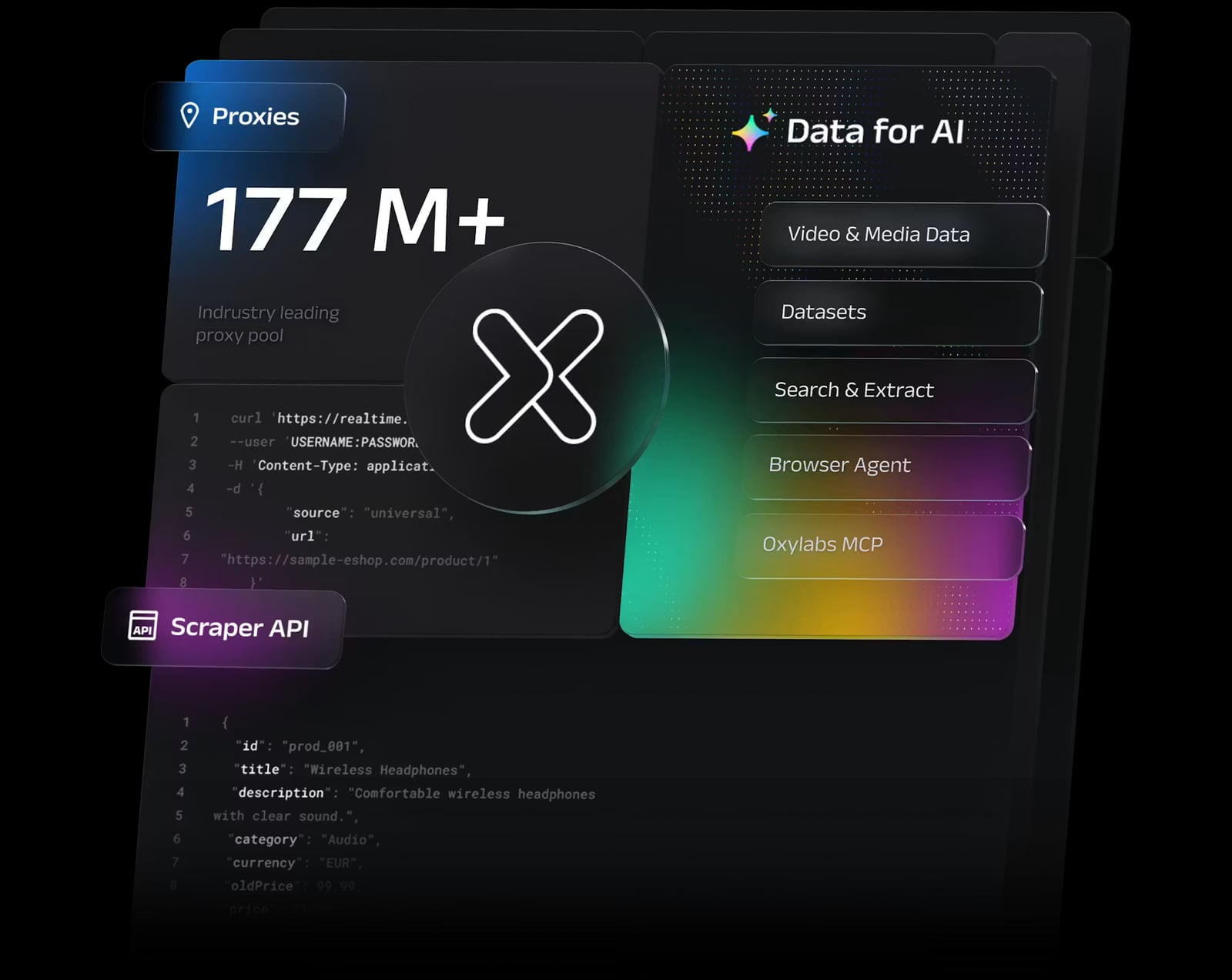
Oxylabs pairs a 175M+ residential IP pool and 20M+ mobile IPs with dedicated datacenter and ISP proxies, plus AI-powered scraping tools including Web Unblocker, Web Scraper API, Fast Search API, and Headless Browser. City-level targeting, a 99.9% uptime guarantee, and transparent entry pricing ($1.20/IP for datacenter, $4/GB for residential) make it a strong fit for e-commerce price monitoring, SERP tracking, ad verification, and brand protection. It is less of a "one-click dataset" product than Bright Data and more of a toolkit you assemble.
3. Apify — Best for Custom Actors and Marketplace Coverage
Apify's unit of work is the "Actor" — a serverless container running your scraping code on their infrastructure. The community marketplace is a genuine network effect: for niche targets, someone has often already built and maintained the scraper. The compute-unit pricing model is fairer than per-request billing for bursty or variable-cost jobs. Starter plans begin around $29/month, with a residential proxy add-on at roughly $8/GB. It loses to Bright Data on raw proxy scale but wins on runtime control.
4. ScraperAPI — Best Drop-In Proxy and Render Layer
ScraperAPI is the "bring your own scraper, we handle proxies and rendering" option. Plans start around $49/month with 100K credits and 20 concurrent requests, scaling to 5M credits and 200 concurrent at higher tiers. It is the right pick if you already have scraping code and only want to outsource rotation, retries, and JavaScript rendering. It is less compelling if you would rather not write the scraper at all.
5. ScrapingBee — Best Onboarding Experience
ScrapingBee offers one endpoint, sensible defaults, and working code samples — the smoothest start in the category. Dedicated APIs cover Amazon, Google, YouTube, Walmart, and other high-demand targets. Credit math gets confusing once you mix JavaScript rendering (5 credits) with premium proxies (10–25 credits), and a hung page can quietly burn budget. Plans start around $49/month with 250K credits.
6. Zyte — Best for Scrapy Shops
Zyte is the company behind Scrapy, the most widely used open-source Python scraping framework, and its commercial product is essentially Scrapy plus managed infrastructure and AI extraction. Pricing is tiered by monthly commitment, dropping from roughly $0.13–$1.27 per 1K HTTP responses at pay-as-you-go down to $0.06–$0.61 per 1K at the $500/month commit level. If your team already lives in Scrapy, Zyte is the least disruptive upgrade path.
7. Firecrawl — Best for LLM-Ready Extraction
Firecrawl is a developer-first API that turns pages into Markdown or structured JSON for LLM pipelines, with endpoints for crawling, change monitoring, and deep research. It supports JSON schema or natural-language prompts, ships an official MCP server, and bills only successful requests (403/404 still cost one credit). A free tier covers 1,000 credits per month; paid plans start around $16/month for 5,000 pages. It is a strong complement to a proxy platform rather than a full replacement for one.
8. Scrapfly — Best Single-Key Anti-Bot Stack
Scrapfly bundles proxy rotation, JavaScript rendering, anti-bot bypass, and CAPTCHA solving behind one API key and one shared credit pool. Its Extraction API accepts 19+ pre-trained AI models, an LLM prompt, or a prompt-plus-schema, returning structured data in a single call. Result caching per URL and schema reduces repeat spend. It is slightly complex for beginners and pay-as-you-go is unavailable on the base tier, but for teams fighting aggressive anti-bot defenses it is one of the most complete single-vendor options.
9. Decodo (formerly Smartproxy) — Best Value Residential Proxies
Decodo has built a reputation as the best-value residential proxy provider, with plans starting around $3.75/GB on a 3GB plan and a 100MB, 3-day trial. It is a sensible pick when residential IPs are the core requirement and you have your own scraping logic. It does not match Bright Data or Oxylabs on pre-built scraper coverage, so factor that into total cost if you need managed extraction.
10. Octoparse — Best No-Code Option
Octoparse turns web pages into structured data through a point-and-click desktop app for Windows and Mac, with cloud extraction, 600+ preset templates, and built-in proxy rotation on paid plans. It supports AJAX loading, pagination, automated logins, and CAPTCHAs, and exports to Excel, CSV, JSON, and databases. The free plan offers 10 local tasks but lacks proxies and CAPTCHA solving. Paid plans start around $69/month. For a deeper look at a comparable visual scraper, see our ParseHub review.
How to Choose Between These Platforms
Oxylabs Proxy & Web Scraping Platform product interface.
| If your priority is... | Start with... |
|---|---|
| Maximum scale and pre-built datasets | Bright Data |
| Proxy variety and enterprise SLAs | Oxylabs |
| Custom scraping code on managed infra | Apify |
| Adding proxies to existing scrapers | ScraperAPI |
| Fastest onboarding | ScrapingBee |
| Scrapy-native workflows | Zyte |
| LLM and RAG pipelines | Firecrawl |
| Aggressive anti-bot targets | Scrapfly |
| Cheap residential IPs | Decodo |
| No-code visual scraping | Octoparse |
One pattern worth noting: most teams end up combining a proxy-first platform with a browser automation layer for pages that require real rendering, login state, or interaction. If that second layer is what you need, AdsCrawl vs Scrapfly vs ApiFlash is a useful comparison of API-first browser tools that complement the platforms above.
Related reading
- How to Use AdsCrawl with Visualping: Setup & Workflow - Combine AdsCrawl browser automation with Visualping change alerts to monitor dynamic, login-gated pages. Setup steps, code, and a decision guide.
- AdsCrawl vs Thunderbit: Browser API vs No-Code Scraper - Compare AdsCrawl and Thunderbit: real browser sessions and CDP control versus no-code AI scraping. See pricing, limits, and which fits your workflow.
Sources and further reading
- Top 10 Proxy Services for Scraping in 2026: Price & Functional ... - Mar 23, 2026 ... Top 10 Proxy Services for Scraping in 2026: Price & Functional Comparison · 1. OnlineProxy.io: The Unlimited Disruptor · 2. Bright Data: The ...
FAQ
What is the difference between a proxy service and a web scraping platform?
A proxy service supplies IP addresses for requests; a web scraping platform adds rendering, anti-bot handling, parsing, and often pre-built scrapers or datasets. Many vendors in this list offer both, but the depth of each varies significantly.
Do I need residential proxies for scraping in 2026?
For sites with aggressive anti-bot defenses, yes — residential and mobile IPs are far less likely to be blocked than datacenter ranges. For low-friction targets, datacenter proxies are cheaper and faster.
Which platform is best for beginners?
ScrapingBee and Octoparse have the gentlest onboarding. ScrapingBee is API-first; Octoparse is point-and-click.
Can I use these platforms for AI training data collection?
Yes. Firecrawl, Bright Data, and Oxylabs all support structured output suitable for machine learning pipelines, including JSON and Markdown formats.
How much should I expect to pay?
Entry plans in this category range from about $16/month (Firecrawl) to $69/month (Octoparse), with proxy-heavy workloads typically billed per GB or per successful record.
Conclusion
There is no single winner in the 2026 proxy and web scraping market — only the right fit for your target sites, scale, and team. Bright Data leads on scale, Oxylabs on proxy variety, Apify on custom runtime control, and Firecrawl on LLM-ready extraction. Start with the two or three platforms that match your primary constraint, run a small paid test against your hardest target, and let real success rates decide. For a broader view of adjacent data infrastructure, see our Top 10 web data platform products.