
AdsCrawl vs Browserbase vs Browserless: 2026 Comparison
Compare AdsCrawl, Browserbase, and Browserless for cloud browser automation: CDP control, stealth, proxies, pricing, and which fits your scraping stack.
AdsCrawl vs Browserbase vs Browserless: Which Cloud Browser Fits Your Stack?
Choosing browser infrastructure is less about feature checklists and more about how much control you want over the browser itself. AdsCrawl, Browserbase, and Browserless all run real Chromium in the cloud, but they optimize for different jobs: raw developer control, AI-agent workflows, and anti-bot resilience respectively.
This comparison breaks down where each platform is genuinely strong, where trade-offs appear, and how to pick based on your team's actual workload.
Quick verdict
| If your priority is… | Consider |
|---|---|
| Direct Playwright/Puppeteer/CDP control with managed browser identity and transparent tiered pricing | AdsCrawl |
| AI agents that browse, search, and extract with an open-source framework | Browserbase |
| Hard anti-bot targets with integrated CAPTCHA solving and BQL scripting | Browserless |
What each platform actually is
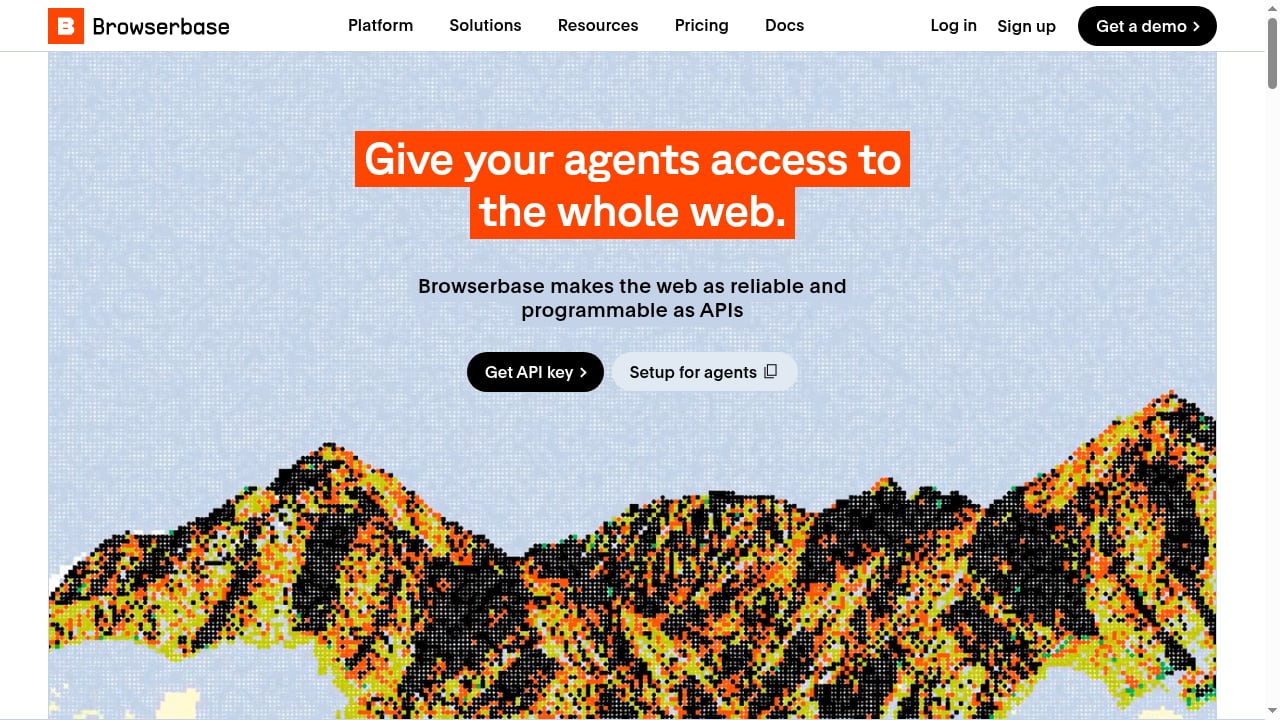
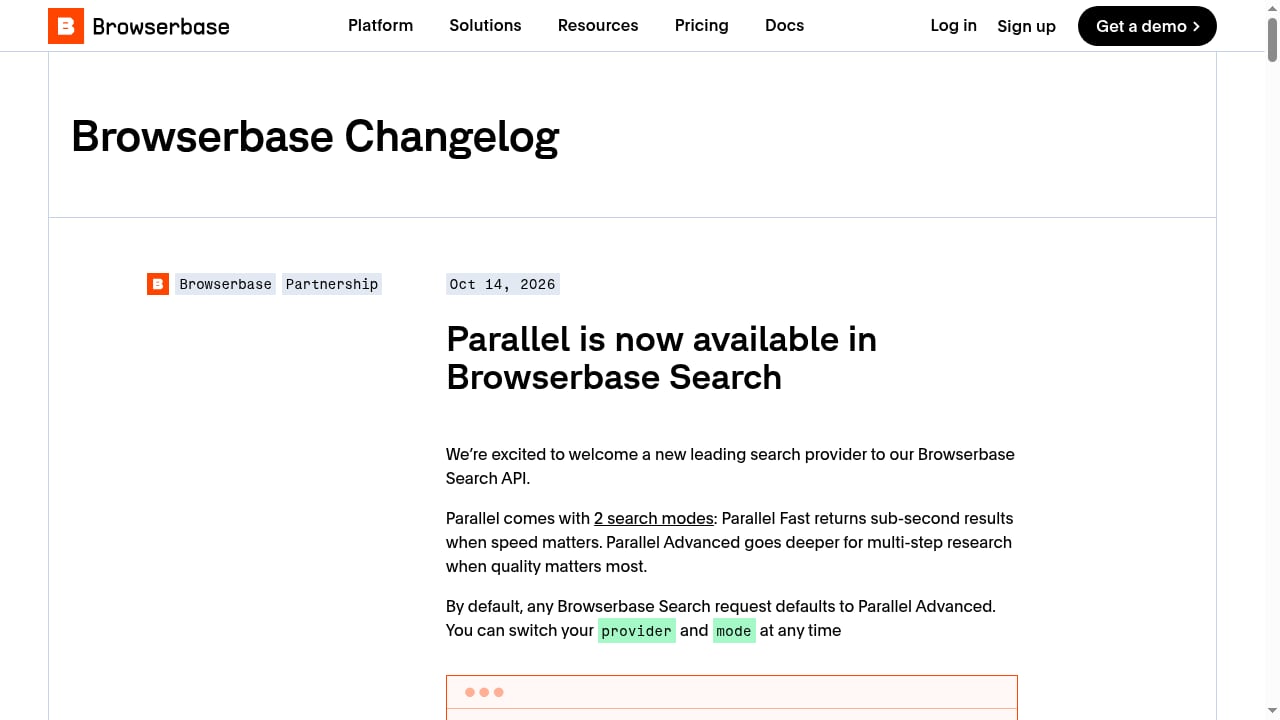
First viewport screenshot of Browserbase.
AdsCrawl: managed cloud browser with a developer-first API
AdsCrawl is a managed cloud browser and browser automation API. You connect Playwright, Puppeteer, or any CDP client to real cloud Chromium browsers, then retrieve HTML, Markdown, JSON, or screenshots from JavaScript-heavy pages.
Its core building blocks include:
- Synchronous rendered-content endpoints —
POST /htmlandPOST /screenshotfor straightforward rendering tasks. - SPA extraction templates plus structured DOM and network field extraction.
- Stateful cloud browser profiles that persist settings after a session stops.
- Dedicated remote CDP sessions with short-lived live-control tokens.
- Per-user running quotas so concurrent usage stays predictable.
- Proxy routing via residential proxies or your own custom proxies, with dynamic region routing and random User-Agents.
Pricing is tiered and published: a Free plan with 500 one-time credits, Hobby at $9/month, Starter at $49/month, and Pro at $199/month, with monthly credits, browser concurrency, Cloud Browser profiles, and API key limits scaling by tier. The platform is powered by AdsPower and ships documentation in English and Chinese.
Browserbase: browser infrastructure built for AI agents
Browserbase gives AI agents access to the web by making it as programmable as an API. Its suite includes a Search API for finding relevant sites, a Fetch API that converts any URL into HTML, JSON, or markdown, and Browser-as-a-Service for navigating interactive pages and completing multi-step actions.
The platform handles authentication, flows, and dynamic content, and adds stealth capabilities to reduce bot detection. Stagehand, its open-source AI browsing framework built on Playwright, exposes simple act, extract, and observe APIs for natural-language automation. Browserbase Functions lets teams deploy agents directly on the platform, and the product includes ad blocking, CAPTCHA solving, and compliance with HIPAA and SOC 2 Type 1. It reports usage by more than 10,000 companies.
Browserless: cloud browsers that survive anti-bot pressure
Browserless positions itself as "The Browser Your AI Agents Run On" — a cloud browser that won't crash or get blocked. Developers connect over MCP, Puppeteer, Playwright, or BrowserQL (BQL) to run automations, scrape data, and let AI agents drive real browsers end to end.
Its differentiators cluster around resilience: CAPTCHA solving for reCAPTCHA, Cloudflare Turnstile, DataDome, Lemin, MTCaptcha, sliders, and more; residential and datacenter proxy rotation; and session management that keeps scripts alive through anti-bot challenges. It also offers an official MCP server for tools like Claude.ai, Cursor, Windsurf, and VS Code; REST endpoints such as /smart-scrape, /search, /map, and /crawl; Authenticated Profiles for login-once-reuse sessions; a CLI to sync local browser profiles to the cloud; Autologin with 1Password; and email OTP fetching. Notable proof points include integrated CAPTCHA solving in Browser Use, per-session WebGL fingerprints, and a Script Generator that turns plain-English descriptions into BQL or Playwright scripts.
Head-to-head comparison
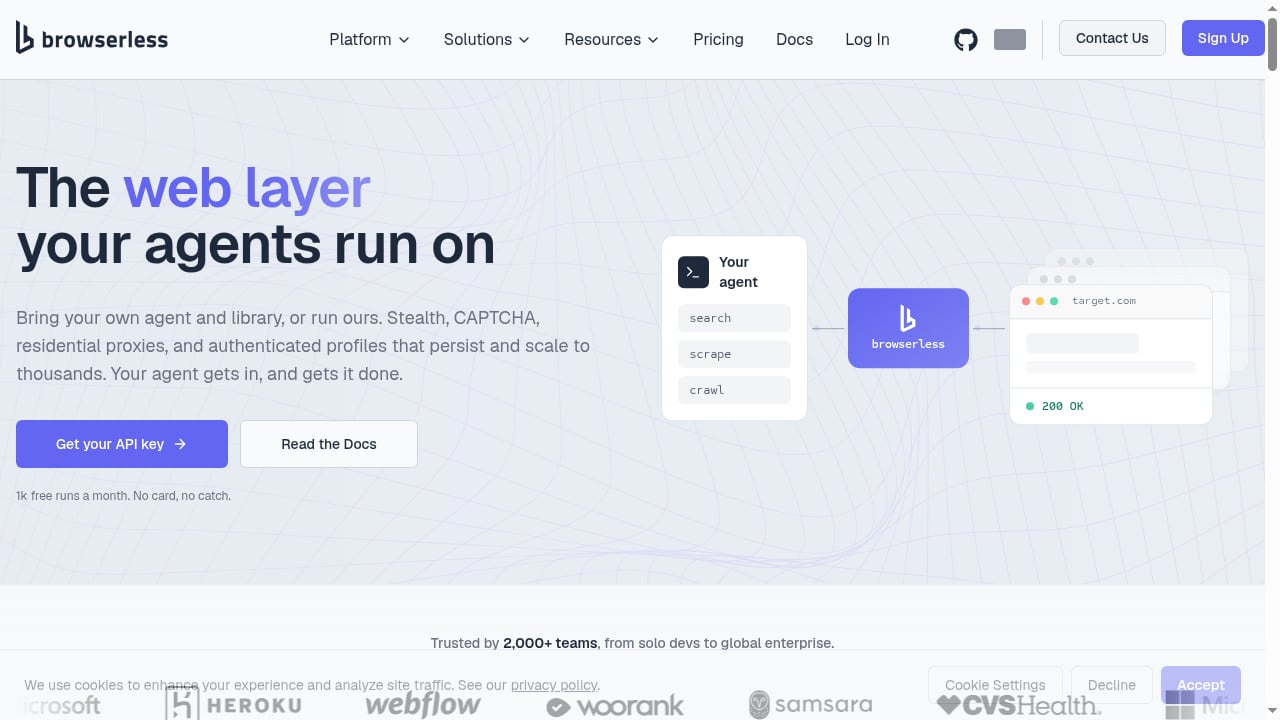
First viewport screenshot of The Browser Your AI Agents Run On | Browserless.
Browser control and session model
All three support Playwright and Puppeteer, so migration friction is low. The difference is in the session abstraction.
AdsCrawl exposes dedicated remote CDP sessions with short-lived live-control tokens, which suits teams that want to attach debugging tools or drive the browser directly rather than through a proprietary layer. Stateful cloud browser profiles persist settings after a session stops, which matters for workflows that depend on consistent browser identity across runs.
Browserbase abstracts more of the session lifecycle in service of agent workflows — useful when the agent, not the developer, decides what to do next. Browserless offers the widest protocol surface (MCP, Puppeteer, Playwright, BQL), which is valuable if different teams in your org prefer different tools.
Rendering and extraction
AdsCrawl's synchronous POST /html and POST /screenshot endpoints return rendered output without requiring you to manage a session, and SPA templates plus structured DOM/network field extraction cover the common "JavaScript-heavy page" problem. Output formats include HTML, Markdown, JSON, and screenshots.
Browserbase's Fetch API is optimized for the same job — URL in, HTML/JSON/markdown out — and its Search API adds a discovery step before fetching. Browserless counters with /smart-scrape, /search, /map, and /crawl, which lean toward large-scale extraction rather than single-page rendering.
If your workload is mostly "render this page and give me structured data," AdsCrawl and Browserbase are close. If it's "crawl a domain and map it," Browserless has the more purpose-built endpoints.
Proxies and identity
AdsCrawl supports residential proxy routing or custom proxies, combined with managed browser identity, random User-Agents, and dynamic region routing. This is a practical setup for teams that need geo-consistent requests without building proxy infrastructure.
Browserbase emphasizes stealth to avoid bot detection, and Browserless emphasizes proxy rotation across residential and datacenter pools plus per-session WebGL fingerprints. On raw anti-bot evasion, Browserless and Browserbase both invest heavily; AdsCrawl's advantage is the combination of proxy routing with persistent browser profiles and explicit region control in one managed layer.
Pricing transparency
AdsCrawl publishes a clear ladder: Free (500 one-time credits), Hobby ($9/month), Starter ($49/month), Pro ($199/month). Credits, concurrency, profiles, and API key limits scale by tier, so a solo developer can start cheaply and a high-volume team can forecast spend.
Browserbase and Browserless both operate credit- or usage-based models tied to plan tiers, and their pricing pages are the authoritative source as plans change. When comparing, normalize on rendered pages per dollar and concurrent browsers per dollar, not headline plan price — CAPTCHA solving and proxy bandwidth often dominate real cost.
AI-agent readiness
Browserbase is the most explicitly agent-oriented: Stagehand's act, extract, and observe APIs, Browserbase Functions, and a Search API designed for agents that need to find pages before reading them.
Browserless is close behind with an official MCP server for Claude.ai, Cursor, Windsurf, and VS Code, plus a Script Generator that converts plain English into runnable BQL or Playwright.
AdsCrawl is agent-capable in the sense that any CDP client works, but its positioning is developer tooling rather than agent frameworks. If your roadmap is "autonomous agent that browses," Browserbase and Browserless have more off-the-shelf scaffolding. If your roadmap is "production scraper with full browser control," AdsCrawl's model is a better fit.
Compliance and enterprise signals
Browserbase cites HIPAA and SOC 2 Type 1 compliance, which matters for regulated industries. AdsCrawl and Browserless publish less on this front, so teams with formal compliance requirements should verify current certifications directly before committing.
Which should you choose?
First viewport screenshot of Changelog - Browserless.
Choose AdsCrawl if you want a managed cloud browser with direct CDP access, persistent browser profiles, proxy routing with region control, and predictable tiered pricing you can start at $9/month. It fits production scraping, QA, monitoring, and remote CDP workflows where the developer stays in control.
Choose Browserbase if your primary consumer is an AI agent. The Search + Fetch + Browser-as-a-Service trio, Stagehand, and Functions reduce the amount of glue code you write, and the compliance posture helps in regulated environments.
Choose Browserless if you're fighting aggressive anti-bot systems. Integrated CAPTCHA solving across major providers, proxy rotation, WebGL fingerprints, and BQL give you the deepest toolkit for hostile targets.
Many teams end up running two: one platform for agent experiments and another for high-volume production scraping. That's a reasonable architecture — just keep the extraction contract (output schema, retry policy, proxy rules) consistent across both.
Practical migration notes
First viewport screenshot of Changelog.
- Keep your Playwright/Puppeteer code portable. All three accept standard clients, so avoid platform-specific helpers in your core scraping logic.
- Test with one hard target first. Pick the page that breaks your current setup and run it on each platform before committing.
- Measure cost per successful extraction, not cost per request. A cheaper plan that fails on 30% of pages is more expensive.
- Check profile persistence semantics. AdsCrawl persists settings after a session stops; confirm how the other platforms handle login state if your workflow depends on it.
For a broader view of how managed browser APIs compare against data-delivery platforms, see AdsCrawl vs Zyte: Cloud Browser API or Managed Data Delivery? and AdsCrawl vs Scrape.do vs Zyte: Best Web Scraping API in 2026. If you're evaluating anti-detect tooling specifically, Top 10 Cloud-Based Anti-Detect Browser Automation Products 2026 covers fingerprint quality and scaling trade-offs.
Related reading
- ParseHub Review 2026: Free Web Scraper, Real Limits - Honest ParseHub review for 2026: point-and-click scraping, free tier limits, pricing, AJAX handling, setup traps, and when to switch to a cloud API.
- How to Use AdsCrawl with UptimeRobot for Free Monitoring - Combine AdsCrawl's cloud browser API with UptimeRobot's free uptime monitoring to catch JavaScript-rendered downtime and content failures.
FAQ
Is AdsCrawl a Browserbase alternative?
Yes. Both provide cloud Chromium browsers with Playwright and Puppeteer support. AdsCrawl emphasizes direct CDP sessions, persistent browser profiles, and transparent tiered pricing; Browserbase emphasizes AI-agent tooling like Stagehand and a Search API. They overlap on rendering and extraction but diverge on who the primary user is.
Is Browserless better than Browserbase for CAPTCHA-heavy sites?
Browserless advertises integrated CAPTCHA solving for reCAPTCHA, Cloudflare Turnstile, DataDome, Lemin, MTCaptcha, and sliders, plus per-session WebGL fingerprints. Browserbase also lists CAPTCHA solving and stealth. For the hardest targets, Browserless's BQL and proxy rotation give it an edge in published capabilities, but test your specific target before deciding.
Can I use Playwright with all three platforms?
Yes. AdsCrawl, Browserbase, and Browserless all support Playwright connections. AdsCrawl and Browserless also support Puppeteer, and AdsCrawl accepts any CDP client. Browserless additionally offers BrowserQL and an MCP server.
How does AdsCrawl pricing compare?
AdsCrawl publishes a Free plan with 500 one-time credits, Hobby at $9/month, Starter at $49/month, and Pro at $199/month. Credits, browser concurrency, Cloud Browser profiles, and API key limits scale by tier. Browserbase and Browserless use usage-based tiers that change over time, so compare current pricing pages on rendered pages per dollar.
Do I need a proxy with a cloud browser?
Not always, but residential or custom proxies help when targets apply rate limits or geo-restrictions. AdsCrawl supports residential proxy routing or custom proxies with dynamic region routing. Browserless offers residential and datacenter proxy rotation. Browserbase focuses on stealth and authentication handling.
Conclusion
There's no single winner across all workloads. AdsCrawl is the strongest fit when you want a managed cloud browser you drive directly — CDP sessions, persistent profiles, proxy and region control, and pricing that starts at $9/month. Browserbase wins when AI agents are the primary consumer and you want Stagehand plus a Search API. Browserless wins when anti-bot resilience and CAPTCHA solving are the bottleneck.
Start with the workload that hurts most today, benchmark one hard target on each platform, and let success rate per dollar make the decision.