
AdsCrawl vs Scrape.do vs Zyte: Best Web Scraping API in 2026
Compare AdsCrawl, Scrape.do, and Zyte for web scraping in 2026: rendering, anti-bot success, pricing, and the best fit for developers and teams.
AdsCrawl vs Scrape.do vs Zyte: Best Web Scraping API in 2026
Choosing a web scraping stack in 2026 is less about sending an HTTP request and more about surviving Cloudflare, DataDome, and Kasada while returning clean, structured data. Three names come up repeatedly in that conversation: AdsCrawl, Scrape.do, and Zyte. They overlap, but they solve different parts of the problem.
This comparison breaks down how each platform works, where it is strong, and which one fits your workload. AdsCrawl is covered only on criteria where it has a supported advantage, so you get an honest view rather than a marketing pitch.
How the three platforms differ at a glance
First viewport screenshot of Changelog | Documentation | Scrape.do.
| Platform | Core model | Best for |
|---|---|---|
| AdsCrawl | Managed cloud browser + browser automation API (Playwright, Puppeteer, CDP) | Teams that need a full browser environment, persistent profiles, and rendered output |
| Scrape.do | Single-endpoint scraping API with proxy rotation and rendering | Latency-sensitive, high-volume requests where speed and price per request matter |
| Zyte | AI-powered scraping platform with managed data delivery | Companies that want structured data delivered, not just raw pages |
AdsCrawl: a cloud browser you control
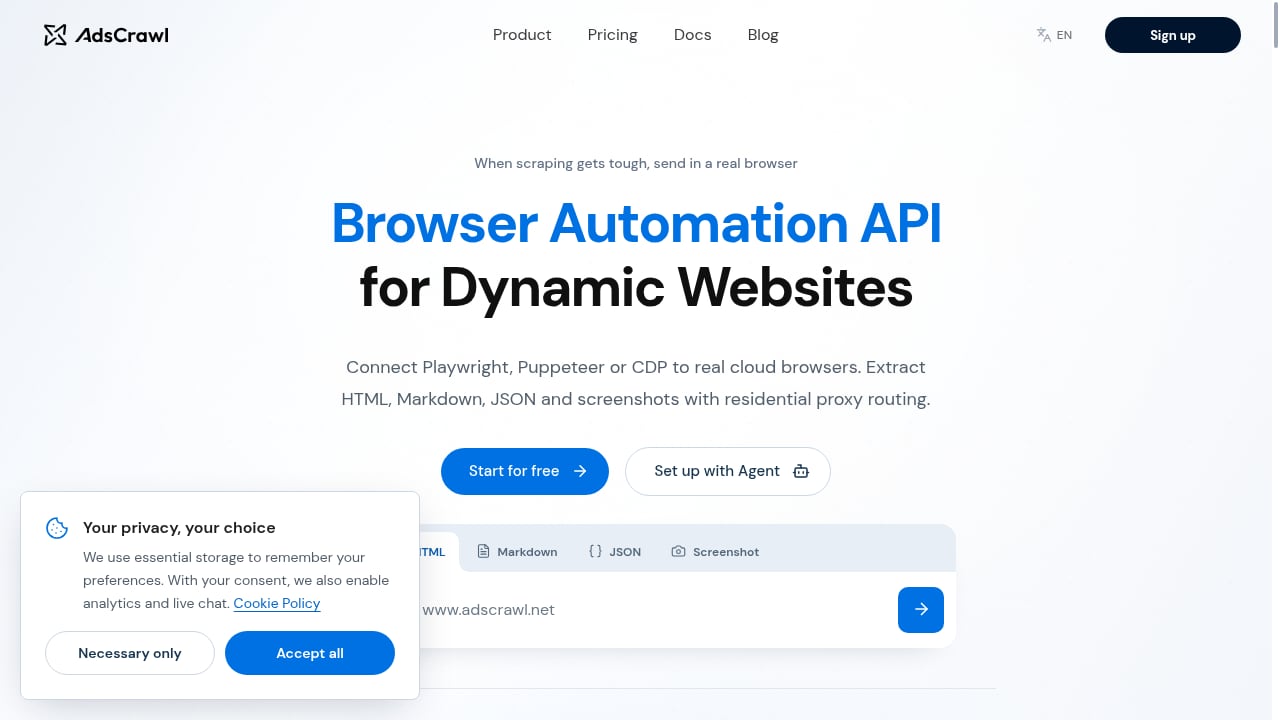
First viewport screenshot of Browser Automation API for Dynamic Websites | AdsCrawl.
AdsCrawl is a managed cloud browser and browser automation API. Instead of hiding the browser behind a single URL parameter, it gives you real cloud Chromium instances you connect to with Playwright, Puppeteer, or any CDP client.
Key capabilities:
- Rendered-content APIs such as
POST /htmlandPOST /screenshotreturn rendered HTML, Markdown, JSON, or screenshots from JavaScript-heavy pages. - Stateful cloud browser profiles persist settings after a session stops, which matters for logged-in workflows and multi-step navigation.
- Dedicated remote CDP sessions with short-lived live-control tokens let you debug and drive a browser in real time.
- Proxy routing supports residential proxies or your own custom proxies, plus random User-Agents and dynamic region routing.
- Per-user running quotas keep concurrency predictable across teams.
Pricing is tiered and transparent: a Free plan with 500 one-time credits, Hobby at $9/month for solo developers, Starter at $49/month for small production teams, and Pro at $199/month for high-volume automation teams. Credits, browser concurrency, cloud browser profiles, and API key limits scale with each tier. The platform is powered by AdsPower and documents both English and Chinese.
If you want to see how this compares to a one-time visual scraper, read AdsCrawl vs WebHarvy: Cloud Scraping API or One-Time Visual Tool?.
Scrape.do: speed and predictable per-request cost
First viewport screenshot of Scrape.do - Powerful Toolkit for Hassle-Free and Scalable Web Scraping.
Scrape.do is a single-endpoint scraping API. You send a URL, and the service handles proxy selection, JavaScript rendering, geo-routing, and anti-bot bypass, returning HTML, JSON, XML, or Markdown.
Its strengths are well documented:
- Latency focus. In Scrape.do's own 2026 benchmark, it averaged 5.5 seconds per request and returned a Zillow response in 2.6 seconds, the fastest in that test.
- High success rate. It hit 100% on five of seven test domains and averaged 98.61%, finishing second only to Bright Data's 98.87% in the same benchmark.
- Developer ergonomics. Advanced behavior is toggled with query parameters like
render=true,super=true,output=markdown, andgeoCode=US, so it drops into any HTTP client without a new SDK. - Markdown output is a first-class return type, which removes a parsing step in LLM and RAG pipelines.
Pricing starts with a freemium tier of 1,000 requests per month, then a Hobby plan at $29/month for 250,000 requests with all features included. Credit multipliers apply on the base plan: JS rendering costs 5 credits, premium proxies cost 10, and both combined cost 25.
Scrape.do is a strong pick when response time and predictable per-request cost are the variables that move your project. For a broader look at how API-first tools stack up, see Scrapfly Review 2026: API, Pricing, Pros & Real Limits.
Zyte: managed data delivery and AI-powered extraction
First viewport screenshot of Web Data Collection: APIs and Managed Data Delivery | Zyte.
Zyte positions itself as an all-in-one, AI-powered web scraping platform backed by a world-class data delivery team. The pitch is simple: "Your devs or ours?"
Where Scrape.do returns a page and AdsCrawl gives you a browser, Zyte focuses on the end of the pipeline: structured, validated data delivered to your systems. That makes it a fit for organizations that would rather buy an outcome than maintain extraction logic.
Zyte is frequently cited as the go-to choice for AI-powered structured extraction. In Bright Data's 2026 roundup of the best web scraping APIs, Zyte was listed as the recommendation for teams that need AI-powered structured extraction rather than raw HTML.
The trade-off is control. When you hand extraction and delivery to a managed team, you gain reliability and lose some of the fine-grained browser behavior that a CDP-level tool provides.
Where AdsCrawl has a supported advantage
Not every criterion favors AdsCrawl, and this comparison does not pretend otherwise. On raw request latency, Scrape.do publishes faster numbers. On managed delivery, Zyte is built around it. AdsCrawl's advantage shows up in specific, verifiable areas:
Full browser control, not just a rendered response
Scrape.do returns rendered output through a single endpoint. AdsCrawl gives you a real Chromium browser you drive with Playwright, Puppeteer, or any CDP client. That matters when you need to click, type, scroll, intercept network requests, or wait on complex client-side state that a one-shot render cannot capture.
Persistent browser profiles
AdsCrawl's stateful cloud browser profiles persist settings after a session stops. If your workflow depends on staying logged in or reusing a configured browser identity across runs, this is a structural advantage over stateless request APIs.
Transparent, low-entry pricing for browser automation
AdsCrawl's Hobby tier starts at $9/month, and the Free plan includes 500 one-time credits. For solo developers who want to experiment with a full cloud browser before committing, that is a low-friction entry point compared with enterprise-oriented managed data contracts.
Live debugging with remote CDP sessions
Short-lived live-control tokens let you attach to a running browser session and debug it in real time. That is a practical advantage when a scrape breaks and you need to see why, rather than guessing from a failed response.
For a deeper look at how browser task APIs and cloud automation fit together, see The Complete Guide to Browser Task APIs: From Background Idle Scheduling to Cloud Automation.
Decision guide: which one fits your workload?
Use this framework to pick:
- You need a full browser with persistent state and CDP access. Choose AdsCrawl. Playwright or Puppeteer workflows, logged-in sessions, and multi-step navigation are its core use cases.
- You need the fastest response times at predictable per-request cost. Choose Scrape.do. Its single-endpoint design and Markdown output make it efficient for latency-sensitive and LLM ingestion workloads.
- You need structured data delivered, not raw pages. Choose Zyte. Its AI-powered extraction and managed delivery team suit organizations that want to buy outcomes rather than maintain parsers.
Many teams combine approaches. A common pattern is using a browser automation API for complex, stateful targets and a request-based scraping API for high-volume, simpler pages. If you are feeding rendered competitor data into a monitoring platform, see How to Use AdsCrawl with Price2Spy® for Price Monitoring.
Related reading
- Top 10 Web Scraping Browser Extensions 2026 - Ranked review of the top 10 web scraping browser extensions in 2026, with evaluation criteria, pricing signals, and guidance on when to move to a cloud API.
Sources and further reading
- Best Web Scraping Services: Top 10 Companies in 2026 - Best web scraping services: Top 10 tools in 2026. Blog Floppydata.
- Top 10 Best Website Scraping Software of 2026 - Octoparse is the best fit overall for teams that want scheduled scraping without writing extraction code.
- The 9 Best Web Scraping APIs & Tools in 2026 - The 9 best web scraping APIs and tools in 2026, ranked on published benchmark data. Compare success rates, pricing, and anti-bot performance.
FAQ
Is AdsCrawl a replacement for Scrape.do?
Not exactly. Scrape.do is a request-based scraping API optimized for speed and per-request cost. AdsCrawl is a managed cloud browser you control through Playwright, Puppeteer, or CDP. If your targets need real browser interaction and persistent profiles, AdsCrawl fits better. If you need fast, simple rendered responses at volume, Scrape.do is a strong choice.
How does Zyte differ from both?
Zyte focuses on AI-powered structured extraction and managed data delivery. Instead of returning a page for you to parse, it aims to deliver validated data. That reduces engineering overhead but gives you less control over the browser layer.
Which platform has the best success rate on protected sites?
In Scrape.do's 2026 benchmark, Scrape.do averaged 98.61% across seven tough domains, second to Bright Data's 98.87%. AdsCrawl and Zyte were not part of that specific benchmark, so treat cross-platform success-rate claims with caution and test against your own target domains.
Can I use AdsCrawl with my existing Playwright scripts?
Yes. AdsCrawl supports Playwright, Puppeteer, and any CDP client, so you can point existing automation code at a cloud browser session instead of rewriting it.
What does AdsCrawl cost compared with the alternatives?
AdsCrawl starts with a Free plan of 500 one-time credits, then $9/month for Hobby, $49/month for Starter, and $199/month for Pro. Scrape.do starts with 1,000 free requests per month and a $29/month Hobby plan. Zyte's pricing is oriented toward managed delivery and enterprise agreements.
Conclusion
AdsCrawl, Scrape.do, and Zyte are not three versions of the same product. Scrape.do is a fast, single-endpoint scraping API with excellent latency and a competitive success rate. Zyte is a managed, AI-powered data delivery platform for teams that want structured outcomes. AdsCrawl is a managed cloud browser for developers who need real Chromium sessions, persistent profiles, and CDP-level control.
The right choice depends on where your bottleneck is: browser complexity, request speed, or data delivery. Test each against your own target domains, and pick the one that matches your workflow rather than the one with the longest feature list.