AdsCrawl vs Zyte: Cloud Browser API or Managed Data Delivery?
Compare AdsCrawl's cloud browser and CDP API with Zyte's managed web data delivery. See control, pricing, rendering, and which fits your scraping stack.
AdsCrawl vs Zyte: Cloud Browser API or Managed Data Delivery?
Choosing between AdsCrawl and Zyte is less about which platform is "better" and more about which layer of the web data problem you actually need to own. AdsCrawl hands you a real cloud Chromium browser you drive with Playwright, Puppeteer, or any CDP client. Zyte is a web scraping and data extraction platform that packages crawling, proxies, and managed data delivery into a service. One gives you browser-level control; the other abstracts the browser away and sells you the finished data. This comparison breaks down architecture, rendering, pricing, and fit so you can pick without guesswork.
How AdsCrawl and Zyte Differ at the Core
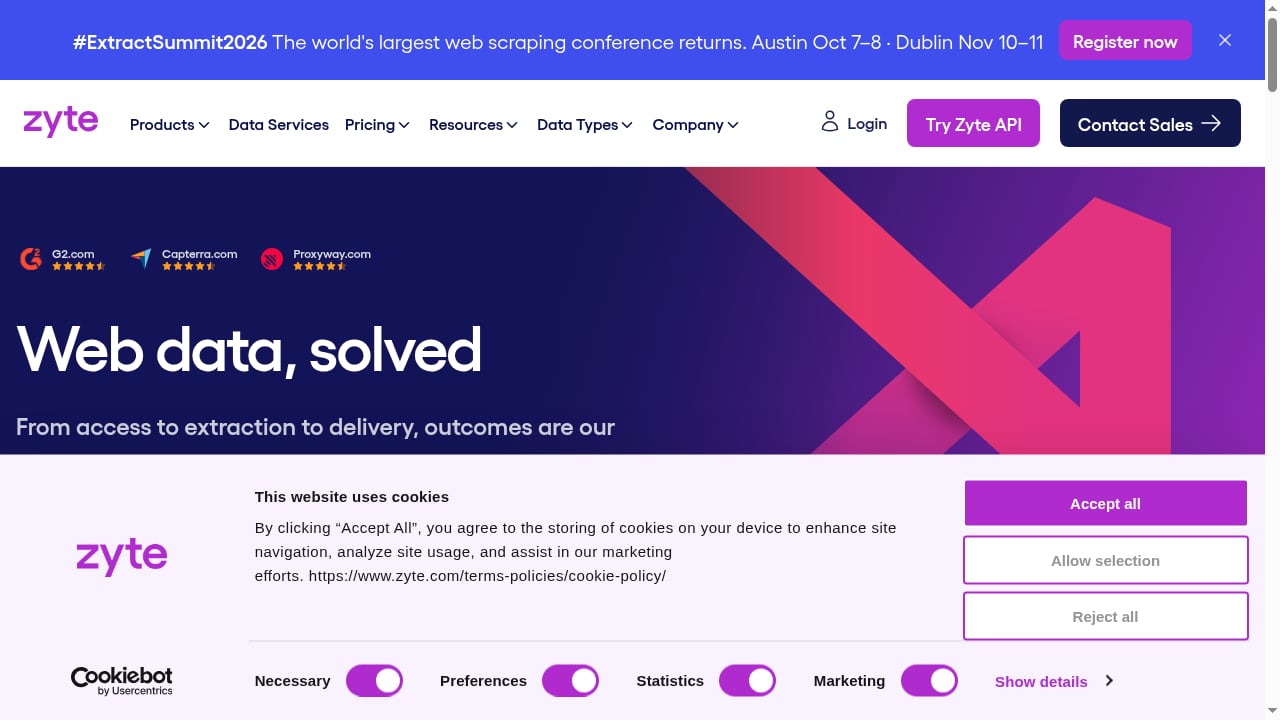
First viewport screenshot of Web Data Collection: APIs and Managed Data Delivery | Zyte.
The two products sit at different points on the scraping stack.
AdsCrawl is a managed cloud browser and browser automation API. You connect a real cloud Chromium session over CDP, route traffic through residential or custom proxies, and retrieve HTML, Markdown, JSON, or screenshots from JavaScript-heavy pages. The browser is the product. You keep control of navigation, interaction, and extraction logic.
Zyte positions itself as an all-in-one, AI-powered web scraping platform with a data delivery team behind it. The pitch is that your developers or Zyte's team handle the collection, and you receive structured data rather than raw page state. The browser becomes an implementation detail you do not manage.
That single difference — browser control versus managed output — drives almost every other trade-off below.
Browser Control: CDP Sessions vs Abstracted Crawling
AdsCrawl: Real Browser Sessions You Can Inspect
AdsCrawl exposes synchronous rendered-content endpoints such as POST /html and POST /screenshot, plus dedicated remote CDP sessions with short-lived live-control tokens. That means you can attach a Playwright or Puppeteer client and interact with page state directly: click through pagination, fill forms, wait for network responses, and read the DOM after scripts settle.
Stateful cloud browser profiles persist settings after a session stops, and per-user running quotas keep concurrency predictable. For teams debugging why a page renders differently across requests, this visibility matters — you are inspecting the browser, not guessing at what a black box returned.
Zyte: The Browser Is Hidden Behind the Service
Zyte's model is scraping-first. You describe what you want, and the platform handles proxies, browsers, and extraction. That is efficient when your target is straightforward and your team would rather not maintain browser infrastructure.
The trade-off is control depth. When a target site changes its rendering behavior, or when you need to verify a specific DOM state, an abstracted API gives you less to inspect. You are working with the service's output rather than the live browser session.
Rendering JavaScript-Heavy Pages
Modern sites increasingly build navigation and content client-side. A crawler that only reads initial HTML can miss links and content that scripts generate later — a limitation well documented in cloud crawling tools like Screpy's SEO crawler, which notes that JavaScript rendering is required when scripts produce meaningful page content or navigation, and that rendering cannot bypass logins or bot challenges.
AdsCrawl is built for exactly this scenario. It renders JavaScript-heavy pages in a real Chromium environment, supports SPA extraction templates, and can return structured DOM and network field extraction. If your workflow depends on what the page looks like after scripts run, the cloud browser approach is direct.
Zyte also handles JavaScript rendering as part of its scraping pipeline, but the rendering step is internal. You get the result, not the session. For teams that need to tune wait conditions, intercept network calls, or reproduce a rendering bug, that abstraction can become friction.
Protocol Support and Developer Workflow
AdsCrawl is protocol-native. If your team already writes Playwright or Puppeteer scripts, you point them at a cloud browser endpoint and keep your existing code. CDP access means custom interactions and debugging tools continue to work.
This matters for AI agent and automation workflows, where a stateful browser that can log in, click, and retain context across steps is more useful than a single-shot HTML fetch. The browser task API guide covers how background scheduling and cloud automation fit together if you are designing that kind of pipeline.
Zyte's developer experience centers on its scraping API and data delivery rather than raw browser protocol access. If your team prefers to define extraction rules and receive structured records, that is a legitimate advantage. If your team prefers to own the browser, it is a constraint.
Pricing and Scaling Models
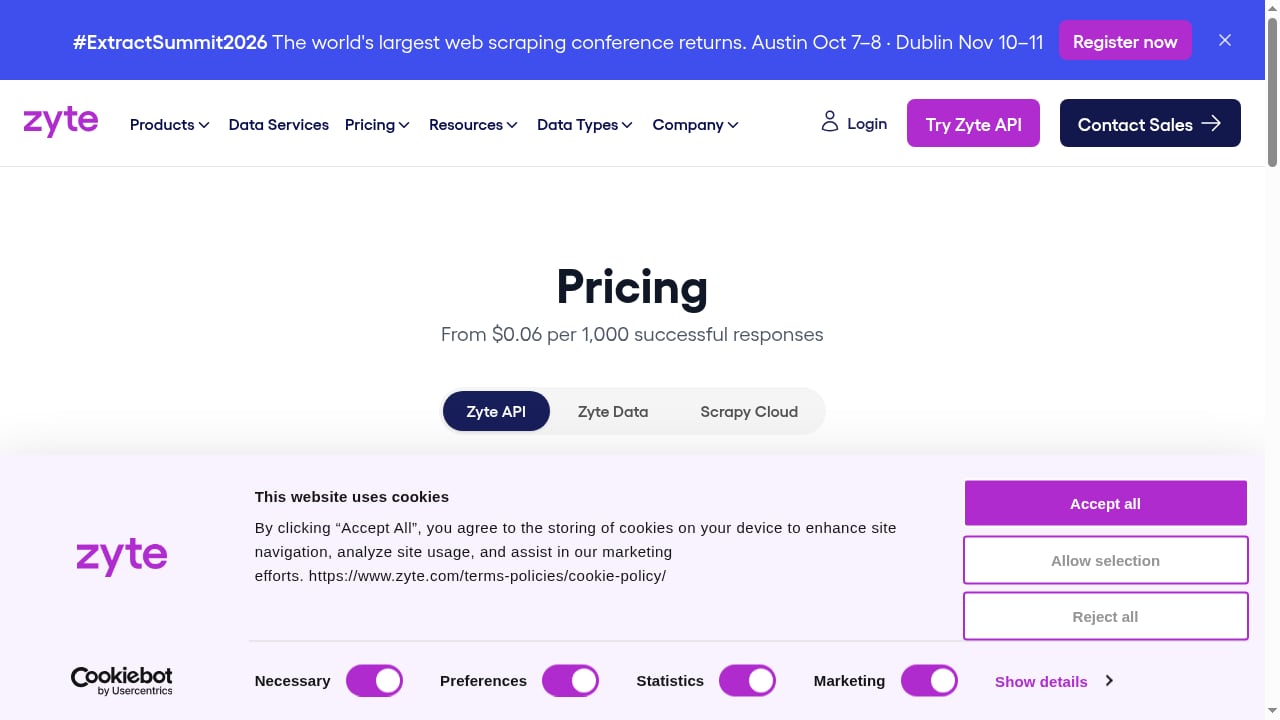
First viewport screenshot of Pricing | Zyte.
AdsCrawl uses transparent tiered pricing with monthly credits, browser concurrency, cloud browser profiles, and API key limits scaling by plan:
- Free — 500 one-time credits to test the API
- Hobby — $9/month for solo developers
- Starter — $49/month for small production teams
- Pro — $199/month for high-volume automation teams
That structure lets a solo developer validate a workflow cheaply and scale concurrency as volume grows. Because you control the browser session, you also control how many requests each session performs, which affects credit consumption directly.
Zyte's pricing is tied to its managed scraping and data delivery model. Costs scale with the volume and complexity of extraction rather than with browser sessions you operate yourself. For teams that want a predictable per-record cost and no browser management, that can be simpler. For teams optimizing request efficiency inside their own automation logic, a session-based model like AdsCrawl's is easier to reason about.
Anti-Bot Handling and Browser Identity
AdsCrawl provides managed browser identity, random User-Agents, trusted proxies, and dynamic region routing. Residential proxy routing or custom proxies are configurable per workflow. Fingerprint profiles and concurrent sessions support consistent rendering across requests — useful when a target expects a stable browser identity.
Zyte handles anti-bot defenses as part of its managed service. The platform absorbs that complexity, which is valuable if you do not want to think about proxy rotation or fingerprint consistency. The difference is where the responsibility sits: AdsCrawl gives you the controls and expects you to use them; Zyte takes the controls away and handles them for you.
When to Choose AdsCrawl
AdsCrawl fits when browser control is the point, not a detail:
- You need CDP-level access to inspect or manipulate page state
- Your team already uses Playwright or Puppeteer and wants a managed cloud version
- You are building AI agent workflows that need a stateful, interactive browser
- You need to verify rendering state or debug why a page behaves inconsistently
- You want transparent, tiered pricing that scales from solo testing to high-volume automation
- You need HTML, Markdown, JSON, or screenshots from JavaScript-heavy pages on demand
If those describe your workflow, the AdsCrawl vs Scrape.do vs Zyte comparison goes deeper on how the three stack up on rendering and pricing.
When Zyte Is the Better Fit
First viewport screenshot of Pricing | Zyte.
Zyte makes sense when you want outcomes rather than infrastructure:
- You want structured data delivered, not raw browser sessions
- Your team would rather not maintain browser fleets or proxy logic
- You need managed data delivery with a service team behind it
- Your extraction targets are stable enough that an abstracted API is sufficient
There is no shame in choosing the managed path. It removes operational burden. The question is whether that burden was ever yours to carry.
A Practical Decision Framework
First viewport screenshot of Pricing | Zyte.
Ask three questions before you commit:
- Do you need to see inside the browser? If yes, AdsCrawl's CDP sessions are the differentiator. If no, Zyte's abstraction is fine.
- Who owns extraction logic? AdsCrawl leaves it with you. Zyte can take it off your plate.
- How does cost scale? AdsCrawl scales by credits, concurrency, and profiles. Zyte scales by managed extraction volume.
For teams running production scraping, QA, monitoring, and remote CDP workflows, the browser-level control usually wins. For teams that want data delivered and infrastructure forgotten, the managed platform wins.
Related reading
- ParseHub Review 2026: Free Web Scraper, Real Limits - Honest ParseHub review for 2026: point-and-click scraping, free tier limits, pricing, AJAX handling, setup traps, and when to switch to a cloud API.
- Top 10 Cloud-Based Anti-Detect Browser Automation Products 2026 - We ranked the top 10 cloud-based anti-detect browser automation products for 2026 by fingerprint quality, automation APIs, scaling, and pricing.
- How to Use AdsCrawl with UptimeRobot for Free Monitoring - Combine AdsCrawl's cloud browser API with UptimeRobot's free uptime monitoring to catch JavaScript-rendered downtime and content failures.
Sources and further reading
- AdsCrawl vs Browserless vs ScrapingBee: Which API Wins? - Compare AdsCrawl, Browserless, and ScrapingBee for browser automation, scraping, and AI agents. See which API fits your workflow and budget.
- API Providers - APIs.io - Browse all API service providers indexed on APIs.io, ranked by the API Evangelist rating. Find providers by name, see their APIs, capabilities, and more.
FAQ
Is AdsCrawl a Zyte alternative?
Yes, for workflows that need browser-level control. AdsCrawl provides a managed cloud browser and CDP API, while Zyte provides a scraping and managed data delivery platform. They overlap on data extraction but differ on how much browser control you retain.
Can AdsCrawl handle JavaScript-heavy pages?
Yes. AdsCrawl renders pages in real cloud Chromium browsers and returns HTML, Markdown, JSON, or screenshots. It supports SPA extraction templates and structured DOM and network field extraction.
Does AdsCrawl support Playwright and Puppeteer?
Yes. You can connect Playwright, Puppeteer, or any CDP client to AdsCrawl's cloud browsers, which means existing automation scripts can be pointed at a managed endpoint.
How does AdsCrawl pricing compare to Zyte?
AdsCrawl uses tiered monthly plans: Free with 500 one-time credits, Hobby at $9/month, Starter at $49/month, and Pro at $199/month, with credits, concurrency, profiles, and API key limits scaling by tier. Zyte's costs scale with its managed scraping and data delivery model.
Which is better for AI agent workflows?
AdsCrawl is built for AI agent use cases with Markdown extraction, CDP control, fingerprint profiles, and concurrent sessions. If your agent needs to interact with a page across multiple steps, a stateful cloud browser is a strong fit.
Conclusion
AdsCrawl and Zyte solve adjacent problems. AdsCrawl sells browser infrastructure: real cloud Chromium sessions, CDP access, proxy routing, and transparent tiered pricing for developers and teams who want to own their automation logic. Zyte sells managed data delivery: an AI-powered scraping platform that abstracts the browser and can put a data team behind the work.
The right choice depends on whether you want to drive the browser or receive the data. If control, debugging visibility, and protocol-level access matter to your stack, AdsCrawl is the more direct fit. If you would rather hand off collection entirely, Zyte's managed model is worth evaluating on its own terms.