
ClawEngine.ai Review: Clean, LLM-Ready Web Scraping API
Hands-on ClawEngine.ai review: how its web scraping API turns sites into clean Markdown or JSON for LLM pipelines, plus pricing signals, setup, and limits.
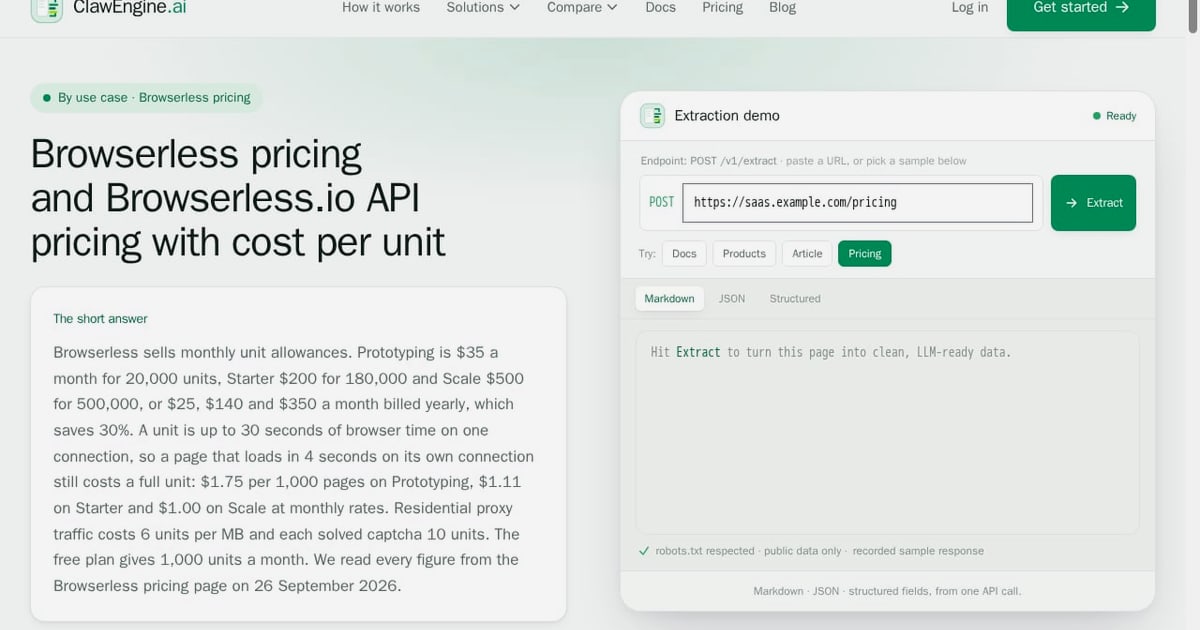
ClawEngine.ai Review: Clean, LLM-Ready Web Scraping API
If you have ever piped raw HTML into a language model, you know the result: token bloat, broken tables, and navigation menus that drown out the actual content. ClawEngine.ai positions itself as the fix — a web scraping API that turns any website into clean, LLM-ready data. This review examines what that promise actually means in practice, who benefits most, and where the platform still has trade-offs.
What ClawEngine.ai Actually Does
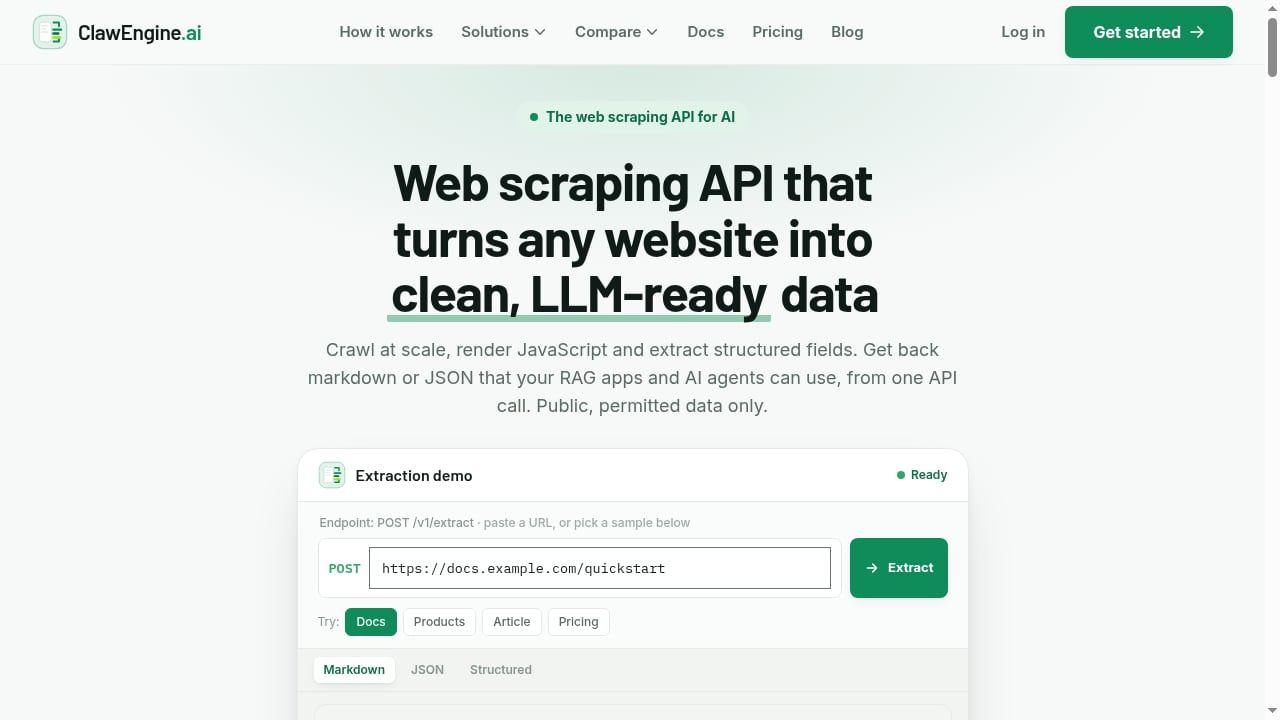
First viewport screenshot of Web Scraping API for Clean, LLM-Ready Data | ClawEngine.ai.
ClawEngine.ai is a hosted web scraping API. You send it a URL; it handles fetching, JavaScript rendering, and content extraction, then returns the page as Markdown or structured JSON. The pitch is that the output is ready to drop into an LLM pipeline, RAG index, or AI agent without a separate parsing step.
The product context describes four core capabilities:
- Crawl at scale — follow links across a site rather than scraping one page at a time.
- Render JavaScript — execute client-side frameworks so single-page apps return real content.
- Extract structured fields — define the fields you want and receive JSON instead of a wall of text.
- Output Markdown or JSON — choose the format that fits your downstream model or database.
You get an API key and start making calls. There is no browser fleet to maintain, no proxy pool to rotate, and no HTML cleanup layer to write yourself.
Why LLM-Ready Output Matters
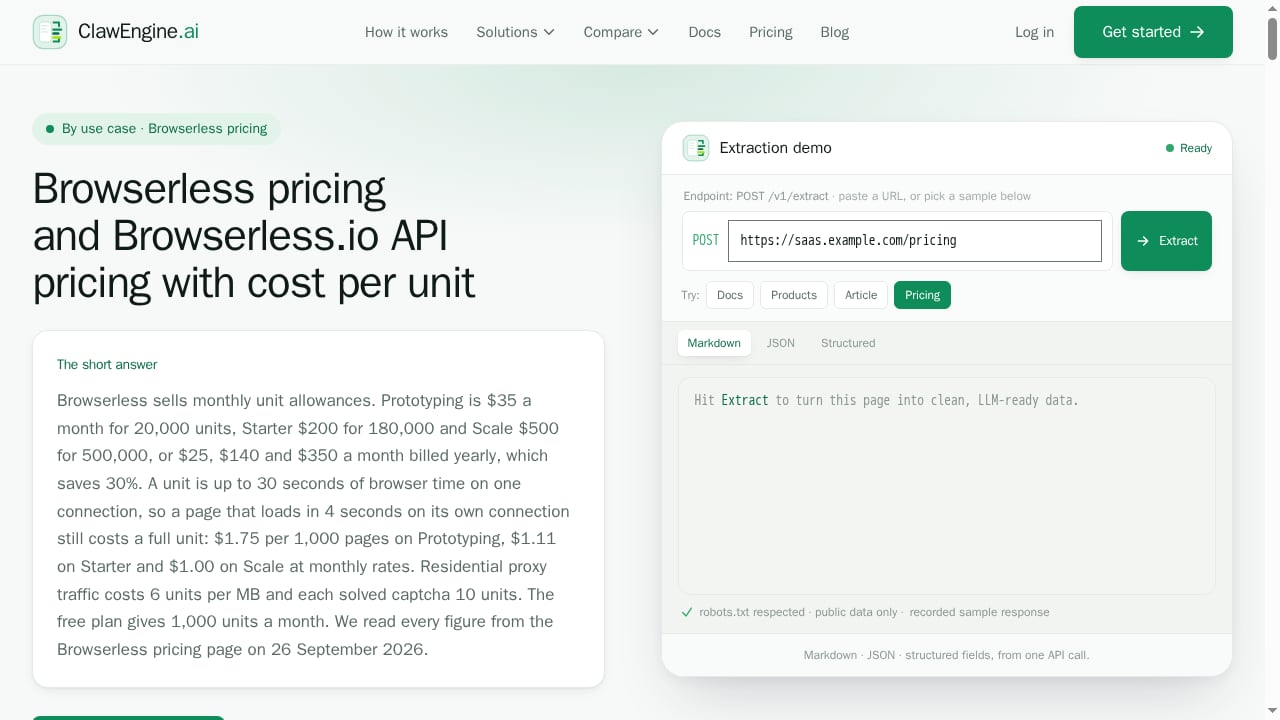
First viewport screenshot of Browserless Pricing and Browserless.io Cost per Unit | ClawEngine.
The case for clean output is not cosmetic. Raw HTML carries navigation, ads, footers, and inline styling that consume tokens without adding meaning. When you feed that into a model, you pay for noise twice: once in token cost, and again in degraded answer quality.
A scraping API that returns Markdown or schema-based JSON removes that layer. The Firecrawl comparison of web scraping APIs notes that Markdown output can use roughly two-thirds fewer tokens than raw HTML — a difference that compounds across thousands of pages. The Context.dev ranking of AI scraping APIs makes a similar point: tools built for AI from the start tend to handle extraction and anti-bot logic natively rather than bolting it on.
ClawEngine.ai sits in that AI-native category. The question is whether its execution justifies the switch.
Ideal Users and Use Cases
ClawEngine.ai fits teams that need web data inside an AI workflow, not teams that need a general-purpose scraping framework.
Strong fits:
- RAG pipeline builders who need to ingest documentation sites, knowledge bases, or product catalogs as clean text.
- AI agent developers who want a single API call to return usable content instead of orchestrating browser automation themselves.
- Data teams replacing brittle scripts that break every time a target site changes its markup.
- Startups without scraping infrastructure that would rather pay per request than hire an engineer to babysit proxies.
Weaker fits:
- Teams that need pixel-level control over browser sessions, cookies, and request headers.
- Projects scraping sites where the data sits behind complex multi-step interactions.
- Organizations with strict data residency requirements that mandate self-hosted collection.
If your work leans toward full browser control rather than clean data delivery, a cloud browser API may be the better category — see the AdsCrawl vs Zyte comparison for how that trade-off plays out.
Strengths
Output quality is the headline
The Markdown and JSON formats are the reason to consider ClawEngine.ai at all. If the extraction strips boilerplate reliably, you skip an entire post-processing stage. That is real engineering time saved, not marketing language.
JavaScript rendering is built in
Modern sites built on React, Vue, or Angular return an empty shell to a plain HTTP request. ClawEngine.ai renders the page before extraction, which means the content you want is actually present in the response.
Crawling and extraction in one API
Rather than stitching together a crawler, a renderer, and a parser, you work with one service. That reduces the number of failure points in a pipeline and simplifies debugging.
Structured field extraction
Schema-based JSON extraction means you can ask for specific fields — price, title, author, date — and receive them typed and labeled. For downstream databases and model prompts, that is far more useful than a Markdown blob.
Limitations to Weigh
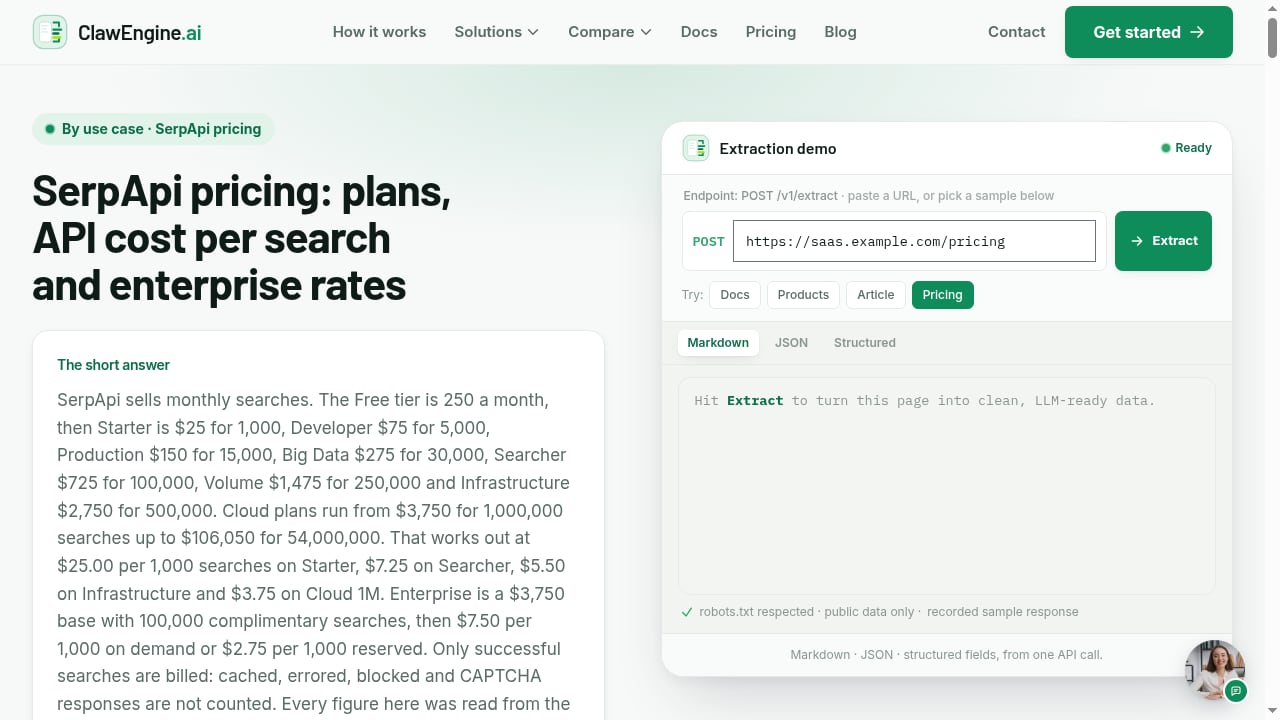
First viewport screenshot of SerpApi Pricing: Cost per 1,000 Searches by Plan | ClawEngine.ai.
Pricing signals are the biggest unknown
The product context does not publish tier pricing. That is a genuine gap for budget planning. Comparable AI scraping APIs in 2026 cluster around $16–$49 per month for entry tiers, with credit multipliers for JavaScript rendering and premium proxies. Treat any ClawEngine.ai cost estimate as provisional until you confirm current rates directly.
Credit consumption can be opaque
Most scraping APIs charge one credit for a simple fetch and several credits when rendering or proxy escalation is required. If ClawEngine.ai follows that model, a JavaScript-heavy target can cost five to twenty-five times a static page. Test your actual targets before committing to volume.
Less low-level control
A managed API abstracts away the browser. That is the point, but it also means you cannot fine-tune fingerprints, inject scripts, or manage session state the way you would with a CDP-based tool. Teams with advanced anti-bot needs may hit a ceiling.
No self-hosting option
If your compliance posture requires data to stay on your own infrastructure, a hosted API is a non-starter. Open-source alternatives exist, but they shift the operational burden back to you.
Setup: What to Expect
The onboarding path described in the product context is short: get an API key, then make requests. In practice, a sensible evaluation looks like this:
- Request an API key and confirm the free or trial allowance.
- Test a static page first to validate Markdown quality and confirm the extraction strips navigation and footers.
- Test a JavaScript-heavy page to measure rendering latency and credit consumption.
- Define a JSON schema for one real target and check whether the extracted fields match your expectations.
- Run a small crawl across ten to twenty linked pages to see how depth and rate limits behave.
- Compare output against your current pipeline — token count, accuracy, and manual cleanup time.
That last step matters most. A scraping API is only worth switching to if the output reduces downstream work. If you are still writing regex to fix the Markdown, the value proposition weakens.
ClawEngine.ai vs the Alternatives
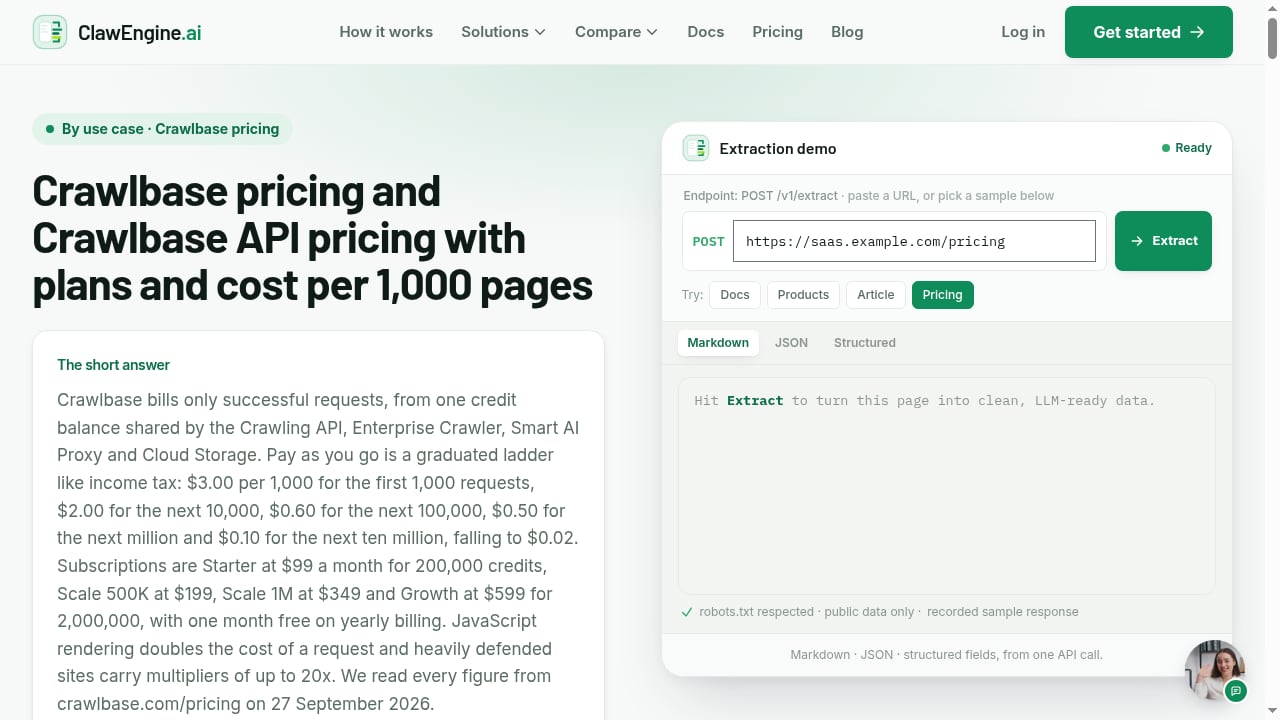
First viewport screenshot of Crawlbase Pricing and Crawlbase API Pricing by Plan | ClawEngine.
The AI scraping market is crowded, and the right choice depends on where you want to spend effort.
| Need | Better fit |
|---|---|
| Clean Markdown for RAG, minimal setup | ClawEngine.ai or a similar AI-native API |
| Full browser control and CDP access | A cloud browser API |
| Pre-built scrapers for specific sites | A platform with an actor or template library |
| Self-hosted, zero software cost | An open-source crawler |
| Enterprise proxy scale | A proxy-first vendor |
For a broader view of how these categories stack up, the top 10 web scraping API platforms for 2026 ranks providers by success rate, rendering, and pricing. If your priority is head-to-head developer experience rather than AI output, the AdsCrawl vs Scrape.do vs Zyte breakdown covers rendering, anti-bot success, and cost.
Decision Criteria: Should You Use ClawEngine.ai?
Use this checklist before committing:
- Does your pipeline need Markdown or JSON, not HTML? If yes, an AI-native API is the right category.
- Are your targets JavaScript-rendered? If most pages are static, a simpler and cheaper API may suffice.
- Can you tolerate per-request pricing? Managed APIs trade infrastructure cost for usage cost.
- Do you need browser-level control? If so, look at CDP-based tools instead.
- Have you tested output quality on your own targets? Benchmarks from other teams rarely match your specific sites.
- Is the pricing model transparent enough to forecast? Credit multipliers are where budgets break.
If you answer yes to the first three and no to the fourth, ClawEngine.ai is worth a trial. If browser control or self-hosting is non-negotiable, it is not the right tool.
Related reading
- How to Use AdsCrawl with Searlo: Search Data + Browser Automation - Combine Searlo's SERP API with AdsCrawl's cloud browser to discover search results and scrape JavaScript-heavy pages. Setup, workflow, code, and FAQ.
- AdsCrawl vs Browserbase vs Browserless: 2026 Comparison - Compare AdsCrawl, Browserbase, and Browserless for cloud browser automation: CDP control, stealth, proxies, pricing, and which fits your scraping stack.
Sources and further reading
- 7 Best API Crawl for AI: Get LLM-Ready Data in 2026 - Discover the best API crawl for AI tools that turn websites into structured, LLM-ready data. Compare features, pricing, and find the right crawler.
FAQ
What is ClawEngine.ai?
ClawEngine.ai is a web scraping API that converts websites into clean, LLM-ready data. It crawls pages, renders JavaScript, extracts structured fields, and returns content as Markdown or JSON.
Is ClawEngine.ai good for RAG pipelines?
Yes, that is its primary use case. Clean Markdown reduces token usage and improves retrieval quality compared to raw HTML, which is exactly what RAG systems need.
Does it handle JavaScript-rendered sites?
According to the product description, yes. JavaScript rendering is listed as a core capability, which matters for single-page applications built with React, Vue, or Angular.
Can I get structured JSON instead of Markdown?
Yes. The API supports structured field extraction, so you can request specific fields and receive JSON rather than a text blob.
How much does ClawEngine.ai cost?
Pricing is not published in the available product context. Comparable AI scraping APIs in 2026 start between $16 and $49 per month, but you should confirm ClawEngine.ai's current rates and credit multipliers directly before budgeting.
What are the main limitations?
Limited low-level browser control, no self-hosting option, and potential credit multipliers for JavaScript rendering or premium proxies. Pricing transparency is the biggest open question.
Conclusion
ClawEngine.ai targets a real and growing problem: LLMs need clean web data, and getting it reliably is harder than it looks. By combining crawling, JavaScript rendering, and structured extraction behind one API, it removes a meaningful amount of engineering work from AI pipelines.
The strengths are clear — clean Markdown and JSON output, built-in rendering, and a single integration point. The limitations are equally clear — opaque pricing signals, less browser-level control, and no self-hosted option.
For teams building RAG systems, AI agents, or data pipelines where output quality directly affects model performance, ClawEngine.ai is a reasonable candidate to trial. Test it against your own targets, measure the token savings, and compare the total cost against your current approach. If the output is clean enough to skip post-processing, the switch pays for itself. If not, the market has plenty of alternatives — and the comparison guides linked above will help you find the right one.