
Top 10 Web Scraping API Platforms 2026: Ranked & Compared
We ranked the top 10 web scraping API platforms for 2026 by success rate, rendering, pricing, and developer experience. Compare and pick the right API.
Top 10 Web Scraping API Platforms 2026: Ranked and Compared
Web scraping in 2026 is less about writing a request and more about surviving the defenses that sit in front of it. Cloudflare, DataDome, Kasada, and PerimeterX now block naive scrapers within seconds, and single-page applications render their content only after the browser executes JavaScript. A web scraping API absorbs that complexity: you send a URL, the provider handles proxy rotation, browser rendering, CAPTCHA solving, retries, and scaling, and you get back HTML, Markdown, or structured JSON.
This ranking covers ten platforms that genuinely belong to the web scraping API category. Each entry is evaluated on published evidence: benchmark success rates, documented pricing, feature depth, and developer sentiment. The goal is not to crown one universal winner but to help you match a platform to your workload.
How We Evaluated These Platforms
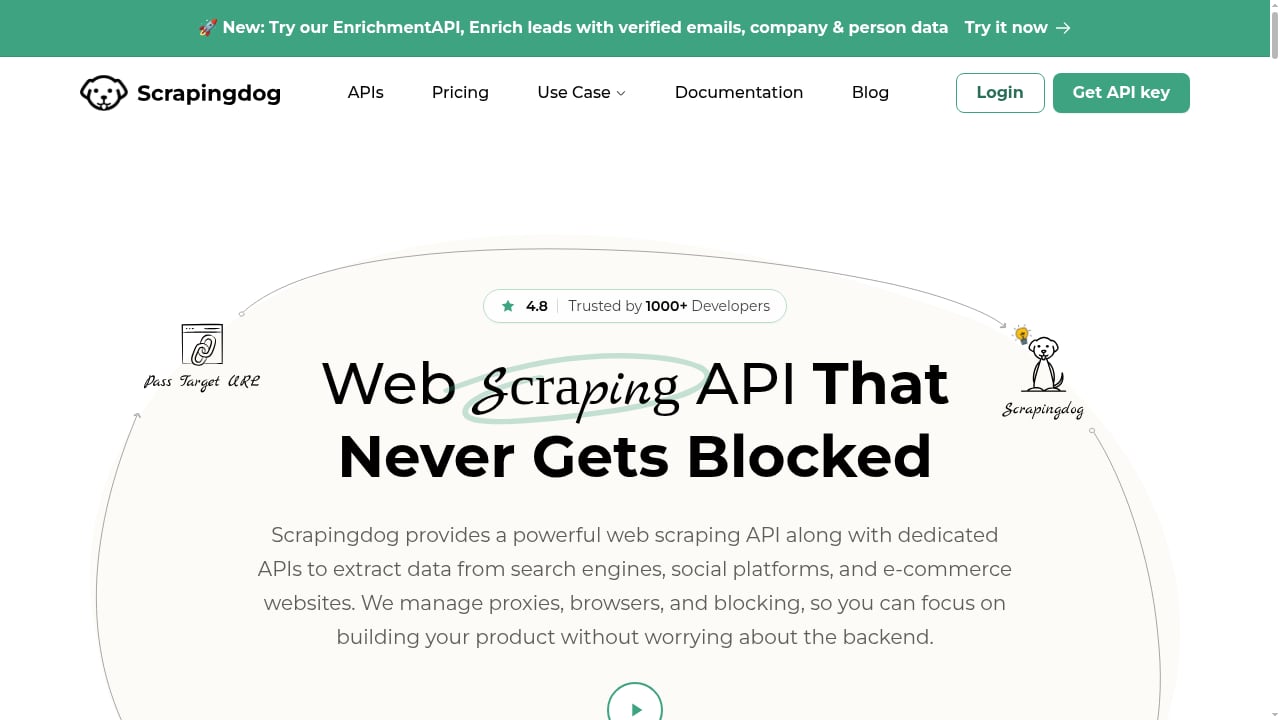
First viewport screenshot of Scalable Web Scraping API for Data Extraction | Scrapingdog.
We scored each product across six dimensions and weighted them by how much they affect real production outcomes:
- Success rate on protected domains — the single most important metric. A cheap API that fails on Cloudflare costs more than an expensive one that works.
- JavaScript rendering and browser control — whether the API executes client-side code, and whether you can interact with the page (click, fill, navigate) or only fetch it.
- Output quality — raw HTML, clean Markdown, or schema-based JSON. Markdown and JSON reduce downstream parsing work, especially for LLM and RAG pipelines.
- Pricing transparency — documented credit multipliers for rendering and premium proxies, plus whether failed requests are billed.
- Developer experience — SDKs, documentation, error messages, and integration ecosystem.
- Scale and compliance — concurrency limits, uptime commitments, and certifications such as SOC 2, ISO 27001, GDPR, and CCPA.
We drew on two published benchmarks: Scrape.do's 2026 benchmark of 16 scraping APIs across seven tough domains, and Proxyway's Web Scraping API Report 2025 covering 11 participants on 15 heavily protected sites. Where a vendor publishes its own benchmark, we treat the numbers as directional rather than independent.
The Top 10 Web Scraping API Platforms for 2026
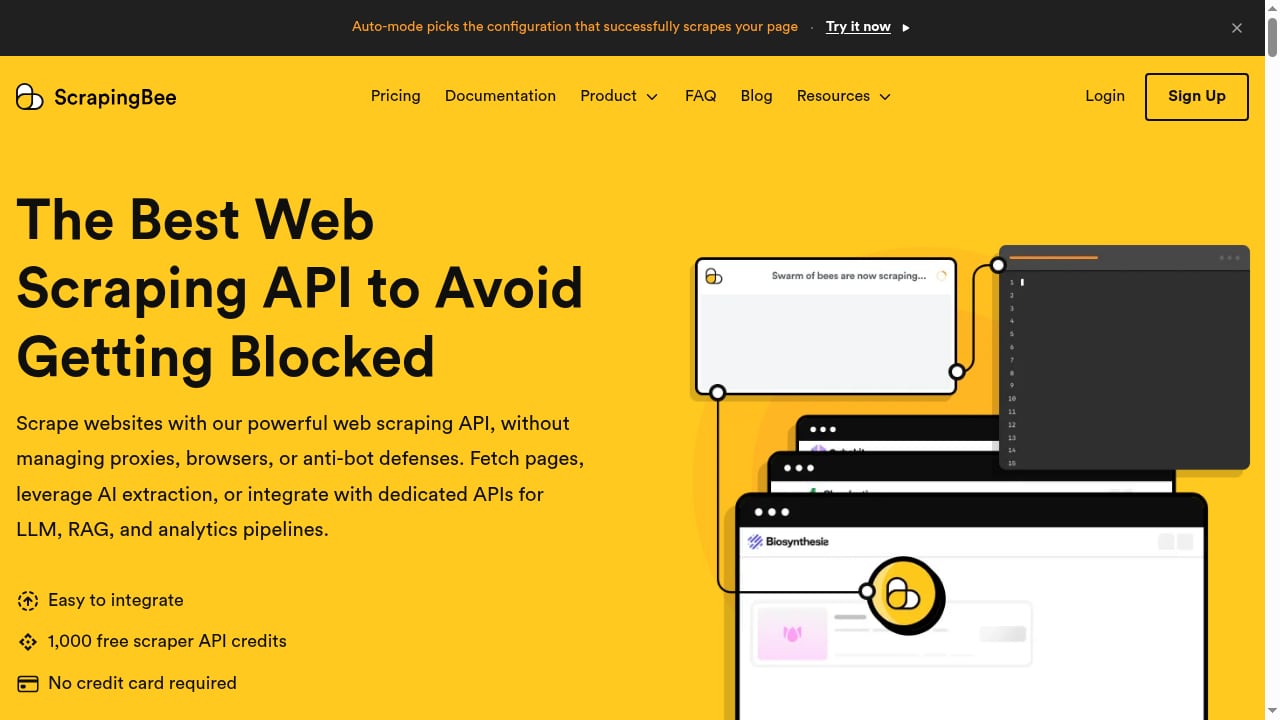
First viewport screenshot of ScrapingBee – The Best Web Scraping API.
1. Bright Data — Best Overall for Enterprise Scale
Bright Data posted the highest average success rate, 98.87%, of the 16 APIs in Scrape.do's 2026 benchmark, hitting 100% on Indeed, GitHub, Zillow, and Google. Its network spans 400M+ residential IPs across 195 countries, and it offers 437+ pre-built scrapers covering Amazon, LinkedIn, TikTok, Zillow, and other major domains.
Strengths: Largest proxy network in the comparison, pay-only-for-success billing, a published 99.99% uptime SLA, and GDPR, CCPA, ISO 27001, and SOC 2 compliance. Bulk handling supports up to 5,000 URLs per API call.
Trade-offs: Premium domains such as Walmart, Amazon product pages, and social platforms are billed at a higher rate than standard domains. The breadth of the platform can be more than a small project needs.
Best for: Enterprise data pipelines, AI training data, and workloads where a failed scrape has a downstream cost.
2. Scrape.do — Best for Speed-Sensitive Workloads
Scrape.do finished a close second in its own 2026 benchmark with a 98.61% average, and it recorded the fastest Zillow response in that test at 2.6 seconds, with a blended average of 5.5 seconds. It runs a single-endpoint design: advanced behavior such as render=true, super=true, output=markdown, and geoCode=US is controlled with query parameters, so it drops into any HTTP client without a new SDK.
Strengths: Latency-focused architecture, 110M+ IPs across datacenter, residential, and mobile pools, first-class Markdown output, and a freemium tier with 1,000 requests per month. The Hobby plan starts at $29/month for 250,000 requests.
Trade-offs: Credit multipliers apply on the base plan — JavaScript rendering costs 5 credits, premium proxies cost 10, and both combined cost 25. Enterprise pricing is needed above roughly 3.5M requests per month.
Best for: Real-time price monitoring, user-facing search, and SERP workloads where response time matters.
3. ScrapingBee — Best for Beginners and Clean Documentation
ScrapingBee is a web scraping API that handles proxies, headless browsers, and anti-bot defenses so teams can focus on extraction. It serves 4,500+ developers and offers a main HTML API with JavaScript rendering, rotating and premium proxies, geotargeting, screenshots, and extraction rules using CSS or XPath selectors. Dedicated scraper APIs cover Google, Amazon, Walmart, ChatGPT, Gemini, YouTube, and employee search, plus a Fast Search API.
AI-ready features include defining scraping rules in JSON, using AI Query to describe data needs, and integrating with LLM, RAG, and analytics pipelines. Integrations include CLI, Remote MCP, n8n, Make, Zapier, and LangChain. Pricing runs from Freelance at $49/mo to Enterprise 24 at $1,599/mo, with a free trial of 1,000 credits and no credit card required. It holds a 4.9 rating based on 100+ reviews.
Strengths: Clean documentation, an official Python SDK, and a gentle learning curve. The dedicated scraper endpoints remove selector maintenance for common targets.
Trade-offs: Credit multipliers apply for JavaScript rendering and premium proxies, so high-volume rendering workloads need careful cost modeling.
Best for: Developers new to scraping APIs and teams that want dedicated endpoints for search and e-commerce targets.
4. Scrapingdog — Best for Platform-Specific Endpoints
Scrapingdog provides a single API to extract data without managing proxies, headless browsers, or CAPTCHAs. It offers dedicated APIs for search engines (Google Search, Google Maps, Google Trends), e-commerce platforms (Amazon, Walmart, eBay, Flipkart, Myntra, Baidu), and social media (LinkedIn, X/Twitter, TikTok, YouTube). The platform handles JavaScript rendering, custom headers, premium residential proxies, geotargeting, and sessions, returning structured JSON or HTML.
It is trusted by over 1,000 developers with a 4.8 rating, and offers a 30-day free trial with 100 free credits and no credit card required. Pricing scales from a free tier to enterprise plans with up to billions of requests per month, and failed requests are never charged.
Strengths: Broad platform-specific coverage, structured JSON output, and a no-charge policy for failed requests. It suits SEO professionals, e-commerce businesses, data analysts, and developers working on SEO monitoring, price tracking, lead generation, and market research.
Trade-offs: The dedicated endpoints are the main draw; teams needing low-level browser control may prefer a CDP-based cloud browser instead.
Best for: SEO monitoring and e-commerce price tracking where pre-built endpoints save development time.
5. Firecrawl — Best for LLM and RAG Pipelines
Firecrawl is built for AI-powered workflows. It returns clean Markdown that uses roughly 67% fewer tokens than raw HTML, which compounds quickly across thousands of pages. It offers seven endpoints: Scrape, Crawl, Map, Search, Agent, Interact, and Parse. The Interact endpoint lets you scrape a page and immediately click, fill, or navigate using natural language or code, then extract the content that appears.
Strengths: Native integrations with LangChain and LlamaIndex, SOC 2 Type 2 compliance, and a keyless free tier of 1,000 credits per month with no sign-up. The Agent endpoint can navigate complex sites autonomously and return structured data.
Trade-offs: JSON extraction consumes five credits per page versus one for a basic scrape, so costs scale with structured output. It is not a visual builder for non-technical users.
Best for: AI agents, RAG ingestion, and teams that need Markdown or schema-based JSON rather than raw HTML.
6. Zyte — Best for AI-Powered Structured Extraction
Zyte combines managed data delivery with AI-assisted extraction, and it is frequently cited for teams that want structured output without writing extraction rules. Its API handles rendering, proxy management, and anti-bot challenges, and it positions itself around predictable, governed data pipelines.
Strengths: Strong fit for organizations that need consistent structured output and managed delivery rather than raw page access.
Trade-offs: Less low-level browser control than CDP-based platforms, which matters when a workflow depends on interacting with a page before extraction.
Best for: Teams that want managed data delivery and AI-assisted extraction without maintaining selectors.
7. Decodo — Best Flat-Rate Pricing for the Mid-Market
Decodo is noted for predictable flat-rate pricing aimed at the mid-market, which makes budgeting easier than usage-based models that spike with rendering multipliers.
Strengths: Predictable costs and a straightforward feature set for teams that scrape moderate volumes on a fixed budget.
Trade-offs: Flat-rate plans can become expensive if your volume grows beyond the plan's allowance, and premium-domain success rates vary by target.
Best for: Mid-market teams that value budget predictability over maximum throughput.
8. ScraperAPI — Best Budget Option for Unprotected Sites
ScraperAPI is a practical entry point for projects that mostly scrape unprotected or lightly protected sites. It offers a 7-day trial, a pool of 40M IPs, and automatic retry on failures.
Strengths: Accessible pricing, simple integration, and automatic retries that reduce manual error handling.
Trade-offs: It can struggle against the most aggressive anti-bot systems, so it is a poor fit for heavily protected targets.
Best for: Budget-conscious projects and early-stage prototypes on unprotected sites.
9. Oxylabs — Best for No-Code Automation
Oxylabs pairs a large proxy network with OxyCopilot, which generates scraping code from prompts. That makes it useful for teams that want to move from a description of the data to working code quickly.
Strengths: No-code assistance, a mature proxy infrastructure, and a free trial with plans starting around $49/mo.
Trade-offs: The generated code still needs review, and credit multipliers for rendering and premium proxies affect total cost.
Best for: Teams that want prompt-assisted scraper generation on top of established proxy infrastructure.
10. ZenRows — Best for Cloud Browser Automation
ZenRows runs Puppeteer and Playwright on cloud infrastructure, which makes it a fit for workflows that need browser automation rather than a simple fetch. It offers a free tier of 5,000 credits and plans starting around $16/mo.
Strengths: Cloud browser automation, a generous free entry point, and support for the browser automation libraries developers already use.
Trade-offs: Browser automation consumes credits quickly, so high-volume interaction workflows need cost planning.
Best for: Teams that need Puppeteer or Playwright execution without running their own browser fleet.
Quick Comparison Table
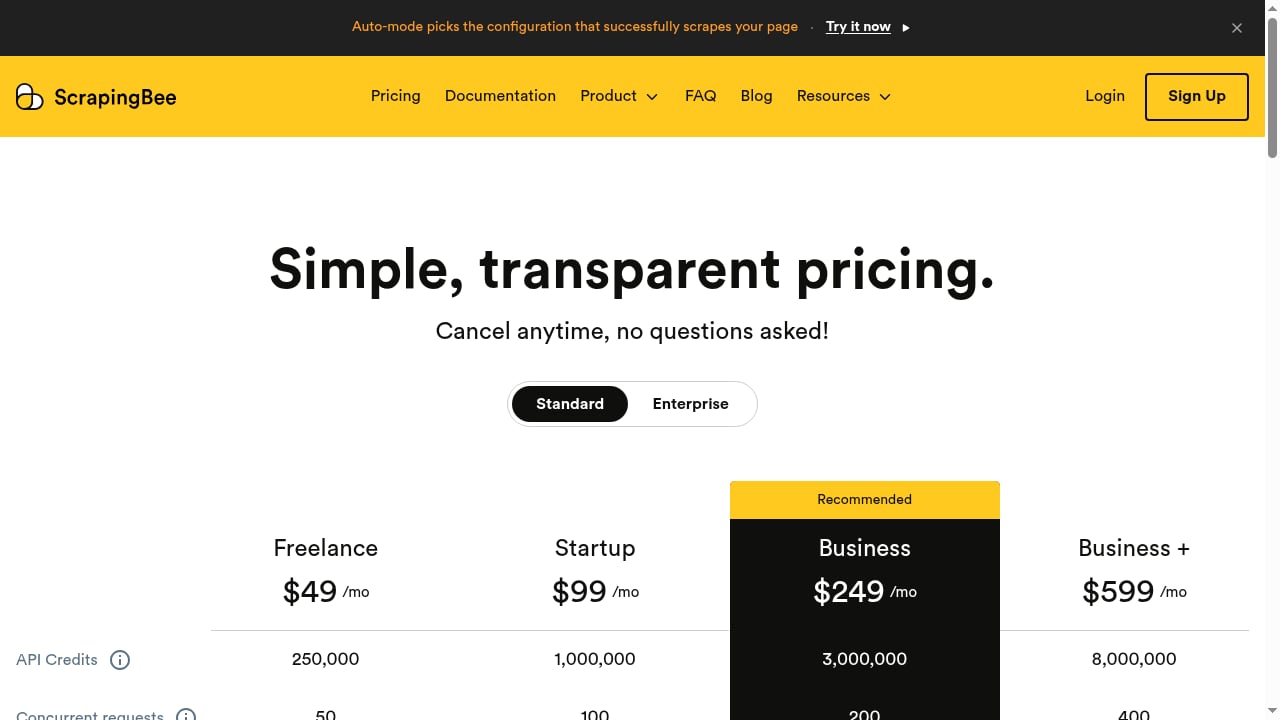
First viewport screenshot of Pricing - ScrapingBee Web Scraping API | ScrapingBee.
| Platform | Best For | Starting Price | Standout Feature |
|---|---|---|---|
| Bright Data | Enterprise scale | Usage-based from $0.75/1K | 400M+ IPs, 437+ pre-built scrapers |
| Scrape.do | Speed-sensitive workloads | Free (1K), $29/mo | Single endpoint, 110M+ proxies |
| ScrapingBee | Beginners | Free (1K), $49/mo | Official Python SDK, clean docs |
| Scrapingdog | Platform-specific endpoints | Free tier, $40/mo | Dedicated Google, Amazon, LinkedIn endpoints |
| Firecrawl | LLM and RAG pipelines | Free (1K), $19/mo | LLM-ready Markdown and JSON |
| Zyte | AI structured extraction | Custom | AI-powered extraction |
| Decodo | Mid-market flat rate | Custom | Predictable flat-rate pricing |
| ScraperAPI | Budget projects | 7-day trial, $49/mo | 40M IPs, auto-retry |
| Oxylabs | No-code automation | Free trial, $49/mo | OxyCopilot generates code from prompts |
| ZenRows | Cloud browser automation | Free (5K), $16/mo | Puppeteer/Playwright on cloud infrastructure |
How to Choose the Right Web Scraping API
First viewport screenshot of Scrape.do - Powerful Toolkit for Hassle-Free and Scalable Web Scraping.
Start with the target, not the price. If your targets are heavily protected, success rate dominates every other variable, and a cheaper API that fails will cost more in retries and engineering time. If your targets are mostly unprotected, a budget option like ScraperAPI is often sufficient.
Next, decide what output you need. Raw HTML requires downstream parsing and is brittle when markup changes. Markdown and schema-based JSON reduce that maintenance, which is why Firecrawl, Scrape.do, and Scrapingdog emphasize structured output.
Finally, model the true cost. Credit multipliers for JavaScript rendering and premium proxies typically range from 5x to 25x, so a headline price per 1,000 requests can understate the real bill by an order of magnitude. Check whether failed requests are billed — Bright Data, Scrape.do, and Scrapingdog all charge only for successful results, which changes the economics on difficult targets.
When a Cloud Browser Fits Better Than a Scraping API
Some workflows need more than a fetch. If your pipeline depends on logging in, clicking through a multi-step flow, or holding a persistent browser session, a cloud browser or browser automation API is a better fit than a standard scraping API. These platforms let you connect Playwright, Puppeteer, or any CDP client to managed Chromium browsers, with proxy routing and rendered output.
AdsCrawl is one example in this adjacent category: a managed cloud browser and browser automation API for dynamic sites, with synchronous rendered-content endpoints, stateful browser profiles, and remote CDP sessions. It is not a web scraping API platform in the sense ranked above, but it is relevant when a scraping API hits a wall on an interaction-heavy target. For a deeper look at that decision, see the comparison of AdsCrawl vs Zyte: cloud browser API or managed data delivery, and for a broader view of the adjacent tooling, the roundup of top 10 cloud-based anti-detect browser automation products.
Common Pitfalls to Avoid
First viewport screenshot of Changelog | Documentation | Scrape.do.
- Ignoring credit multipliers. Rendering and premium proxies multiply your effective cost. Estimate with your real workload, not the base rate.
- Assuming a free tier proves reliability. Free credits are useful for integration testing, not for benchmarking success rates on protected domains.
- Skipping failure handling. Even the best APIs fail on some targets. Build retry logic and validate that returned HTML contains the data you expect.
- Overlooking compliance. For enterprise procurement, certifications such as SOC 2, ISO 27001, GDPR, and CCPA are often non-negotiable.
Related reading
- How to Use AdsCrawl with Searlo: Search Data + Browser Automation - Combine Searlo's SERP API with AdsCrawl's cloud browser to discover search results and scrape JavaScript-heavy pages. Setup, workflow, code, and FAQ.
- AdsCrawl vs Browserbase vs Browserless: 2026 Comparison - Compare AdsCrawl, Browserbase, and Browserless for cloud browser automation: CDP control, stealth, proxies, pricing, and which fits your scraping stack.
- ParseHub Review 2026: Free Web Scraper, Real Limits - Honest ParseHub review for 2026: point-and-click scraping, free tier limits, pricing, AJAX handling, setup traps, and when to switch to a cloud API.
Sources and further reading
- 8 Best Web Scraping APIs in 2026 - Compare the 8 best web scraping APIs of 2026 with code examples, pricing breakdowns, real user reviews, and honest pros/cons to help you choose the right tool for your needs.
- The 9 Best Web Scraping APIs & Tools in 2026 - The 9 best web scraping APIs and tools in 2026, ranked on published benchmark data. Compare success rates, pricing, and anti-bot performance.
- 10 best AI web scraping tools in 2026 | Web Scraper - Compare 10 AI web scraping tools for no-code extraction, monitoring, APIs, RAG pipelines and self-hosting, including pricing and trade-offs
Frequently Asked Questions
What is the best web scraping API in 2026?
On published benchmark data, Bright Data posted the highest average success rate at 98.87% across seven tough domains, with Scrape.do close behind at 98.61%. The best choice depends on your workload: Bright Data for enterprise scale, Scrape.do for latency-sensitive tasks, Firecrawl for LLM pipelines, and ScrapingBee or ScraperAPI for teams starting out.
How much do web scraping APIs cost?
Entry plans range from free tiers with 1,000 monthly requests to paid plans starting around $16–$49 per month. Enterprise pricing is usage-based. The effective cost depends heavily on credit multipliers: JavaScript rendering typically costs 5 credits per request and premium proxies 10–25, so a $29/month plan can deliver far fewer rendered requests than its headline allowance suggests.
Do web scraping APIs handle JavaScript-rendered pages?
Most modern scraping APIs execute JavaScript and return the fully rendered DOM. Rendering usually costs a credit multiplier, so factor it into your budget. If your workflow also requires clicking, form filling, or persistent sessions, a cloud browser or browser automation API is often the better fit.
Are failed requests billed?
It varies by provider. Bright Data, Scrape.do, and Scrapingdog charge only for successful requests, which is significant on difficult targets. Always confirm the failure policy before committing to a plan, because it changes the real cost of scraping protected sites.
Can I use a web scraping API for LLM and RAG pipelines?
Yes. Firecrawl, Scrape.do, and Scrapingdog return Markdown or structured JSON that reduces token usage and parsing work. Firecrawl in particular is designed for AI workflows, with native LangChain and LlamaIndex integrations and Markdown output that uses roughly 67% fewer tokens than raw HTML.
Conclusion
The web scraping API market in 2026 rewards specificity. Bright Data leads on success rate and network scale, Scrape.do leads on latency, ScrapingBee and Scrapingdog lower the barrier with dedicated endpoints and clean documentation, and Firecrawl owns the LLM and RAG use case. Decodo, ScraperAPI, Oxylabs, and ZenRows fill the mid-market, budget, no-code, and cloud browser niches respectively.
The practical path is to benchmark two or three candidates against your actual targets, model the true cost with rendering and proxy multipliers included, and confirm how each provider bills failures. That process will tell you more than any headline price or success-rate claim. If your workflow eventually outgrows a fetch-and-return API and needs real browser interaction, a cloud browser platform such as AdsCrawl becomes the natural next step.