
Parallel Web Infrastructure for AI Agents: 2026 Review
Hands-on review of Parallel's web infrastructure for AI agents: Search, Extract, Task, FindAll, and Monitor APIs, pricing signals, setup, limits, and best-fit use cases.
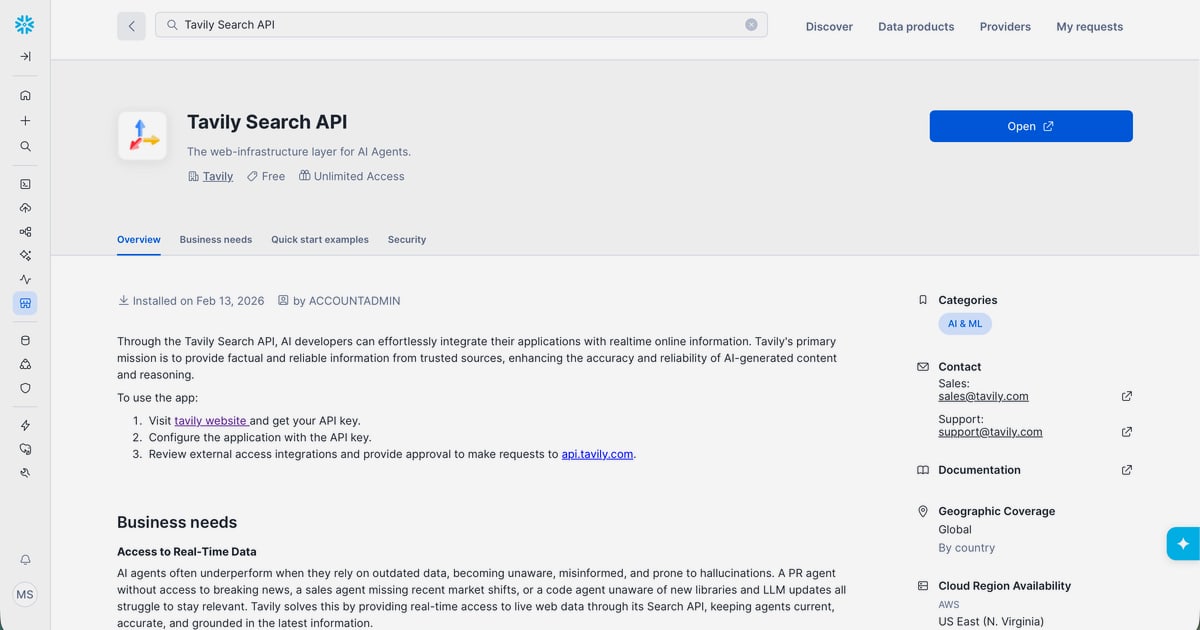
Parallel Web Infrastructure for AI Agents: 2026 Review
Parallel is web infrastructure built for a customer that never opens a browser. Instead of serving pages to a human, it serves facts, excerpts, and cited research to AI agents that need a live answer in the middle of a task. That positioning is specific, and it matters when you decide whether to adopt it.
This review looks at what Parallel actually does, who gets the most value from it, where it falls short, what the pricing signals suggest, and how to decide between it and extraction-first tools like Firecrawl.
What Parallel Is
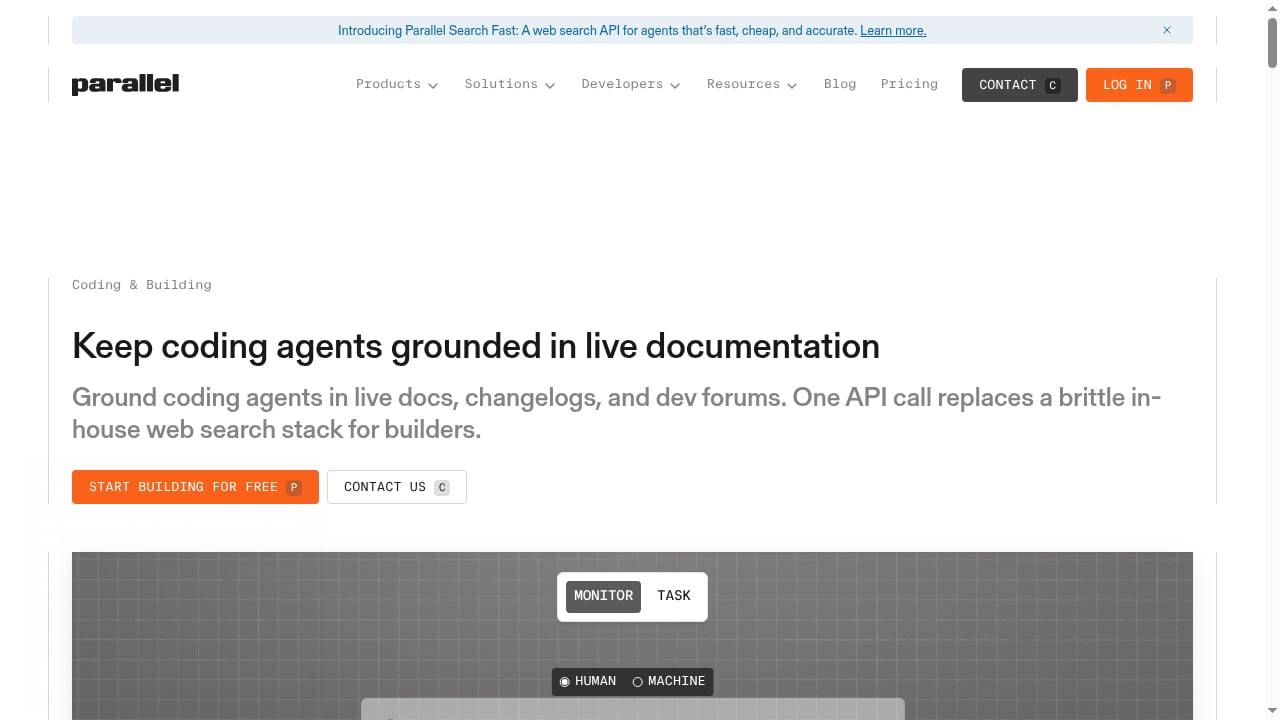
First viewport screenshot of Web Search API for Coding Agents | Parallel.
Parallel is a proprietary API platform for AI search, extraction, deep research, monitoring, and entity discovery. It maintains its own index of billions of pages and updates millions daily, according to the company. Rather than returning raw page content for you to parse, it returns ranked URLs, compressed excerpts, structured research outputs, citations, confidence signals, and entity matches.
The product surface breaks down into five practical pieces:
- Search API — ranked URLs and compact excerpts for a query.
- Extract API — retrieves content from specific URLs and PDFs.
- Task API — asynchronous deep research that returns structured, cited output.
- FindAll and Entity Search — builds lists of companies, people, events, or legal cases matching a plain-English description.
- Monitor API — watches for new events and pushes them into a workflow.
There is also a Responses-style API for web-grounded answers. The important distinction is that Parallel owns more of the workflow than a scraper does: search planning, multi-source retrieval, synthesis, evidence, and structured output all sit on its side of the line.
Who Parallel Is Built For
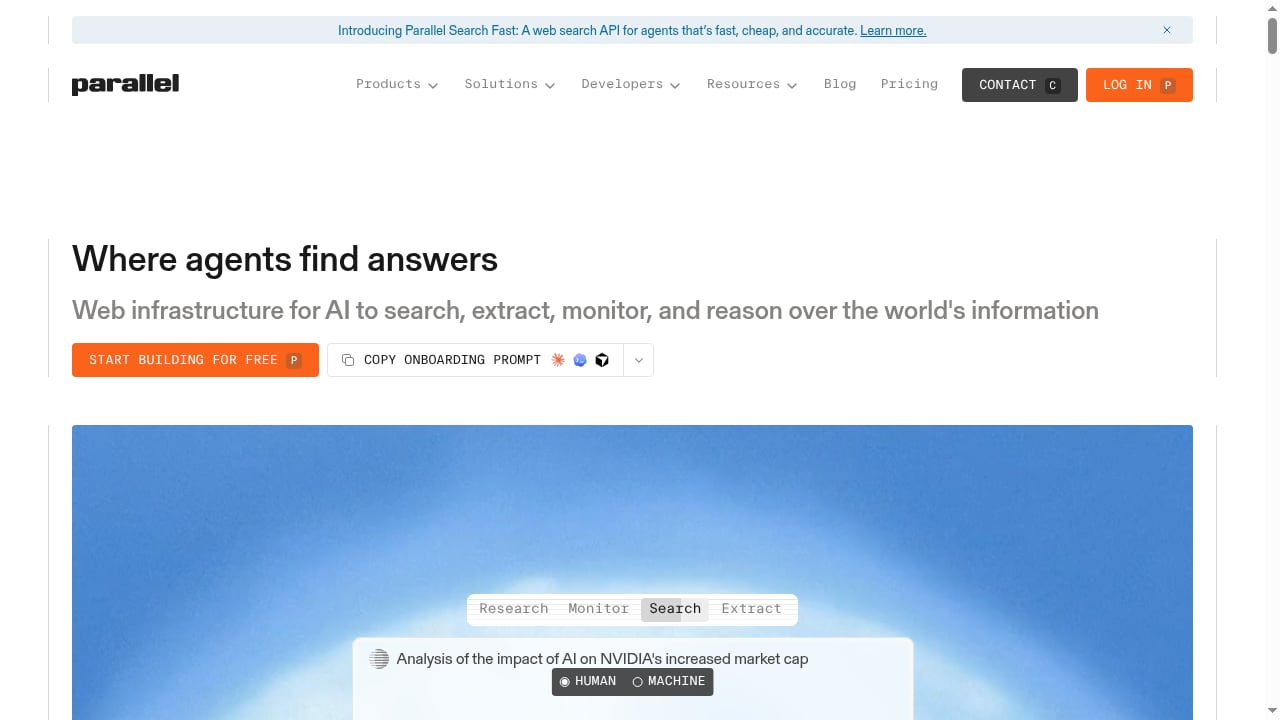
First viewport screenshot of Parallel - Web Infrastructure for AI Agents.
Parallel fits teams whose agents start with a question, not a URL. That is the clearest dividing line in this category.
Strong fits:
- Sales and GTM intelligence agents. Actively's Per Account Agents use Parallel's Task API for structural account facts and the Monitor API for account-specific signals. The company reports 23% higher win rates and 2x conversion rates for customers using the combination — customer-reported figures, not independently verified benchmarks.
- Real estate and property research. Opendoor reported that a roughly ten-minute manual HOA research step became about two minutes of verification using the Task API. The human did not disappear; the work shifted from finding evidence to checking it.
- Public-sector and procurement intelligence. Starbridge said other providers struggled with board minutes, budgets, and awkward government sites, then integrated the Task API into production within days.
- Entity enrichment pipelines. FindAll turns a plain-English request about, say, Ohio dental practices into a candidate dataset without a custom crawler.
Weaker fits:
- Teams that already know exactly which pages to read and just need clean Markdown.
- Workflows where the answer lives only in private systems.
- Cases where a wrong answer is too costly to catch in review.
Strengths
Research output is structured, not raw
Search returns ranked URLs and excerpts. Task and FindAll return structured fields with citations, rationale, and confidence information. For an agent that has to justify a decision, that structure is the product. A reviewer can inspect the basis of an answer rather than trusting a black box.
Monitoring is narrow and account-specific
This is Parallel's sharpest differentiator. Actively needed hundreds of thousands of highly specific, narrow monitors, each tuned to the facts that matter for one account. Polling every source and re-reasoning through results does not scale. Parallel's Monitor API was, per Actively's CEO, the only provider that could support that shape of workload.
Cost is an explicit line item
Published request pricing turns a web lookup into a visible cost. That sounds like a downside until you compare it to the alternative: an unbounded, invisible spend inside a model provider's built-in search. Nooks reported cutting web grounding spend by 70.5% after switching from built-in LLM web search to Parallel Search. That is a customer-reported result, not a universal discount, but the method behind it is worth copying — measure accuracy and cost on your real production questions before switching search layers.
It handles the awkward sources
Government portals, PDFs, and badly structured public records are where generic crawlers fail. Parallel's index and retrieval stack are designed for exactly that long tail.
Limitations
First viewport screenshot of Parallel Pricing – Pay-As-You-Go Web Search for AI Agents.
No crawl or map product
If your workflow starts with a domain and needs every page under it, Parallel is the wrong starting point. There is no direct equivalent to a crawl or map API. You would pair it with an extraction-first tool instead.
Proprietary and closed
Parallel is a proprietary SaaS. There is no self-hosted option and no source transparency. Teams with strict infrastructure control requirements, or those who want to operate the stack themselves later, will feel that constraint. If self-hosting matters, an open-source alternative is the better base layer.
Asynchronous work needs plumbing
Search and Extract are synchronous, with published latency under five and three seconds respectively. Task and FindAll are asynchronous and can run longer because they perform deeper retrieval and synthesis. Parallel recommends webhooks and async handling for long-running research. That is reasonable engineering, but it is engineering you have to do.
Content economics are still an experiment
Parallel's Index program, launched in May 2026, lets site owners inspect how agents use their domains and invites content partners into a compensation program. It estimates a source's marginal contribution to the value of an agent's task rather than paying for crawl access. That is a genuinely interesting model, but it is early, and it initially applies to agents using Parallel's own infrastructure.
Pricing Signals
Parallel publishes per-product pricing rather than a single credit pool. The published entry points look like this:
| Product | Published price |
|---|---|
| Search | From $1–$5 per 1,000 requests depending on mode |
| Extract | $1 per 1,000 URLs |
| Task | From $5–$2,400 per 1,000 runs depending on processor |
| Monitor | From $3–$10 per 1,000 executions depending on processor |
| FindAll | Fixed cost plus per-match pricing |
The spread on Task is the number that should shape your architecture. A cheap processor for a quick fact and an expensive processor for a deep investigation are different products at different prices. Model cost per completed task, not cost per request. A cheap request that returns an unusable answer is the most expensive thing in your pipeline.
For a broader view of how per-page and per-request pricing compares across vendors, see our Top 10 Web Scraping API Platforms 2026: Ranked & Compared.
Setup and Integration
Parallel is an API-first product. There is no no-code builder to evaluate, and setup is a developer task. A practical integration path:
- Start with one repetitive question that has an identifiable public source and a human reviewer.
- Prototype with Search to confirm the index covers your sources.
- Add Extract for the specific URLs your agent needs in full.
- Move to Task once you need synthesis across many sources with citations.
- Add Monitor only after you know which facts actually change and matter.
- Attach citations to every answer and define in advance which claims require human verification.
Starbridge's reported timeline — production integration within days — suggests the API surface is not the hard part. The hard part is deciding what your agent should ask and what it should do with the answer.
If your agent also needs to drive a real browser through JavaScript-heavy pages, that is a different layer. Our guide to combining AdsCrawl with Searlo: Search Data + Browser Automation covers that pattern.
Parallel vs Firecrawl: The Decision That Actually Matters
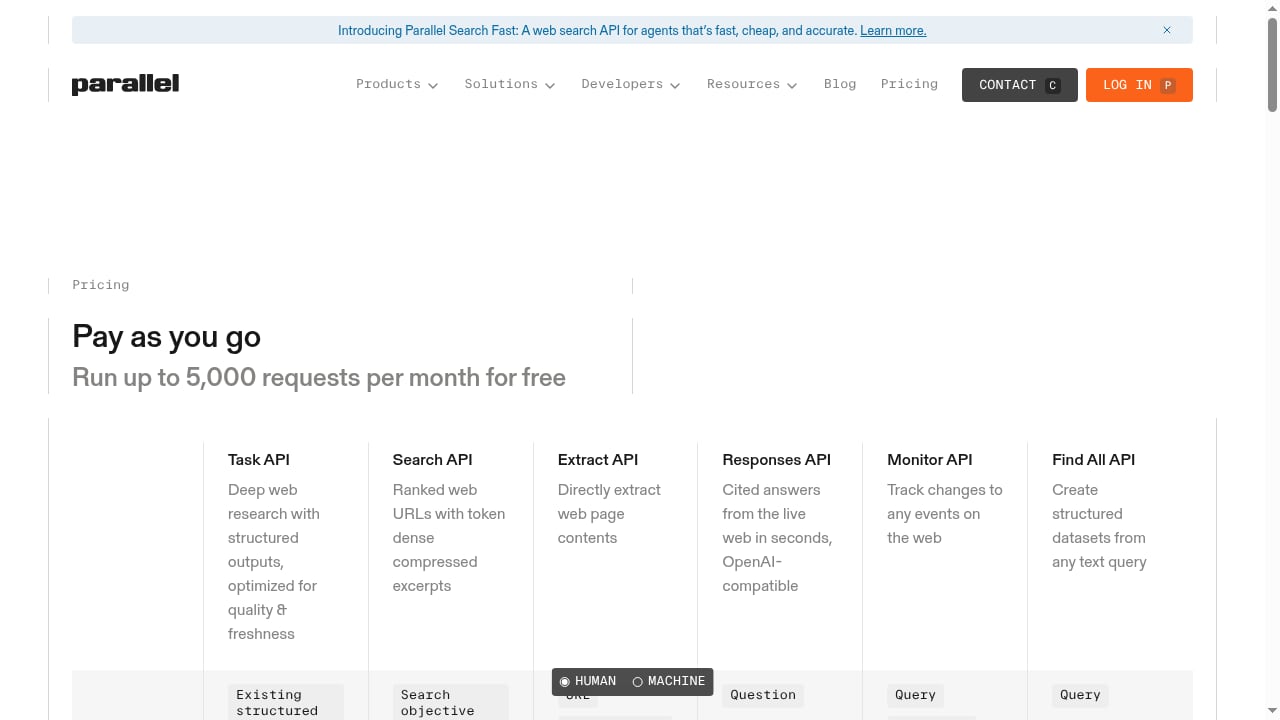
First viewport screenshot of Parallel Pricing – Pay-As-You-Go Web Search for AI Agents.
These two tools overlap but sit in different parts of the retrieval stack. The question is not which is better. It is what your agent needs to do first.
| Dimension | Parallel | Firecrawl |
|---|---|---|
| Starting point | A question, objective, or entity criteria | A known URL, domain, or site |
| Core output | Ranked URLs, excerpts, structured research with citations | Markdown, HTML, JSON, screenshots, metadata |
| Crawl and map | No direct equivalent | Native Crawl and Map APIs |
| Deep research | Task and Responses workflows | Agent for autonomous gathering |
| Entity and list work | FindAll and Entity Search | Possible via Agent, not a core lane |
| Open source | No | Yes, AGPL-3.0 and self-hostable |
Choose Parallel when your agent starts with a research objective and needs structured output with evidence and confidence. Choose Firecrawl when your pipeline starts with known pages or documentation sites and needs clean, consistent content. Many production stacks will use both: Firecrawl for ingestion, Parallel for research and enrichment.
For a closer look at how extraction-first platforms compare on success rate and Markdown quality, see Top 10 AI Web Crawling and Scraping APIs 2026.
Decision Criteria
Score your own workflow against these questions before committing:
- Does your agent start with a question or a URL? Question points to Parallel. URL points to an extraction tool.
- Do you need citations and confidence signals? If a human must review the answer, Parallel's Basis output is a real advantage.
- Is the source material awkward? Government records, PDFs, and board minutes favor Parallel.
- Do you need narrow, high-volume monitoring? This is Parallel's strongest lane.
- Do you need self-hosting or source transparency? Look elsewhere.
- Can you absorb asynchronous workflows? If not, budget the engineering time.
- Have you priced cost per completed task? Do this before you compare vendors.
Related reading
- How to Use AdsCrawl with Sendwin: Multi-Account Browser + Cloud - Combine AdsCrawl's cloud browser API with Sendwin's isolated profiles for multi-account scraping, QA, and monitoring. Setup, workflow, and examples.
- AdsCrawl vs Spider vs Browse AI: Which Fits Your Stack? - Compare AdsCrawl, Spider, and Browse AI for scraping and browser automation. See strengths, limits, pricing, and which tool fits developers vs no-code teams.
- AdsCrawl vs ScreenshotAPI.net: Which Fits Developers? - AdsCrawl vs ScreenshotAPI.net: compare a full cloud browser API with a single-purpose screenshot API for rendering, proxies, pricing, and scale.
Sources and further reading
- How Actively's Per Account Agents use Parallel to turn the entire web into a proactive sales intelligence layer - Actively and Parallel partnered to create a new category of Intelligence-Led Revenue: one where AI agents continuously reason through information across the web, surface buying signals no traditional tool could detect, and progress accounts through the funnel.
- Parallel Web Systems - The Web's Second Customer | YesPress - Parallel sells web access to software that never opens a browser. Its harder question is whether the people who make the web worth searching will get paid.
- Firecrawl vs Parallel: Which Is Better? (+ How to Choose) - Firecrawl and Parallel both help AI agents work with the web, but they are optimized for different jobs. Here's how to tell when you need either, or something different.
FAQ
Is Parallel a search engine?
No. It is infrastructure that software calls. It returns ranked URLs, excerpts, and structured research outputs to an agent, not a page of results to a person.
How much does Parallel cost?
Published pricing starts at $1–$5 per 1,000 Search requests depending on mode, $1 per 1,000 Extract URLs, and $5–$2,400 per 1,000 Task runs depending on processor. Monitor runs $3–$10 per 1,000 executions. FindAll uses fixed cost plus per-match pricing.
Can Parallel crawl an entire site?
Not in the way a dedicated crawler does. There is no direct crawl or map product. Use an extraction-first tool for site-wide ingestion and Parallel for research across sources.
Is Parallel open source?
No. It is a proprietary SaaS platform. Firecrawl, by contrast, is open source under AGPL-3.0 and self-hostable.
What is Parallel's Monitor API used for?
It watches for web changes and pushes events into a workflow. Its distinguishing feature is supporting a very large number of narrow, account-specific monitors rather than broad generic event tracking.
Who should not use Parallel?
Teams whose answers live only in private systems, teams that need self-hosting, and teams where a wrong answer cannot be caught in review. Web search also misses unpublished, stale, or blocked facts.
Conclusion
Parallel is a focused product with a clear thesis: agents need a different web interface than people do. Its strengths — structured cited research, narrow monitoring at scale, explicit per-request pricing, and coverage of awkward public sources — are real and demonstrated by named customers. Its limits are equally clear: no crawl or map product, no self-hosting, asynchronous plumbing, and a content compensation model that is still an experiment.
The practical move is not to adopt or reject it wholesale. Start with one repetitive question that has a public source and a human reviewer. Price every lookup. Compare providers on your real questions, not a benchmark. Keep citations attached. Parallel is strongest where fresh public information matters, questions repeat at scale, and your product can turn cited results into an action.