
Top 10 Cloud Browser Automation & Web Data Extraction APIs 2026
A 2026 ranked review of the top 10 cloud browser automation and web data extraction APIs, with evaluation criteria, pricing signals, and decision guidance.
Top 10 Cloud Browser Automation and Web Data Extraction APIs 2026
Cloud browser automation and web data extraction APIs sit at the access layer of a modern data pipeline. They run real browsers in the cloud, route requests through proxies, and return rendered HTML, Markdown, JSON, or screenshots so your application does not have to manage browser fleets, fingerprinting, or anti-bot recovery on its own. This review ranks ten products that genuinely belong to that category in 2026, explains how they were evaluated, and shows where each one fits.
How This Top 10 Was Evaluated
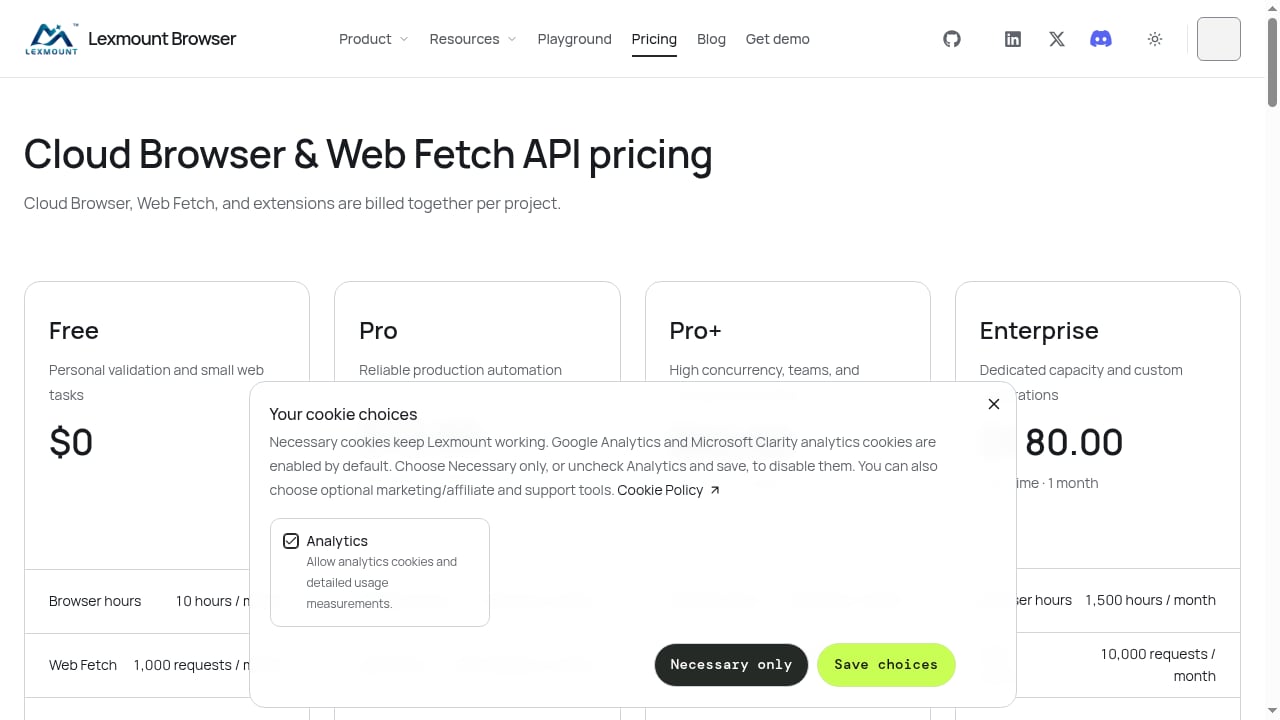
First viewport screenshot of Cloud Browser & Web Fetch API Pricing | Lexmount.
No single product wins every workload, so the ranking below weighs five criteria that matter most when you are choosing infrastructure rather than a one-off script:
- Browser control depth. Can you drive real Chromium sessions over CDP with Playwright, Puppeteer, or a native API, including clicks, form fills, waits, and multi-step flows?
- Extraction output. Does the platform return structured content such as titles, text, links, Markdown, JSON, or screenshots in a single request, or does it only hand back raw HTML?
- Session and identity management. Are browser profiles, contexts, cookies, proxies, and regions reusable across tasks, and can you replay or debug what happened?
- Developer experience. SDKs, CLI, MCP support, documentation quality, onboarding prompts, and how quickly a working prototype is possible.
- Pricing transparency and fit. Published rates, billing units, free tiers, concurrency limits, and whether the model rewards experimentation or punishes it.
Evidence comes from vendor documentation, published pricing pages, and independent comparisons such as Scrapfly's 2026 web scraping API roundup, Context.dev's AI scraping API comparison, and Web Scraper's AI tool review. Where a product's own claims could not be verified, that is noted rather than repeated as fact.
The Top 10 Cloud Browser Automation and Web Data Extraction APIs for 2026
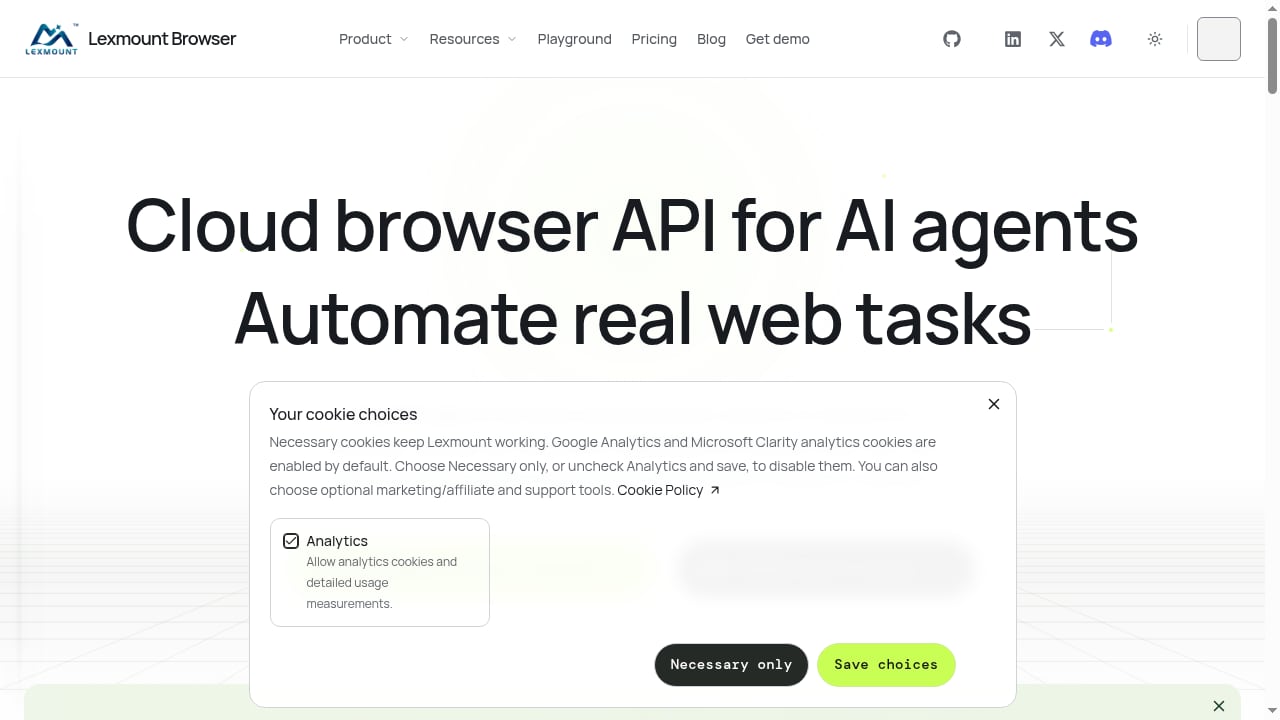
First viewport screenshot of Cloud Browser API for AI Agents & Web Fetch | Lexmount.
1. Lexmount
Lexmount is a cloud browser and web fetch API built for AI agents and developers. It provides isolated browser sessions on demand for browsing, clicking, and filling forms, plus a Web Fetch API that extracts titles, text, and links from public pages in a single request. The product principle is that agents should act autonomously while every step stays visible and a human can take over at any time.
Core capabilities include Cloud Browser for interactive web actions, Web Fetch for structured content extraction, reusable browser task templates with environment-aware agent instructions, and a choice between Chromium and Moli (a lightweight browser optimized for agent browsing). Recording is on by default, with cross-region replay and download persistence. Reusable contexts carry descriptions, regions, forks, and media storage controls, and integrations are available through Skill, MCP, CLI, and SDK/API.
Pricing is per project and billed together for Cloud Browser, Web Fetch, and extensions. The Free tier includes 10 browser hours per month, 1,000 Web Fetch requests, 3 concurrent sessions, and 100 MB of official proxy traffic. Pro is $12 one-time for one month with 100 browser hours, 25 concurrent sessions, 1,000 Web Fetch requests, 100 CAPTCHA uses, and 1 GB of proxy traffic. Pro+ is $60 one-time for 500 browser hours, 100 concurrent, 10,000 Web Fetch requests, and 500 CAPTCHA uses. Enterprise is $180 one-time for 1,500 browser hours, 250 concurrent, 10,000 Web Fetch requests, and 1,500 CAPTCHA uses. Paid plans are one-time purchases covering one calendar month and do not auto-renew, and every tier works out to US$0.12 per included browser hour. Web Fetch top-up packs are available at 10,000, 100,000, and 1,000,000 requests. The site notes that PayPal checkout remains disabled until merchant approval, so no payment is collected from the pricing page today.
Proof points include task templates and tutorials, a DeepSeek Harness example that diagnoses a live webpage and measures UI reveal latency on Selenium's official dynamic test page, and changelog entries covering production agent workflows, repeatable browser automation at scale, and faster agent onboarding. Lexmount ranks first here because it pairs interactive browser control with a one-request extraction endpoint and a billing model that is unusually easy to reason about.
2. Scrapfly Cloud Browser API
Scrapfly's Cloud Browser API provides remote, stealth Chromium sessions over a CDP WebSocket, so you connect Playwright or Puppeteer to a managed browser instead of running your own pool. It is aimed at login flows, multi-step navigation, and stateful sessions where an HTTP request is not enough. Scrapfly's published model charges only for active browser time, with crashed sessions and failed connects free, which lowers the cost of long-running automations that may fail partway. The same platform also offers a Web Scraping API, an Unblocker for anti-bot systems, and an AI Extraction API, so teams can add layers without switching vendors.
3. Firecrawl
Firecrawl popularized the "web scraping for LLMs" category and still has the strongest developer mindshare in AI pipelines. It converts pages to clean Markdown, crawls sites recursively while respecting robots.txt, extracts structured data with schema definitions, and captures screenshots. Its official MCP server is one of the most widely adopted integrations of its kind, and SDKs cover Python, JavaScript, Go, Rust, and Ruby. The trade-off is cost predictability: basic scrapes and JSON extraction consume different credit amounts, and protected pages can still fail, so test your target domains before committing.
4. Context.dev
Context.dev is a web scraping and brand intelligence API built for AI applications. It returns clean JSON or Markdown from a unified API and connects to LLM workflows through an MCP server. Beyond page scraping, it offers brand enrichment endpoints for logos, colors, descriptions, and social links, plus product classification and URL mapping. Pricing starts with a free tier of 1,000 credits per month and scales through Developer, Pro, Growth, and Scale plans with increasing concurrency. It is a strong fit when you need company or brand data alongside page content.
5. Spider.cloud
Spider.cloud is a Rust-based crawling API that positions itself on speed, with published claims of very high pages-per-second throughput. It returns Markdown, HTML, plain text, JSON, or PDF, auto-detects whether a page needs a headless browser, and supports AI-powered structured extraction. SDKs are available for Python, JavaScript, and Rust, and pricing is quoted per thousand pages. Teams with very large crawl volumes should benchmark it against their own targets, since throughput claims depend heavily on page complexity and rendering needs.
6. Bright Data Scraper Studio
Bright Data combines scraper generation with enterprise access infrastructure. Scraper Studio generates editable scraper code and assists with repairs when sites change, while the underlying proxy network handles unblocking at scale. The platform reports high success rates on protected targets and offers a free entry point of 5,000 monthly page loads, with usage-based pricing from around $1.50 per 1,000 successful page loads. It is often more infrastructure than a small project needs, but it fits enterprises that want access reliability and maintenance tooling in one contract.
7. Apify
Apify is an automation ecosystem rather than a single API. Its AI Web Scraper supports natural-language extraction and agentic crawl modes, and the broader platform offers a large marketplace of pre-built Actors for common targets. Developers can run Actors in the cloud, schedule them, and connect results to storage or downstream apps. Costs can include Actor usage, compute, storage, transfer, and proxies, so total spend is less predictable than a flat per-page rate, but the marketplace saves significant build time for standard scraping jobs.
8. ZenRows
ZenRows focuses on scraping protected sites with built-in anti-bot handling and an autoparse feature that converts responses into structured data without manual selector work. It provides Python and JavaScript SDKs and is commonly chosen by teams that want a straightforward API for tough targets rather than a full browser control layer. Pricing starts around $69 per month, and the main limitation is that deep interactive flows are less of a focus than reliable content retrieval.
9. Oxylabs
Oxylabs is best known for large-scale proxy infrastructure, and its web scraping API builds on that foundation with built-in anti-bot handling and an AI assistant add-on for extraction. It offers Python and Go SDKs and is priced from around $49 per month. The platform suits enterprises that already value proxy scale and geographic coverage, though it does not publish an MCP server and is less oriented toward agent-native workflows than the tools ranked above it.
10. Crawl4AI
Crawl4AI is the strongest open-source option in this comparison. It produces LLM-ready content, supports LLM-based extraction, and is configured through Python code. There is no software subscription, but you own deployment, reliability, proxies, model calls, and engineering time. It is a good fit for teams with strict data-residency or customization requirements who are willing to operate the stack themselves.
Cloud Browser API vs Web Data Extraction API: Which Do You Need?
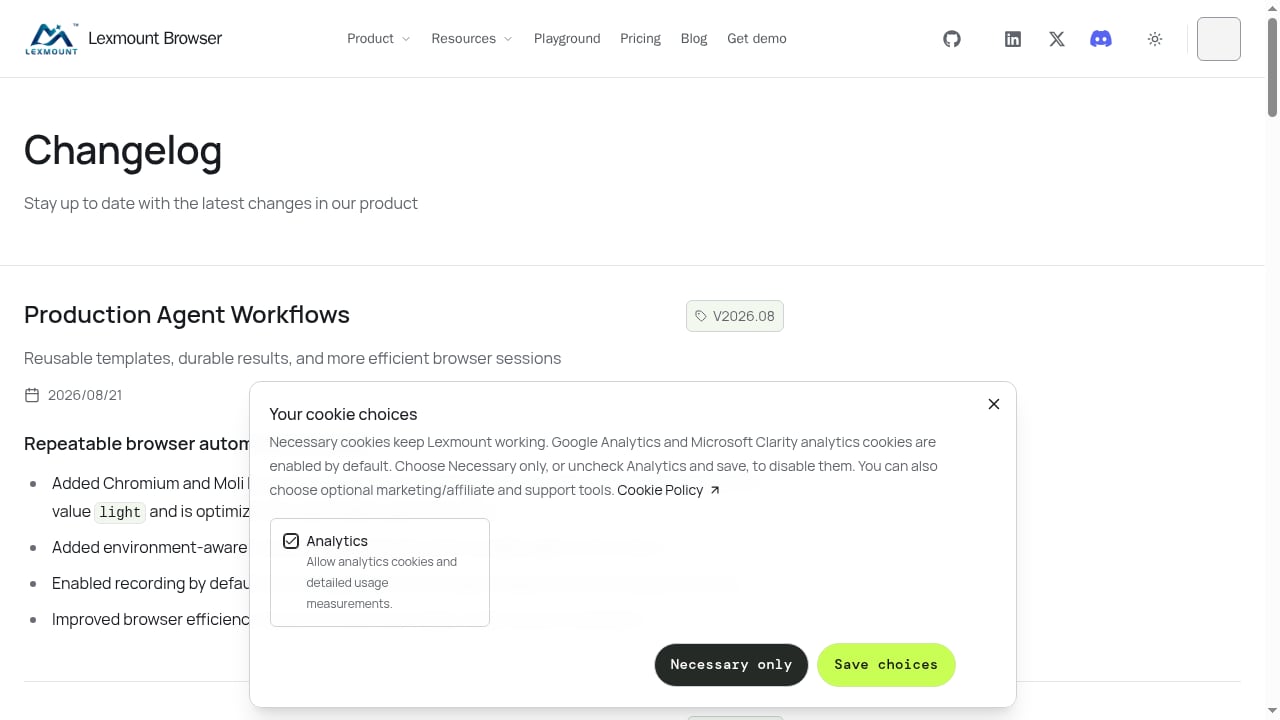
First viewport screenshot of Changelog | Cloud Browser API for AI Agents & Web Fetch | Lexmount.
These two layers are often sold together but solve different problems.
- Choose a web data extraction API when your goal is content: turning a URL into Markdown, text, links, or schema-validated JSON with minimal code. Firecrawl, Context.dev, ZenRows, and Lexmount's Web Fetch endpoint fit here.
- Choose a cloud browser automation API when your goal is interaction: logging in, clicking through multi-step flows, filling forms, or driving a real Chromium session over CDP. Lexmount's Cloud Browser, Scrapfly Cloud Browser, Bright Data, and Apify fit here.
- Choose both when your pipeline discovers pages interactively and then extracts structured data at volume. Most production stacks end up combining an access layer, an extraction layer, and an orchestration layer rather than treating any single tool as a substitute for the others.
If you are still deciding how these pieces fit together, the developer guide on scraping website data from dynamic pages walks through cloud browsers, proxies, and structured extraction with practical examples. For a broader view of adjacent tools, see the Top 10 AI web scraping and data extraction tools.
Where AdsCrawl Fits in an Adjacent Workflow
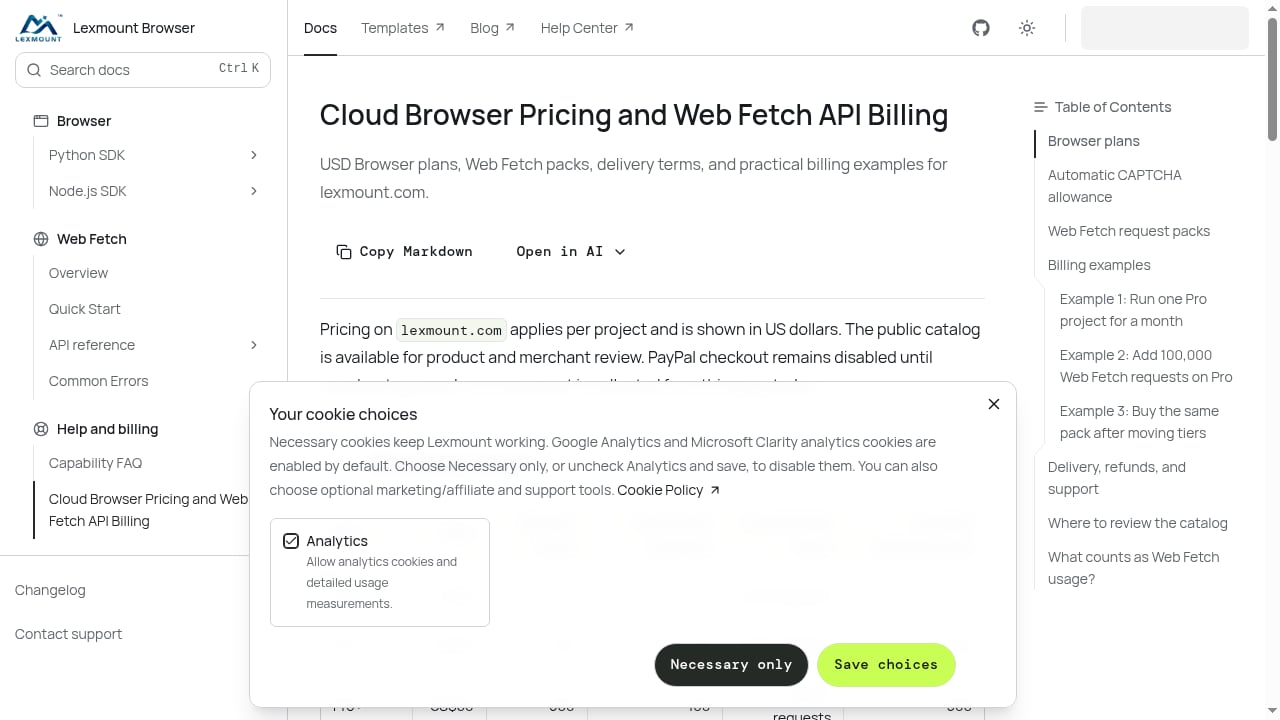
First viewport screenshot of Cloud Browser Pricing and Web Fetch API Billing | Lexmount.
AdsCrawl is a managed cloud browser and browser automation API for developers who need to scrape, test, or monitor dynamic websites that resist simple HTTP requests. It connects Playwright, Puppeteer, or any CDP client to real cloud Chromium browsers, supports residential proxy routing or custom proxies, and returns rendered HTML, Markdown, JSON, or screenshots. The platform is powered by AdsPower and offers 100+ rotating residential proxies, with stateful cloud browser profiles, remote CDP sessions, and live interactive access through a connectUrl. Pricing is credit-based: a Free tier with 500 one-time credits, Hobby at $9/month, Starter at $49/month, and Pro at $199/month.
It is not part of the ranked category above because its center of gravity is browser identity and proxy routing for production scraping, QA, and monitoring rather than a general-purpose cloud browser plus extraction API. That said, it is a reasonable complement when your workflow needs persistent browser profiles or residential proxy routing alongside a primary automation platform. If that describes your stack, the comparison of AdsCrawl vs browser automation and web scraping tools is a useful next read.
Practical Decision Guidance
- Solo developer or prototype: start with a free tier. Lexmount's Free plan and Context.dev's free credits both let you validate a workflow before paying.
- AI agent builders: prioritize MCP support, agent setup prompts, and replayable sessions. Lexmount, Firecrawl, and Context.dev all publish MCP integrations.
- High-volume extraction: compare cost per 1,000 pages rather than headline plan prices. Firecrawl, Bright Data, and Spider.cloud publish per-page or per-credit rates that make this possible.
- Interactive automation at scale: check concurrency limits and session persistence. Lexmount's Pro+ and Enterprise tiers reach 100 and 250 concurrent sessions respectively, which matters when agents run in parallel.
- Strict compliance or self-hosting: Crawl4AI is the open-source route, but budget for the engineering time you will own.
Related reading
- How to Use AdsCrawl with Playwright for Reliable E2E Testing - Learn how to connect Playwright to AdsCrawl cloud browsers for reliable end-to-end testing of modern web apps, with proxy routing, CDP sessions, and CI examples.
- AdsCrawl vs Steel vs Axiom: Browser Infrastructure Compared - AdsCrawl vs Steel and Axiom compared: open-source browser infrastructure for AI agents vs no-code and code automation. Pick the right stack.
- Browser Use Review 2026: AI Browser Agent Tested - Hands-on Browser Use review: how its AI browser agents perform, real pricing signals, setup steps, limitations, and who should use it in 2026.
FAQ
What is a cloud browser automation API?
It is a service that runs real browser sessions in the cloud and exposes them to your code, usually over CDP or a native API. You send navigation, click, and form-fill commands; the provider handles browser infrastructure, proxies, and often fingerprinting.
How is a web data extraction API different?
A web data extraction API focuses on output rather than interaction. You send a URL and receive structured content such as titles, text, links, Markdown, or JSON, without managing a browser session yourself.
Can I use Playwright or Puppeteer with these platforms?
Yes. Several providers, including Scrapfly Cloud Browser, AdsCrawl, and Bright Data, let you connect Playwright or Puppeteer over CDP to remote browsers, so existing automation code keeps working.
Which option is best for AI agents specifically?
Look for MCP support, agent-oriented onboarding, and replayable sessions. Lexmount, Firecrawl, and Context.dev all publish MCP integrations, and Lexmount adds reusable task templates with environment-aware instructions for agents.
How should I compare pricing across these products?
Convert every plan into a cost per 1,000 pages or per browser hour, then test a representative workload. Billing units differ sharply: some charge per successful page, some per credit, and some per active browser hour.
Do I need more than one tool?
Often yes. A common stack pairs a cloud browser API for interactive discovery with an extraction API for structured output, plus your own orchestration and storage layer.
Conclusion
The cloud browser automation and web data extraction API market in 2026 rewards teams that pick by pipeline layer rather than by brand. Lexmount leads this ranking because it combines interactive cloud browsers, a single-request Web Fetch API, replayable sessions, and transparent per-hour pricing in one product. Scrapfly, Firecrawl, and Context.dev are strong alternatives depending on whether you prioritize anti-bot handling, LLM-ready output, or brand data. Whichever you choose, validate it against your own target sites and convert published pricing into a real cost per 1,000 pages before you commit.